


- Story
New strategy game for mangrove restoration
20.08.2025 BFH-HAFL’s Forest Policy and International Forest Management group is developing a new science-based game for a mangrove restoration project in Thailand.
Research assistant Sean Yeo is becoming a game afficionado – and loving it.
Sean is currently focused on designing a serious game based on extensive participatory research for the SNSF-backed ‘RESCuE-2: Mangrove restoration towards sustainable coastal ecosystem management’ project at HAFL.
‘I never thought I’d be doing this,’ Sean said. ‘I’d honestly not heard about this game-playing technique until 2023 when I took Claude Garcia’s “Integrated Natural Resources Management” module [part of the MSc in Life Sciences specialising in Forest Science degree programme].
‘It blew my mind about how it made me feel as a student. I thought, “Wow, this is a great tool to stimulate stakeholder discussions.” You go to panel discussions and meetings and it’s a lot of dialogue, but with a game you feel emotion that can be expressed through physical tokens. You can see and feel the landscape changing before your eyes.’
Participatory approach
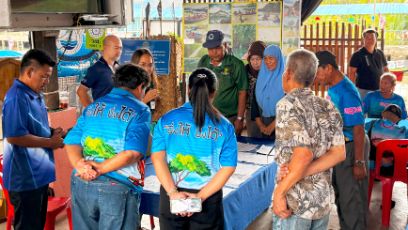
Co-designed by Sean with other researchers, local government representatives, communities and stakeholders, the game aims to help all parties understand their landscape and to discover new ways to co-design better, and more sustainable, mangrove restoration policies.
‘The game is a tool to get to a more sensitive discussion,’ Sean said. ‘It gives an opportunity for stakeholders, like policy makers, to step into the shoes of the villagers and vice versa.’
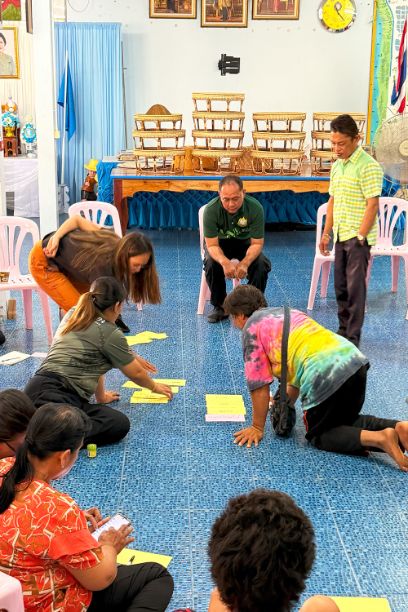
The game-design idea emerged after two workshops Sean conducted in February 2025, with the help of local facilitator Kingpai Koosakulnirund, in Namchiao and Prednai – two coastal villages led by women chiefs.
These workshops used the PARDI framework (Problem, Actors, Resources, Dynamics, Interactions) to map out shared challenges and local perceptions of the mangrove landscape. All stakeholders jointly identified what they felt is relevant, then Sean brought this information back to Switzerland to start designing the prototype.
Mangroves are changing
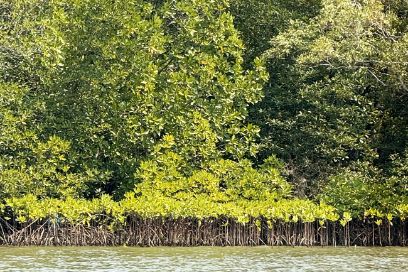
During the February workshops, village community members and some mangrove department officials identified a common problem: mangroves are changing.
‘One really interesting takeaway from the February workshops was that the people said they got lost in the mangroves, due to this change,’ Sean said.
‘These are areas they normally know like the back of their hand. As a researcher, this is very striking and powerful. Being lost in the mangroves affected how they performed livelihood activities, such as finding crabs or navigating the dense forests.
‘This is due to the loss of forest diversity – every tree looks the same. When you have a monospecific forest, it becomes hard to figure out your directions.’
These changes come from recent reforestation attempts following the end of Thailand’s charcoal and tin mining boom.
‘They’ve managed to increase mangrove forest cover in the past decades,’ Sean said, ‘but they have done so through methods like mass planting, using the same few species because of their survival rate success. So, they’ve increased forest cover but at the cost of diversity.’
How the game has evolved
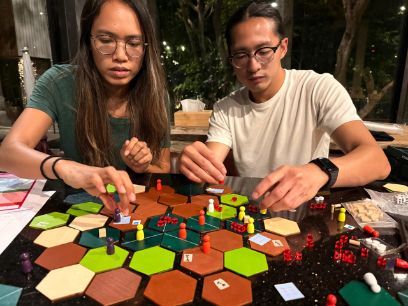
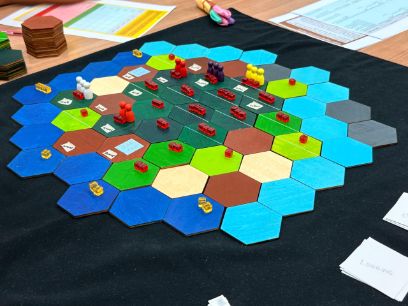
The game is called Chailaen, which means ‘mangrove’ in Thai.
Currently in its sixth draft version, the game uses a hexagonal tile format, partly inspired by the Settlers of Catan boardgame [a multiplayer boardgame, now known as Catan], and incorporates elements from previous serious games, including Planet C-Play Again? and Combustic, which was developed last year by Sean and other HAFL MSc students as a fire management game in the Ukraine.
Chailaen includes impact scenarios related to shrimp farming pollution, tree species diversity, hydrological change and seasonal recurrences. By using a livelihood calendar, everyone could highlight yearly recurrences, such as tourist seasons, tides and harvest periods, to include in the game.
The game simulates different starting conditions for players, reflecting existing imbalances between communities; for example, some players start with more land or established agriculture, while others have fewer resources. This highlights the imbalance in opportunities, despite them all working on the same landscape.
The plan is to also make Chailaen available in other countries with mangroves, such as Cambodia and Malaysia.
Returning to Thailand
Sean hopes to bring a revised version of the game back to Thailand later this year (depending on availability of local communities and partners) to further refine and revalidate the design before the project concludes in May 2026.
‘The design process is still ongoing,’ Sean said. ‘The idea is to bring the first prototype back to the same village communities so they can identify gaps and key areas for further development.
‘By playing the game, they experience different environmental and landscape changes that can shape their decisions; for example, choosing a more agriculture-dominant livelihood or a subsistence livelihood, and how the different actions they take influence the change in the mangroves.
‘They will tell us what’s important to them – what’s accurate and what’s missing – to validate the model. Then before the project ends, we’ll have a more complete model that stakeholders can play to have more holistic discussions and co-design of mangrove restoration policy.
“Only after the game ends, do we (all stakeholders) begin learning and discussing our future.’
Project background
The RESCuE-2 project aims to develop a science-based framework for restoring mangrove forests in the heavily populated South-East Asian coastal zones, where millions of people rely on mangroves for their livelihood.
It’s a collaboration between multiple institutions across Europe and Southeast Asia. It builds directly on the earlier RESCuE-1 project, led by Dr. Uday Pimple, a Thailand-based researcher who remains actively involved in stage two.
Key partners include the Swiss National Science Foundation (SNSF), the Royal Forest Department of Thailand (RFD), Department of Marine and Coastal Resources (DMCR), and local government representatives. Academic collaborators represent BFH-HAFL, Technische Universität Dresden, Université Libre de Bruxelles, CIRAD in Montpellier, and King Mongkut’s University of Technology Thonburi in Thailand (JGSEE).
Find out more
Category: International