CIRCBUILT - CIRCular biobased materials for the BUILT environment
CIRCBUILT is a European project developing 100% bio-based construction materials from agricultural, agri-food, and forestry waste.
Factsheet
- Schools involved School of Architecture, Wood and Civil Engineering
- Institute(s) Institute for Building Materials and Biobased Products IBBM
- Research unit(s) Biopolymers and Wood Chemistry group FGBH
- Funding organisation Europäische Union
- Duration (planned) 01.05.2025 - 30.04.2028
- Head of project Prof. Dr. Ingo Mayer
-
Project staff
Prof. Dr. Heiko Thömen
Dr. Ali Shalbafan
Thomas Walch
Luis Miguel Olaechea von Sonnenberg
Marco Paroni
Yara Steiger -
Partner
TEKNOLOGIAN TUTKIMUSKESKUS VTT OY (VTT)
LUT University (Fi)
AISTI (Fi)
STRANE (F)
Euroquality (F)
INRAE (F)
SEITISS (F)
Certi (I)
ENVI (IT)
AIT (A)
ZHAW (CH)
BFH (CH)
Situation
Solutions to mitigate the embodied carbon emissions in the construction sector are not yet a reality. The building and construction sector isare responsible for approximately 37% of global energy- and process-related CO₂ emissions, highlighting its critical role in addressing climate change (United Nations Environment Programme, 2023). Considering the environmental impact of this sector, bio-based products made from secondary bio-based materials are a promising solution.
Course of action
CIRCBUILT will target large volume sources of lignocellulosic secondary bio-based materials and maximise their mapping coverage and the number of industries providing these materialsit across Europe. The project will provide 3 safe intermediate bio-based components based on resource-efficient processing and with broad market potential. We will further validate at technology readiness level 5 (TRL5) four4 different types of products co-designed with stakeholders and 100% made from secondary bio-based secondary material. BFH will focus more specifically on a new generation of bio-based adhesive made from locally sourced softwood bark (BioNIPU adhesive) overcoming still existing limitations of the tannin-rich bark extracts. BFH will also further develop and a construction panel made from crop residues and the new BioNIPU adhesive. CIRCBUILT will lay out the ground for the commercialisation of the products and the creation of new circular value chains in Europe in accordance with the cascading principles.
Result
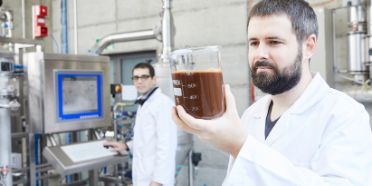
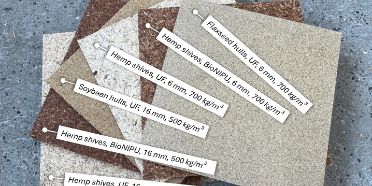
At BFH, extracts from native spruce and larch bark have been successfully produced at our unique pilot extraction plant, suitable for further adhesive synthesis of BioNIPU adhesives. Initial adhesive samples have been developed and have demonstrated their suitability for use in the production of construction panels based on crop residues. The formulation strategy patented by BFH was successfully implemented. It is based on the approach of crosslinking saccharide structures of condensed tannins via urethane bonds, entirely without the use of isocyanates (non-isocyanate polyurethanes, NIPU). A first board production campaign in our composite lab showed promising results using hemp shives, flaxseed hulls, and soybean hulls.
Looking ahead
Until the end of 2027 BFH will focus on the optimization of the BioNIPU adhesive synthesis route, and the development of the construction panel. Other partners will concentrate on the developement of the three other construction products included in the CIRCBUILT: thermal insulation panels, indoor acoustic panels, and adaptive cooling windows.