


Virtual reality communication training with AI-driven avatars
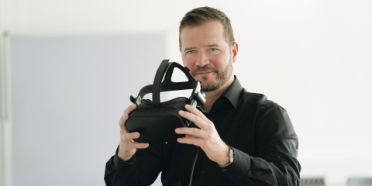
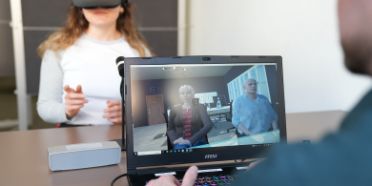
VRAICOMST Virtual Reality Artificial Intelligence Communication Skills Training is a training system developed at Bern University of Applied Sciences that uses virtual reality and artificial intelligence to develop communication skills.
Factsheet
-
Schools involved
School of Health Professions
School of Agricultural, Forest and Food Sciences
School of Social Work
School of Engineering and Computer Science -
Institute(s)
Institute for Human Centered Engineering (HUCE)
Midwifery
Knowledge Systems and Knowledge Sharing
Institute for Specialised Didactics, Profession Development and Digitalisation - Research unit(s) HUCE / Laboratory for Computer Perception and Virtual Reality
- Strategic thematic field Thematic field "Humane Digital Transformation"
- Funding organisation BFH
- Duration (planned) 01.01.2026 - 31.12.2026
- Head of project Prof. Dr. Manuel David Bachmann
-
Project staff
Sascha Schmidt
Prof. Marcus Hudritsch
Maurizio Piu
Dr. Evelyne Aubry
Sigrid Bettina Kretzschmar
Dr. Andreas Gerber - Keywords Virtual reality, communication, artificial intelligence, AI
Situation
The VRAICOMST project focuses on a fundamental professional competence: communication. BFH students are to be given the opportunity to interact in realistic scenarios with AI-driven avatars in virtual reality, enabling them to purposefully develop their conversational skills (with customers, patients, or clients). This approach is cost-efficient, independent of time and place, and does not require the involvement of real people (such as actors or actual clients). A wide range of subject-specific situations—depending on the department and degree program—are prepared and integrated into the training. The goal of the project is to ultimately provide a prototype training system available for all departments. Didactic objectives of the training: A) Students gain confidence for future real-life interactions with customers, patients, or clients. B) The training is designed as a supplement to conventional communication training and also supports blended learning. C) The training enables the early identification and practice of professional strategies for dealing with challenging communication situations. VRAICOMST thus represents a didactic complement to traditional methods, combining digital innovation with proven teaching approaches and elevating the quality of communication skills training to a new level.
Course of action
The project consists of three steps. In the first step, a prototype of the AI-based VR training system (e.g. using OpenAI) is developed. Issues related to data security are clarified. In the second step, the training is integrated into teaching as a didactic element and tested and evaluated with user groups from different professional fields. For this purpose, various subject-specific cases are developed within the respective disciplines. In the third step, the experiences gained are analyzed and evaluated.
Looking ahead
The experiences gained from this project will form the basis for further development towards an open-source solution running on proprietary hardware.