


- Story
Julien de Meyer’s Cecchini Institute connection
09.09.2025 International development consultant formalises his long-standing collaboration with the BFH-HAFL Hugo P. Cecchini Institute.
After several years of project-based collaborations, Julien de Meyer has formalised a new partnership with the Cecchini Institute, bringing with him decades of global experience in rural development, agricultural research and project evaluation.
As the director of Illud est, a small consultancy firm specialising in international development, Julien’s career spans rural development projects and policy initiatives in Africa, Central America, Asia, and the Pacific – all a long way from his hometown in a small village in the ski fields of canton Vaud.
Now based in Australia, he’s currently at HAFL until early October and will then stay in Switzerland and Europe for an additional few weeks.
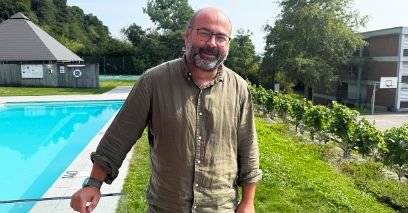
Signing an MoU
“I’m visiting now for two reasons,” Julien said. “The professional reason is I’ve been working on and off for HAFL for about six or seven years, doing projects here and there, and we’ve collaborated on some activities.
“I’m very interested in being connected with an academic and applied institute, so I had a chat with Zenebe Uraguchi, head of the Cecchini Institute, and we decided it was a good idea to formalise this connection with a Memorandum of Understanding (MoU).
“And the second, and personal, reason is family. My daughter has just started university here in Lausanne, and I can also see family close by.”
An Australian-based business with Swiss roots
Earlier in his career, Julien worked as a scientist with Agroscope in Changins and later with the International Maize and Wheat Improvement Center (CIMMYT). He then held senior roles with the Food and Agriculture Organization of the United Nations (FAO) and served as country manager for the Australian Centre for International Agricultural Research (ACIAR) in Indonesia. Over the years, he has carried out long- and short-term assignments in more than 30 countries.
Julien also remains closely connected to research. He was a co-organiser of the first Pacific Regional Research Symposium, fostering dialogue between scientists, policymakers and practitioners. Through his new partnership with the Cecchini Institute, he continues to bridge practice and science, linking perspectives from the Pacific region to Bern and strengthening collaboration across continents.
And even while living in Zimbabwe, Mexico, Indonesia, and Mauritius, and now in Australia with his Australian wife and daughters, he’s always maintained ties to Switzerland.
“Switzerland is always 50% of my work,” he said. “I’m a graduate of ETH Zurich and was an SDC Junior Professional Officer from 1997 to 2003. I’ve always had this connection with SDC and often return here to meet colleagues.
“Being a freelance consultant can be a lonely world and you don’t always get to engage in discussions with colleagues, which I’ve always enjoyed.
“With the recently signed MoU, I can interact with people in the Institute, and if we see that there’s something we can bring value to, we can exchange and discuss.”
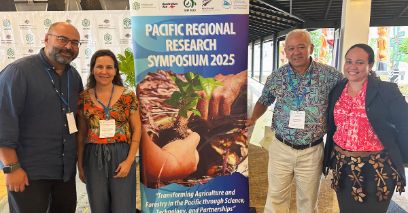
A stronger connection
For Julien, the new agreement is about creating more than temporary partnerships.
“At the moment we have one project with Illud est and HAFL – a cost benefit analysis (CBA) framework contract of SDC,” he said. “Over the years, we’ve actually already done about seven or eight CBAs together.
“We interact with projects and analyse the benefit of the project before it’s implemented: i.e. what’s the return on investment or the social and environmental benefit a project would bring.
“In consultancy, it’s mostly a marriage of convenience and short-lived. Zenebe has allowed me to look a little bit more to the long-term for a new and innovative partnership.
“We’re connecting cross-continent, as we have different networks: I plan to expand my network from Australia to Switzerland and connect them formally.”
Exploring new business opportunities
“Little companies like me are reactive,” Julien said, “so being able to connect with the work of HAFL gives structure. Currently, there are a couple of opportunities that might come up, in the field of project cycle management, training and agriculture.
“We’re also keeping our eyes and ears open with the new Business Development Manager, Reto Gerber, who is developing a structured pipeline of projects.”
But beyond projects and partnerships, Julien highlights the importance of professional growth and shared learning.
“The opportunity is to line-up with the Institute to become more like partners than competitors,” he said. “The only risk is we don’t get any projects! But then we still learn from each other.
“The great part about that, for me, is you need to keep learning … and always be eager to learn. When you want to stop learning then basically that’s when you stop working.”
Find out more
Category: International


