Better Leg Derotation
Towards improvement of patient outcomes in young patients with knee or hip pain undergoing lower leg derotation surgery by combining gait analysis, medical imaging and musculoskeletal modeling to support surgical planning.
Factsheet
- Schools involved School of Health Professions
- Institute(s) Physiotherapy
- Research unit(s) Fussbiomechanik und Technologie
- Funding organisation Others
- Duration 01.01.2021 - 31.12.2024
- Head of project Prof. Dr. Patric Eichelberger
-
Project staff
Michael Streit
Prof. Dr. Patric Eichelberger
Prof. Dr. Heiner Baur
Philippe Bähler - Partner Lead - Dr. med. Emanuel Liechti
- Keywords torsional deformities, patient-specific models, gait analysis, musculoskeletal modeling, surgical planning
Situation
Torsional deformities of the lower leg are known risk factors for osteoarthritis in the hip and knee joint. Increased femoral torsion is associated with posterior extraarticular hip impingement as well as with lateral patellar hypercompression or patellar instability. In these patients femoral derotation osteotomy for deformity correction is performed and reportedly reduces pain, improves function and can delay the need for joint replacement. Today, surgical decision-making for derotation osteotomy and the amount of correction are mainly based on surgeon’s experience. Furthermore, the effect of osteotomy level (distal vs proximal femur) on the joint kinematics and foot position are unknown.
Course of action
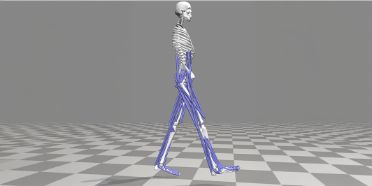
Effects of derotation osteotomy might be evaluated with the help of musculoskeletal modelling, allowing forward dynamic simulations of gait patterns. Hence, musculoskeletal simulations might help to optimize surgical decisions to restore a normal gait pattern and minimize the risk for osteoarthritis. However, there is currently no workflow established that not only relies on scaling a standard model during musculoskeletal simulation, but also integrates medical imaging data to generate patient-specific musculoskeletal models for simulation. The project aims developing a solution to integrate medical imaging (MRI), 3D gait analysis, and musculoskeletal modeling in OpenSim into the surgical planning workflow of lower leg derotation osteotomy.
Result
An OpenSim processing and analysis pipeline was developed, integrating the automation of model scaling to reduce manual user interaction and to increase reproducibility. Based on gait measurements on 20 healthy participants, the OpenSim pipeline demonstrated good overall agreement in joint kinematics and kinetics compared to the standard in clinical gait analysis (Conventional Gait Model 2.3). The pipeline enhances gait analysis in the Bern Movement Lab by the modalities of muscle and internal joint force computations and is available open source.
Looking ahead
While a stable basic pipeline has been established for inverse dynamic analysis of gait measurements with OpenSim, the model personalization beyond common scaling procedures and moving towards forward dynamic analysis to support surgical planning remain open points.