


Mekong research network for equitable and climate-resilient forest landscapes
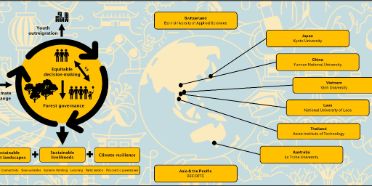
Our research network investigates whether and how equitable local forest governance with strong inclusion of women and youth can foster the resilience of forest landscapes in view of climate change in the Greater Mekong Region.
Fiche signalétique
- Départements participants Haute école des sciences agronomiques, forestières et alimentaires
-
Institut(s)
Gestion multifonctionnelle des forêts
Cecchini Institute - Unité(s) de recherche Politique forestière et gestion forestière internationale
- Organisation d'encouragement Autres
- Durée (prévue) 01.07.2026 - 31.12.2027
- Direction du projet Dr. Mélanie Feurer
-
Équipe du projet
Dr. Mélanie Feurer
Dr. Jean-Laurent Pfund
Jelena Markovic - Partenaire Leading House Asia Pacific / University of Zurich
- Mots-clés Society, policy and rural development;Climate change mitigation and adaptation;Forestry and landscape management;Innovation and co-creation of knowledge;
Situation
Local, collectively managed forests in the Greater Mekong Region are essential for their contribution to biodiversity conservation and rural livelihoods. These forests, however, face growing threats from climate, land use, and societal changes. Increasing rural youth outmigration is linked to a declining interest in natural resource-based livelihoods. Consequently, management of CF falls to older residents, particularly women, who have until now often been excluded from general decision-making. In view of exacerbating vulnerabilities due to climate change, large research gaps remain on the feasibility of more inclusive and innovative forest governance mechanisms that focus on women and youth. This project aims to catalyze a deeper understanding of how inclusive and equitable forest governance can serve as a foundation for strengthening climate resilience in forest-dependent communities across the Greater Mekong Region. By building an international research network, we will jointly explore ways to better integrate women, youth, and other marginalized groups into sustainable and resilient local forest management. Specifically, we will a) develop a common framework addressing the links between inclusive forest governance and climate resilience, b) expand previous research on women involvement in CF to new regions, and c) prepare a joint research funding proposal to enhance empirical research towards equitable and resilient forest landscapes.