

- Story
Projects strengthen resilience in the Andes
18.12.2025 BFH-HAFL plays a key role in two important projects that support Andean communities to become more resilient to climate change.
The ENANDES (Enhancing Adaptive Capacity of Andean Communities through Climate Services) and ENANDES+ projects, co-led by several international partners and supported by BFH-HAFL staff, promote co-designed climate services for smallholder farmers.
Building trust through co-production
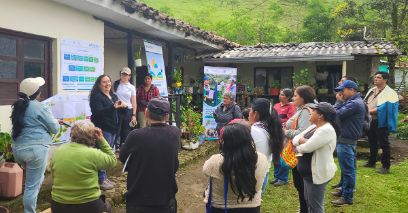
ENANDES (funded by the Adaptation Fund and led by the World Meteorological Organization (WMO), aimed to increase the resilience and adaptive capacity to climate variability and change of highly vulnerable communities in Chile, Colombia and Peru.
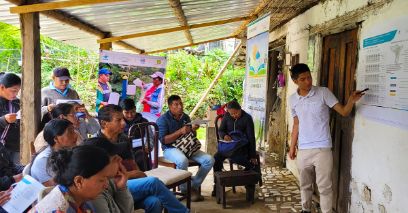
Weather and climate services are important for climate change adaptation, especially for smallholder farmers who are particularly vulnerable. Having access to weather and climate services is important, but not enough. Access to the right information and how it can be applied is vital. This is only possible if there are enough resources, as well as the capacity to tailor the services according to the user; or even better, to co-design the services together.
BFH-HAFL was involved, together with the meteorological services, in evaluating socio-economic benefits related to the provision of climate services promoted by ENANDES. This enabled the services to be targeted to the users’ needs.
Scaling-up regionally
ENANDES+, a contribution to ENANDES, expands on this approach in six Andean countries (including Argentina, Bolivia and Ecuador, in addition to Chile, Colombia and Peru). Led by MeteoSwiss and funded by the Swiss Agency for Development and Cooperation (SDC), the initiative aims to strengthen climate early-warning systems, build institutional capacity and improve coordination across national meteorological services.
Andean actors include DMC (Chilean Meteorological Directorate), IDEAM (Colombian Institute of Hydrology, Meteorology, and Environmental Studies), INAMHI (National Institute of Meteorology and Hydrology of Ecuador), SENAMHI (National Service of Meteorology and Hydrology of Bolivia), SENAMHI (National Service of Meteorology and Hydrology of Peru), and SMN (National Meteorological Service of Argentina). Regional centres such as CIIFEN (International Center for Research on the El Niño Phenomenon) and CRC-SAS (Regional Climate Center for Southern South America) participate, too.
HAFL connection
Following on from the work originally conducted by the CLIMANDES project, led by former HAFL staff member Filippo Lechthaler, and its experiences in Peru, the HAFL team continues work in the region with ENANDES and ENANDES+.
Researchers at HAFL have supported partner countries in developing contextualised studies of socio-economic benefit analysis. The weather and climate services have diverse structural conditions and face different realities within, as well as between, the countries. While they are specialists in their fields, not all have the means to include specialists in their teams to connect directly with their users, even if the services are available. The HAFL team supported the countries to assess the socio-economic benefits from different perspectives with diverse methods.
HAFL lecturer Dr. Christine Jurt Vicuña Muñoz and research associate Sofia Foladori have been analysing how these climate information services support the projects, showing how well-tailored climate data can strengthen the resilience of vulnerable Andean communities.
“The differences within and between the countries,” Christine explained, “highlight why this information needs to be adapted to each context, so it can be used effectively. That’s why the services must be co-designed with the people who will use them.”
Further information
The ENANDES project concluded at the end of July 2025 and ENANDES+ will finish in October 2026.
Read a recent in-depth project profile of ENANDES and ENANDES+ on the SDC A&FS website.
Find out more
Category: International