

- Story
Value in diversity and inclusion
27.07.2026 When underserved groups like women and young people have access to the right skills, networks, and opportunities, they become powerful drivers of economic growth, innovation, and resilience.

Key Facts
- Gender equality and inclusion are often framed as social responsibility. Yet evidence shows that inclusive businesses are more resilient, innovative, and better positioned to grow.
- RECONOMY revitalises, reconnects and reshapes economic opportunities for the benefit of marginalised people like women and youth.
- RECONOMY is implemented in the Eastern Partnership countries (Armenia, Azerbaijan, Georgia, Moldova, and Ukraine) and the Western Balkans (Albania, Bosnia & Herzegovina, Kosovo, Montenegro, North Macedonia, and Serbia).
Complex social challenges rarely sit neatly inside one sector, one institution, or one national border. Questions of diversity and inclusion are shaped by the systems around people: labour markets, training pathways, enterprises, public agencies, communities, households and regions.
Direct interventions, such as training pathways, can open important doors. Yet lasting inclusion depends on understanding why those doors were closed in the first place. A systems approach looks at the structures, incentives, relationships, and rules that shape access to opportunity, then works with the actors who can change them.
The RECONOMY is one such program. It looks for structural causes rather than symptoms, co-develops solutions with system actors, and facilitates change instead of offering one-off direct support.
For diversity and inclusion, this matters: lasting progress depends on strengthening the systems that shape who gets access to opportunity, who can participate, and who is able to contribute value.
Supporting people by creating value
RECONOMY is a Sida-funded, HELVETAS-implemented programme that promotes inclusive and green economic development across the Eastern Partnership and Western Balkans. Prof. Dr Zenebe Uraguchi contributed to the programme’s work to create opportunities and pathways for people to undertake relevant training to participate and contribute value.
In the transport and logistics sector, he supported the program in applying a systems approach to understand the causes behind long border waiting times, congestion, and pollution.
But the challenge was wider than traffic alone including issues. In the Western Balkans, for example, economic development is constrained by multiple structural challenges. Freight transport depends heavily on roads while rail systems remain underdeveloped, contributing to congestion, pollution, high logistics costs, and border delays that are often far longer than in many EU countries.
At the same time, despite having a young, multilingual, and adaptable population, the region faces serious skills gaps and high outward migration to Western Europe. These challenges weaken industrial productivity and hamper economic development, as more women and youth struggle to find and keep decent jobs due to inadequate education, limited training opportunities, and persistent skill mismatches.

RECOMONY demonstrates that competition and inclusion are not mutually exclusive goals. We respond to market demands so businesses operate more efficiently, small enterprises can compete, and people can access meaningful employment.

Building Skills for Industry
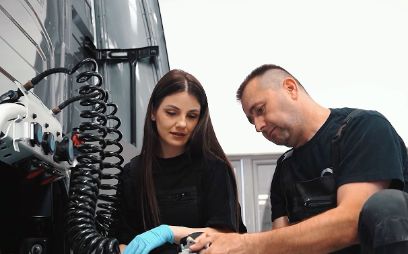
This is where important opportunities emerge. The business model focuses on mechatronics for heavy-duty industrial equipment and commercial vehicles. As an interdisciplinary field combining mechanical engineering, electrical engineering, and information technology, mechatronics creates strong employment and skills development opportunities aligned with industrial demand. The project follows a demand-driven approach linked to industrial actors such as Volvo and related sectors in the region.
The business model is built around three interconnected pillars: development and provision of market-relevant training, uptake and employment through industry demand, and linkages and investment that connect training institutions, enterprises, and labor market actors. These pillars aim to strengthen workforce readiness, improve employment pathways for women and youth, and support industrial competitiveness in the region.

Driving Long-Term Transformation
The project’s development objectives extend beyond skills training alone. It seeks to promote safer and more efficient transportation through intelligent safety systems, advanced vehicle technologies, and a skilled workforce capable of supporting modern transport solutions at scale.
It also aligns workforce development with the changing nature of work shaped by digital transformation and the green transition, emphasizing reskilling and upskilling in response to industrial change. At the same time, the project aims to expand economic opportunities for women and youth by improving employability, strengthening regional connectivity, and facilitating the movement of goods, services, capital, and people across the region.
The initiative also contributes to the green transition by supporting lower-emission transport systems, encouraging investment in decarbonized mobility solutions, and creating pathways for the increased adoption of electrical and hybrid vehicles. Experiences generated through mechatronics may further create opportunities for expansion into sectors such as construction and agriculture, where digitalization and automation are becoming increasingly important.
Find out more
Category: International