Environmental and Resource Management

Do you want to do more than just talk about sustainability by actually working on real solutions?

Then the BSc in Environmental and Resource Management at BFH is the right programme for you. Learn how natural resources can be protected and utilised – from the use of land and water to sustainably shaping production, supply chains and consumption.

The degree programme combines scientific, societal and practical perspectives. Explore how change can be initiated, planned and implemented – in landscapes and ecosystems, as well as in supply chains, organisations and value creation systems.

During your studies, you can specialise in one of two areas: Sustainable Land and Water Use or Sustainable Value Creation Systems.

This prepares you to take on responsibility and to contribute to sustainable resource management solutions in a practical, interdisciplinary and future-oriented way. Study full time or part time.

Watch on YouTube with English subtitles

Factsheet

  • Title/Degree Bachelor of Science (BSc)
  • Specialisations Sustainable Land and Water Use
    Sustainable Value Creation Systems
  • Mode of study Full-time (6 semesters), part-time (7-10 semesters)
  • Start date Academic year 25/26: September 8, 2025
    Academic year 26/27: September 7, 2026
  • Application deadline Academic year 25/26: April 30, 2025
    Academic year 26/27: April 30, 2026
  • ECTS credits 180 ECTS credits
  • Teaching language German and French in mixed-language classes, English in the fourth semester
  • Location Zollikofen
  • School School of Agricultural, Forest and Food Sciences HAFL

Study focus

The bachelor’s degree programme in Environmental and Resource Management, with a focus on agriculture, forestry and the food industry, enables you to initiate and implement sustainable transformations in the workplace and daily life.

Advantages of this degree programme

During your studies, you will:

  • focus on one of the specialisations: Sustainable Land and Water Use or Sustainable Value Creation Systems;
  • acquire skills that enable you to initiate, plan and support sustainability-related change processes in various industries and companies and thus help shape the future;
  • benefit from our lecturers’ practical knowledge and professional networks;
  • engage in challenge-based learning which will develop your networked-thinking and problem-solving skills;
  • benefit from the close links between teaching, practice and research, gaining experience in various research areas while you learn.

Study Today. Transform tomorrow.

Learn, experience, shape the future!

From exciting course content and a unique campus life to diverse career paths – discover in the following videos why studying Environmental and Resource Management is worthwhile.


Watch on YouTube with English subtitles

Watch on YouTube with English subtitles

Specialisations

In addition to the core modules and optional modules, the bachelor’s degree programme offers two specialisations. Exchange students (semester 4) can select modules from all three specialisations.

Whether it’s biodiversity, water quality or the use of soil and land, many environmental issues are determined where people shape landscapes and use resources: in agriculture, in housing estates, along streams and lakes, or in protected areas.

In the Sustainable Land and Water Use specialisation, you’ll learn about ecological and socio-economic systems as an interconnected whole – and how to develop practical solutions. You’ll work across disciplines and use data effectively to assess situations, plan measures and make informed decisions.

The focus is on how you can develop improvements, in collaboration with experts, and demonstrate their impact; for example, by designing monitoring schemes for species and habitats, supporting the revitalisation of water bodies, or analysing conflicts of use in spatial and landscape planning. In this way, you’ll advance projects relating to water, biodiversity, and soil and land use in an impactful way.

Contents:

  • Biodiversity promotion and monitoring, species management
  • Agricultural production systems and their ecological and economic evaluation
  • Sustainable land use and planning in rural and urban areas
  • Hydrology, water use and quality, water conservation and revitalisation
  • Soil degradation and conservation

Whether it’s climate, biodiversity, resource consumption, waste, or societal risks, many of these challenges are linked to how raw materials are extracted and how products are manufactured, transported, sold, and consumed.

In the Sustainable Value Creation Systems specialisation, you’ll learn how supply chains, production processes and consumption systems can be made more sustainable – to conserve resources, reduce environmental impact, strengthen circular economies, and improve socio-economic standards.

The focus is on analysing, evaluating and further developing value chains, and on implementing sustainable solutions in companies, organisations and the public sector.

Contents:

  • Resilient value-creation systems
  • Raw-material production and processing
  • Logistics, distribution and trade
  • The circular economy
  • Raw-material cycles and energy management
  • Sustainability analyses and assessments of operations and production systems
  • Sustainability reporting and controlling

Career prospects

Do you want to pursue a meaningful career and contribute to a more sustainable society by specialising in sustainability and resource management? A bachelor’s degree in Environmental and Resource Management at BFH will provide you with the necessary skills in the fields of sustainability, resource management and environmental sciences, and open up a wide range of prospects on the labour market.

Ready for demanding specialist tasks and leadership roles?

A bachelor’s degree (BSc) in Environmental and Resource Management from BFH opens up career opportunities in a wide range of industries and companies.

Our graduates work in the following fields within environmental and resource management:

  • Sustainable development specialist
  • Lifecycle assessment specialist
  • Natural resource management specialist
  • Environmental project manager
  • Circular economy specialist
  • Biodiversity consultant
  • Staff member at the Office for the Environment, Forestry and Nature
  • Sustainability manager in a food wholesale business
  • Staff member at the Energy and Environment Unit
  • Etc.

In private companies, professional organisations and NGOs, in federal, cantonal and communal authorities, in consultancy or engineering firms, etc.

Further studies

In the Master of Science in Circular Innovation and Sustainability programme, you gain an in-depth understanding of biological and technical cycles and learn about their potential for developing sustainable product and process innovations. You also gain the ability to rethink conventional business models and design them in a circular way.

The MSc in Life Sciences, specialising in Agricultural Science, Forest Science or Regional Management in Mountain Areas, prepares you to become a methodically competent and solution-oriented specialist or manager.

Contact us

To register for the programme and for further information: see the German or French webpages.

Student mobility

Incoming mobility

Would you like to spend an exchange semester or year at BFH-HAFL in Switzerland? If your home university is on our list of partner universities, please contact your International Office. If not, ask your International Office to contact us.

  • Application deadline
    For the autumn semester: 15 April
    For the spring semester: 15 October
  • Language
    Semester 4 modules in the Bachelor of Science in Environmental and Resource Management are taught in English.
  • Modules for exchange students

Accommodation

There is a hall of residence on the BFH-HAFL campus. Demand for rooms is much greater than availability, so apply early.

Information

Would you like to find out more? We will be happy to answer your questions at our information events.

Student advisory service

Choosing a degree programme is an important decision. During an individual consultancy session, we answer your questions and clarify any personal requirements you might have.


We can also help you with any questions you have about the exchange semester.

Location + facilities

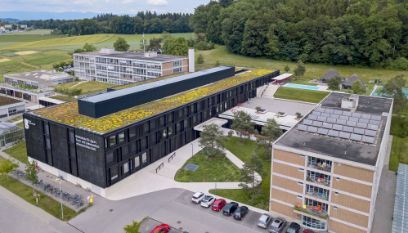
The BFH-HAFL campus is located in Zollikofen, near Bern. Nestled between fields and forests, it not only offers a modern infrastructure for studying, but also numerous leisure facilities.

The Zollikofen campus

Most teaching takes place on campus – in lecture theatres, modern laboratories or in our own food process technology pilot plant.

But the campus is not just a place to study, it also offers a wide range of leisure facilities, such as a swimming pool, barbecue areas, a sauna and much more. And there is also an award-winning cafeteria.

The student hall of residence has around 100 furnished rooms.

Show address and location of the site.