Service portfolio
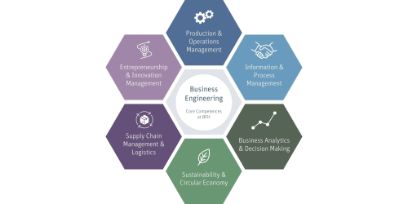
We offer analyses, research and consulting projects, impulse presentations, workshops and coaching in the following areas:



We analyse situations and develop strategies to successfully design products, services and business systems for a sustainable, data-centric world.
We develop and communicate strategic impulses, methods and solutions for increasing competitiveness, innovation strength, planning and investment security in companies and organisations. The focus is on practical and impact-oriented knowledge transfer in the areas of innovation, logistics and supply chain management, production management, business analytics, sustainability and entrepreneurship.
We offer analyses, research and consulting projects, impulse presentations, workshops and coaching in the following areas:
The world is becoming increasingly data-rich, interconnected, and complex. Traditional cause-and-effect models are often no longer sufficient to support well-informed management decisions.
Our analytics group develops data-driven models and digital twins and applies them to digital product passports, lifecycle and transparency analyses, and simulations in order to better understand complex socio-technical systems and support decision-making under uncertainty. By combining statistical methods, simulation, and intuitive visualization, we make complex relationships understandable and actionable for decision-makers.
Digital Twins and Simulation: Development of digital twins for the analysis and simulation of complex systems. This allows scenarios to be tested and the potential impacts of decisions to be assessed at an early stage.
Business Dynamics and System Modeling: Modeling and simulation of the economic development and performance of complex dynamic systems.
Digital Product Passports and Data Ecosystems: Analysis of information architectures and data platforms for digital product passports, as well as their role in transparency, the circular economy, and sustainable value creation.
Digital Business Models and Information Platforms: Analysis, development, and simulation of data-driven business models and digital platforms.
Data Analysis and Visualization: Development of scientifically grounded, management-oriented visualization methods to support complex decision-making processes.

We promote entrepreneurship and innovation in an engineering context – from the initial idea to the spin-off. We support students, staff, and companies with a structured, methodologically sound approach in developing and implementing new solutions.
Our focus is on designing effective innovation processes as well as developing and validating market-viable business models. In doing so, we combine scientific methods with hands-on implementation – particularly within the framework of Innosuisse projects.
Development and validation of new product and business models
Analysis of market and competitive environments
Optimization of innovation processes
Application of agile methods such as Lean Startup and Design Thinking
Building collaborations between companies and start-ups
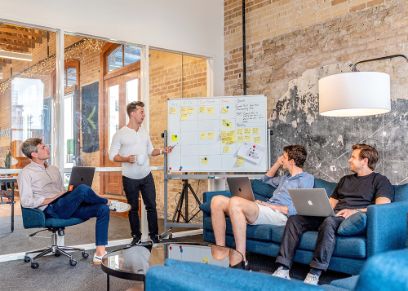
Organisations generate more data than ever, but turning that data into well-designed, efficient processes remains a challenge. Our group researches and applies methods for process digitalization, automation, and information management along digital value chains.
We help companies and organisations to:
Our work combines applied research with hands-on practice. The Digital Value Chain Lab (DVC Lab) serves as our living research and teaching environment, using a real coffee roastery to demonstrate end-to-end digitalization from raw material to consumer.
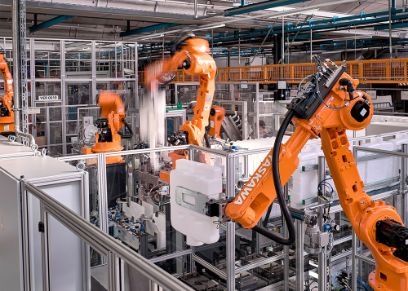
New findings in digitalisation and automation that are relevant for production landscapes are emerging almost daily. But when are these useful for an existing system? How can the performance of existing systems be optimised? How should maintenance be carried out? Our group addresses these and other questions about production management.
Due to increasing shares of external value creation and the growing complexity of long supply chains, the holistic design and management of value creation with an end-to-end view is becoming more and more important. While in the past there was a strong focus on cost drivers and efficiency gains, issues of resilience, transparency, sustainability and collaboration in multi-level supply chains need to be addressed equally.

To develop a low-carbon, sustainable economy, companies must be able to assess and respond to environmental, economic and social challenges. We offer relevant knowledge and tools that accelerate this transition. This includes advice on topics such as:

Our research and consulting activities are based on the following competencies:
Contact us or meet our experts directly at various events. Cooperation results in a win-win situation for everyone involved: your company, society and the University of Applied Sciences.