
Sexual harassment

We do not tolerate sexual harassment. We — and especially those in leadership positions — take responsibility for actively promoting a harassment‑free environment. You can find all relevant information, counselling services, and additional resources on this page.

We do not tolerate sexual harassment. We, and in particular persons in positions of authority, have a responsibility to ensure a harassment-free environment. The basis for this are the Code of Conduct and the Regulations for the protection of personal integrity of Bern University of Applied Sciences.

What is sexual harassment?

Sexual harassment is any conduct with a sexual connotation that is unwanted by the recipient or degrades persons on the basis of their sex.

Sexual harassment can take different forms, such as:

  • lewd, demeaning or disdainful comments or jokes;
  • display or distribution of sexist, especially pornographic, material;
  • sexual assault, the soliciting of sexual acts, unwelcome physical contact and obtrusive behaviour;
  • sexual advances which exploit a relationship of dependency or which are made with a promise of advantages or threat of disadvantages;
  • sexual acts and behaviours that are punishable under law.
Drawing the line between harmless flirtation, friendly relations and sexual harassment can seem difficult at first glance. But there’s a simple rule: the decisive factor is not the intention of the person acting, but how their behaviour is received by the affected person – whether or not one gets too close to them in an unwelcome way.

Flirting …
… is a mutual thing
… is constructive, encouraging
… is desired by both sides
… boosts self-esteem
… triggers joy
… makes everyday work more enjoyable
… respects personal boundaries

Sexual harassment
… is a one-sided approach
… is humiliating, insulting
... is not desired by a person
… undermines self-esteem
… triggers anger
… poisons the working environment
… violates personal boundaries

You’ve experienced an incident – what should you do?

1. Address the person directly:
 

  • Immediately and unambiguously inform the offending person or persons that their behaviour is unwelcome and will not be tolerated.
  • If you do not feel that you are being taken seriously and the harassment continues, tell the harassing persons that you will submit a complaint.

2. Address the person indirectly:
 

  • If you are afraid of a direct confrontation with the harassing person or your efforts have been unsuccessful, write them a letter or an e-mail.
  • Specify in writing what bothers you and demand that they stop the harassing behaviour in the future.
  • Make a copy of this letter or e-mail.

3. Confide in others:
 

  • Talk to people you trust.
  • Seek the opportunity to speak with colleagues as well. Maybe you are not the only person being harassed and you can respond together with others.

4. Confidential counselling and support:
 

  • Seek confidential advice if you need support or if the incidents continue.
  • Contact the relevant contact points. Specially trained professionals listen to you, advise you and assist you confidentially and free of charge.

5. Internal contact via the line manager or report to the Investigative Service:
 

  • If you would like us to do something, talk to your supervisor, the HR consultant responsible for you, your teachers or the head of your degree programme, or contact the BFH Investigative Service.
  • You can find information on making internal contact via the line manager or reporting to the Investigative Service on the page about the protection of personal integrity at BFH.

 6. Legal action:
 

  • The law offers various tools to defend oneself against sexual harassment.
  • Be sure to seek advice if you are considering legal action.
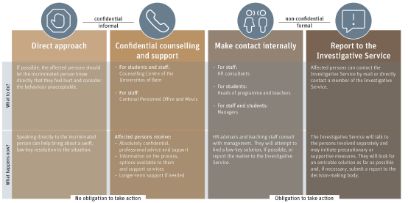
Graphic depicting the process in the context of a violation of personal integrity. Enlarge image
In cases of violations of personal integrity, we support affected persons with counselling services and have clear procedures and authority to resolve cases.

Counselling Centre Universities of Bern contact person


Mirjam Zeiter, M. Sc.
Psychologist

T    +41 31 636 82 70
E    mirjam.zeiter@be.ch

You’ve witnessed an incident – what should you do?

How should you behave when you observe sexual harassment in your environment? You can assist the person who experienced the harassment with the following actions:

  • Don’t laugh when people make sexist remarks or jokes.
  • Talk to the person if you think or notice that they are being sexually harassed.
  • Encourage them to actively fight back.
  • Accompany them to meetings with external confidential contacts or the responsible internal contacts.
  • Inform managers of the harassment.
  • Make yourself available as a witness.

Sexual Harassement Awareness Day

Each year in spring, Swiss universities raise awareness of sexual harassment in the higher‑education context as part of the Sexual Harassment Awareness Day.

We take part in this important day of action. The aim of the campaign is to prevent sexual harassment and sexism. At our university, we strive to create and foster a culture that is inclusive and sensitive to discrimination — sexual harassment has no place here.

Sexual Harassment Awareness Day 2026 BFH

On 21 April 2026, from 12:15 to 1:15 p.m., an online lunchtime discussion on the topic of allyship will take place for members of the BFH. The discussion will feature Mirjam Zeiter (Counselling Service of the Bernese Universities) and Konrad Weber (allyship.ch). The event is organised by the Office and Commission for Equal Opportunities.

The Investigative Service

The Investigative Service has an obligation to act as soon as it becomes aware of a violation of personal integrity. You can contact the Investigative Service at personal.integrity@bfh.ch or contact a member of the Investigative Service directly.