

- Story
From HAFL assistant to Swiss Ambassador
23.10.2025 Former staff member Siroco Messerli has gone from the agricultural fields to the diplomatic frontline. He reflects on his time in Zollikofen, and how applied science is more important than ever.
When asked if he ever imagined, as a young research assistant in International Agriculture at BFH-HAFL, that he would one day be an ambassador, Siroco Messerli gave an emphatic response.
“Absolutely not!”
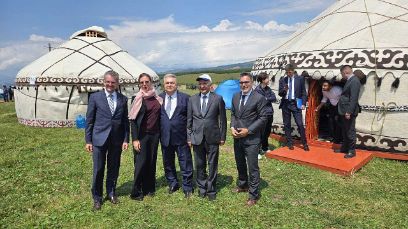
Speaking from his office in Bishkek, Kyrgyzstan, Ambassador Messerli was happy to discuss his unusual diplomatic career path, and how it all began in agriculture.
“Agriculture has the word ‘culture’ in it,” he said. “and agriculture IS about culture – it’s more than just growing food. It’s the basis of all human beings.”
Ambassador Messerli worked at HAFL (then the Swiss College of Agriculture) in Zollikofen, Switzerland, from 2001 to 2004. But we need to go back further to get a full picture of his career, and the way things have fallen into place.
After completing a master’s degree in agriculture at ETH Zurich and the University of Reading in 1999, Ambassador Messerli spent a year in Kyrgyzstan – making his recent appointment as Swiss Ambassador to the country a full-circle moment, 25 years in the making.
“That first year in Kyrgyzstan happened quite coincidentally,” Ambassador Messerli said. “ETH was looking for a student for an agroforestry research project, and they couldn’t find anybody because you had to learn Russian first.
“I’d just completed my degree, so I went to the professor and said, ‘Look, I’m free. Would you accept a graduate?’ And that’s how I arrived in Kyrgyzstan in 2000.”
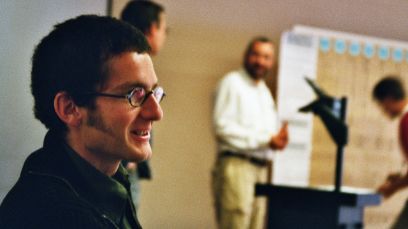
Working at HAFL
After the ETH research project ended in 2001, Ambassador Messerli returned to Switzerland. While working at ProSpecieRara, he saw a job advertisement for a research assistant and quickly dismissed it, until fate played a hand.
“I saw the job advertisement, in print, but threw it away,” he said. “I thought it wasn’t my kind of job. Then a week later, emptying the rubbish bin, this crumpled piece of paper fell out and I opened it and thought, ‘Oh, there’s that job; actually, it looks interesting!’ And I applied and eventually got it.”
Under the group leadership of Gil Ducommun, Ambassador Messerli was assigned to the crops team led by Urs Scheidegger. His colleagues included Hugo Cecchini, after whom the HAFL Hugo P. Cecchini Institute is named, and recently retired professors Dominique Guenat and Christoph Studer.
His work revolved around three main areas:
-
Teaching assistant
“This was an enriching experience. I hadn’t taught before, so I did an additional diploma to teach at agricultural schools. But after three years I realised teaching was ‘not my thing’. It was too repetitive. It was nice to meet new students every year, but it became clear to me that it was not my destiny to become a teacher or professor.”
-
HAFL Services and external mandates
“This was great as it gave me in-depth experiences in working abroad. We had projects in Russia and I went to North Korea with Christoph Studer for three weeks, which was very insightful. Sometimes today, people are surprised when I tell them that I’ve been in North Korea.
“I also did an evaluation in Lesotho, which was challenging. I’d never done an evaluation before but HAFL sent me alone. There was a lot of trust from HAFL in me as a person.”
-
Managing the greenhouse
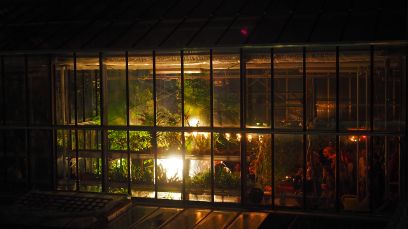
“In terms of enrichment, the best part of my time at HAFL was working in the greenhouse. I was tasked to manage it, growing coffee and cocoa plants and teaching the students who had their own plant-growing projects. During one winter, I came up with an idea to hold cultural events in there, and with French teacher Barbara Tscharner we created the ‘Treibhauskultur’ series. HAFL Director Alfred Buess was open to it and gave us a budget. Together with some motivated students, we started it, and it went on successfully for many years.”
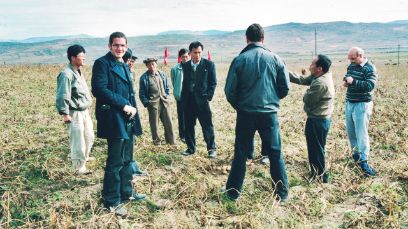
Life after HAFL
When his limited contract at HAFL ended, Ambassador Messerli returned for another six years to the country that fascinated him. During this time he published several journal articles – see here, here and here – and worked for Helvetas as a project advisor, before moving to Nepal for three years.
While fate may have played a hand in his job appointments at the start of his career, that has not been the case during the past 12 years.
“I’ve always had an interest in an international career,” he said. “At ETH, I was engaged in a group for international development and cooperation. Also, when choosing my studies, the ability to work abroad, later, was important to me. However, I’m not somebody, even now, who plans life. As advice to students, I say don’t plan exactly where you want to go. Look at opportunities and decide if it’s something you really want to do.”
In 2013, he joined the Federal Department of Foreign Affairs (FDFA), first as a Deputy Director in Bangladesh, then as Head of Division back in Bern. From 2021 he worked for the Swiss Embassy in Bosnia and Herzegovina as Deputy Head of Mission and Director of Cooperation.
His appointment as Swiss Ambassador to Kyrgyzstan was announced in March 2025 and began in August. Over the years, he’s become used to the four-year job-rotation system that feels like a fresh start every time, and the fact he’s living in another landlocked country. Kyrgyzstan is surrounded by China, Kazakhstan, Uzbekistan and Tajikistan.
“Actually, when I think about it, I’ve never done any posts by the sea,” he laughs. “Even in Dhaka I was far away from the sea. But it doesn’t matter where you work. When you come to a country you discover how fascinating it is, and the people’s incredible hospitality.”
The second Switzerland
Returning to Kyrgyzstan again felt comfortable, for several reasons. Not only does he know the country and its people well, but there are several similarities.
“The Kyrgyzstanis often – even when I was here 25 years ago – like to call their country ‘the second Switzerland’ or the ‘Switzerland of Central Asia’,” he said.
“Both are quite small countries – well, I mean, Kyrgyzstan is about five times the size of Switzerland, but still, that’s not a large country – and the people are very proud of their mountains, too. It’s even more mountainous than Switzerland.”
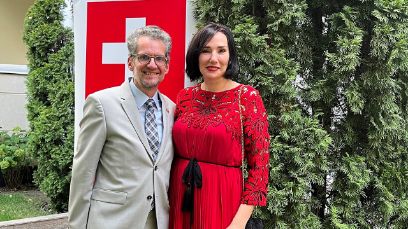
First posting as Ambassador
Back during that research year, spent on horseback in the country’s southern mountains, he never imagined it would be the beginning of such a long association leading to an ambassador posting.
“I would say my good knowledge of Kyrgyzstan and its languages had an influence on me getting posted here now,” he said, “but there are many more criteria when we get selected. A previous connection is certainly not the decisive factor.
“There are different ways how you can become an ambassador, and there is certainly a process behind it. The classic way is to start at a young age and follow the different stages of a diplomatic career, or you can enter via a different path like I did. What I appreciate a lot in Switzerland is that careers in our public service are based on merit.”
Noticeable changes
Since returning to Kyrgyzstan for the first time in 15 years, he’s noticed many changes.
“I’ve seen climate change firsthand,” he said. “Back then there was much more ice and snow. The far mountains towards China, which are about 7000 metres high, were covered, and you still see that, but the lower mountains, at 4000 metres, only have small remnants of glaciers left. When you see it like that, you really start to worry.
“Climate change is a topic Switzerland works on intensively here. We have a cooperation programme, working particularly on water and energy. From a diplomatic point of view, water is an important topic in terms of maintaining regional trust and peace.
“We also work on disaster risk reduction, which has a direct link, of course, to climate change. Like Switzerland, Central Asia is facing climate-related challenges, such as flash floods, landslides, and the drying up of the Aral Sea.”
Agriculture opens doors
While his day-to-day work life now looks a lot different to his HAFL days, he’s thankful for how it’s influenced him.
“It was my first real job, so it certainly shaped me,” he said. “I can’t apply what I did at HAFL in my current job, but I still use these experiences as an ambassador. My regular workday means jumping between very different tasks – you need to be able to relate to different people, situations, organisations … be it bilateral, multilateral … to talk with ministers, ambassadors, citizens, media … you need to be a generalist.
“And I think a background in agriculture is useful for that. It’s about the basics of life – how we cultivate what we need to survive. It’s an interesting entry point in discussions and something people can relate to. And, if I look at my peers, it seems to be an occupation which encourages people to take on all kinds of roles.”
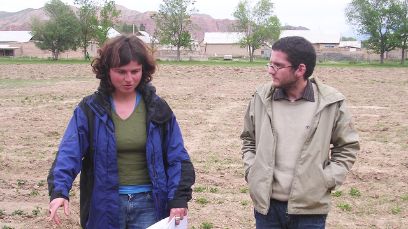
Message for students
Ambassador Messerli participated in the Erasmus programme and encourages students to look into similar overseas study opportunities.
“This is something I would recommend to all students,” he said. “I think you should grab it. I learned a lot in this period.
“Follow your instincts and think how you want your career path to be. Don’t do things because others expect it. Listen to your professors, of course, but make your own choices.
“Self-competence and social competence are essential. Knowledge is important, but presenting yourself, communicating, negotiating, mediating, understanding others – these matter even more.”
When looking to the jobs of the future, and especially considering AI, he understands how challenging it is for younger generations, but also sees it as an opportunity.
“The whole question of artificial intelligence … I mean, this is something that’s here – it’s not coming tomorrow, it’s already here,” he said.
“Switzerland has founded the Geneva Science and Diplomacy Anticipator (GESDA). It’s exciting for young people, also for HAFL students, as it anticipates human, social and technological developments over different time horizons.
“GESDA is essentially a cooperation between diplomacy and science, and there are many topics which relate to the work at HAFL; for instance, the topic of future food systems, what will they look like? How will they function? There are also topics on engineering, crops and livestock, and reimagining farming.”
Combatting the rejection of scientific evidence
With HAFL focusing on applied sciences, Ambassador Messerli said the school is in a good position to navigate the complexities society is currently facing, such as climate change, fragility, changes in development cooperation, and more.
“HAFL has always been a forward-looking institution,” he said. “And the sciences being taught at HAFL are facts, not just interpretations or beliefs.
“Science is under pressure. Politicians, populist movements and citizens on social media are increasingly denying, and even actively rejecting, scientific evidence.
“I call it attacks on science, because it’s not ‘science critical’ – it’s okay to be science critical because science is about being critical – but the dismissal of well-supported scientific consensus is driven by forces wanting to devalue scientific facts.
“Applied science is crucial; it helps explain science through concrete products, such as better quality milk, fodder, food products, and so on. I would encourage HAFL and the whole bioscience community to bring themselves into this discussion, to jointly defend the science and the science community.
“And science is key to our survival. The key question for humanity has always been: how do we feed the world? The challenges are population growth, deterioration of natural resources and climate change. We need applied science, technology and evidence-based approaches to continue addressing these challenges.”
Final HAFL reflections
Ambassador Messerli credited his time at HAFL – and the trust placed in him and the opportunities the position offered – with giving him the confidence to take on new challenges.
“My time at HAFL was important,” he said. “It’s part of the foundation of my career, of who I am, what I did, and what I’m doing in my life today. I’m thankful for the skills and methodologies I learned, and HAFL’s leadership that made it possible.
“The director and my line managers invested in me, even though they knew I would only be there for a few years. It was an excellent time working together, and I’m still always happy to catch up with HAFL colleagues.”
Find out more
Category: International