

- Story
Experiencing Industrialisation Firsthand
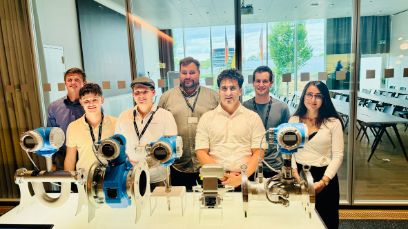
15.09.2026 What does industrialisation look like in practice? During the IPM Summer School, students had the opportunity to experience it firsthand over the course of two weeks at the Endress+Hauser facility in Reinach.
Key Points at a glance
-
Experience industry firsthand: Two weeks of practical learning during the Summer School at Endress+Hauser – directly on site and working on real-world challenges.
-
Put knowledge into practice: Expert input, workshops and projects with industry professionals and lecturers.
-
Learn together: Interdisciplinary exchange, teamwork and the opportunity to present their own solutions.
For the second time, students of Industrial Engineering at BFH took part in the Summer School together with students from FH Graubünden, Lucerne University of Applied Sciences and Arts, and the University of Applied Sciences and Arts Northwestern Switzerland (FHNW). The programme focused on topics including lean management, production, industrialisation, smart manufacturing and supply chain management.
The industrial environment provided an impressive setting for the programme: the Endress+Hauser Group employs around 18,000 people worldwide and operates more than 30 production sites across four continents. Endress+Hauser Flow, the centre of competence for flow measurement technology and host of the Summer School, employs around 2,900 people worldwide, including more than 1,600 at its Reinach site.
The academic input came from both the participating universities and Endress+Hauser experts. What made the Summer School special was the opportunity to experience the concepts directly on the shop floor and apply them to real-world challenges. This allowed the students not only to learn about methods and models, but also to see first-hand how they are applied in an international industrial company.
BFH contributed two key perspectives on industrialisation. Cédric Bessire covered factory planning, while Moritz Maier focused on innovation and the Stage-Gate process. Together, their contributions connected the development of new products with the design of the industrial structures needed to manufacture them efficiently.
The complexity of this interplay becomes clear from the sheer variety of products at Endress+Hauser Flow: the product portfolio comprises more than 30 million possible variants. Product innovation creates new opportunities – and additional variety. Production, processes and factory planning must therefore be designed to manage this complexity effectively.
The students were not merely observers. Working in interdisciplinary teams across the participating universities, they tackled practical challenges relating to Endress+Hauser Flow products. They analysed complex interdependencies, brought together different perspectives and developed their own approaches to solving the challenges.
At the end of the Summer School, the students presented the results of their projects to representatives of Endress+Hauser, including Urs Endress and members of the management team. They had the opportunity to discuss their solutions directly with them and receive immediate feedback from professionals who deal with precisely these kinds of industrial challenges in their day-to-day work.
The IPM Summer School therefore provides a strong link between academic learning and industrial practice. For the students, the connections between innovation, production, industrialisation and supply chain management become not only understandable in theory, but tangible in practice.
We are already looking forward to the next IPM Summer School!

We can explain industrialisation in the lecture hall. But to truly understand it, you have to experience it where it happens every day. That is what makes the Summer School so valuable to me: our students spend two weeks immersed in industry, working on real-world challenges and discussing their solutions directly with the people who put them into practice.