

- Story
Enhancing motivation and pride in music lessons
20.02.2026 A student on HKB’s Music Pedagogy programme created pictogram cards to facilitate and enhance music lessons, especially with neurodivergent pupils. She covered the full process, from development to the final, marketable product.
Key points at a glance
- The You “C” Cards have pictograms that help visually structure music lessons and enhance participation and inclusiveness.
- The cards are especially useful when working with pupils who are neurodivergent or have disabilities.
- The deck comprises approx. 80 cards, which are divided in two categories with different functions, Competence Cards and Action Cards.
- The project was developed by a HKB student and was backed by Students4Sustainability and other organisations.
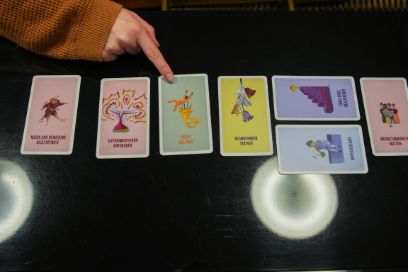
Starting a singing lesson: the cards, which feature pictograms reminiscent of a conventional board game, are placed on a table. They include terms such as ‘Integrate rituals’, ‘Reflection’ and ‘Maintain repertoire’. A pupil browses through the cards and choses how they wish to start the lesson. During the lesson, the pupil and the teacher, Salomé Calina Schneiter, review the cards several times to discuss how to proceed further and summarise their achievements.
More motivation through co-decision
“The You “C” Cards provide a visual structure to the music lessons, making them more tangible, clear, participative and inclusive,” explains Salomé Calina Schneiter, who is currently studying to become a music pedagogue. “Thanks to the cards, the pupils gain a better perception of their needs and can communicate more easily, as visual cues are available. The card deck also addresses topics that are otherwise often overlooked, such as mindfulness, autonomy or designing a personal project.”
The idea behind the card deck: pupils who have a say in music lessons and define their own goals see their motivation increase. The cards are based on psychological and didactic principles that Salomé Calina Schneiter acquired during her studies at Bern Academy of the Arts (HKB).
A very useful tool for neurodivergent pupils
“The You “C” Cards are suitable for all music pupils, regardless of their age,” explains Salomé Calina Schneiter. “In particular, they are extremely useful when working with disabled or neurodiverse pupils, such as people with ADHD or on the autism spectrum.” The cards support communication, give a sense of safety through transparency and opportunities to exert influence, and promote individual learning paths.
How the You “C” Cards work
The approx. 80-card deck is divided into two categories:
competence cards, which make learning goals and learning fields visible, allowing students to recognise their personal strengths and develop them in a targeted manner (e.g. autonomy, motivation, ability to reflect);
and Action Cards, which provide concrete possibilities for action and tools (e.g. organising your own learning, doing breathing exercises), and offer ideas on how to achieve goals and further develop skills. By doing this, the cards support clearly structured and varied lessons.
For teachers, the cards offer an easy way to support inclusion. They can retain their tried-and-tested tools, methods and teaching styles, while providing students with more orientation, clarification of needs and topics, and a clear focus.
The teacher presents the lesson plan as a series of cards and selects 2 to 6 cards in specific sections. This creates a flexible visual structure that clearly communicates the focus for learners and teachers, forming an anchor and thus preventing overstrain.
Manifold effects
Thanks to the cards, pupils can gain a better understanding of their learning journey. They become more aware of what they have learned and what they would like to continue learning.


“It’s always inspiring to see the subjects and areas in which my students are interested,” says Salomé Calina Schneiter, citing the example of a student who discovered her passion for composition.
There is more to the cards than just ‘see’ (as in You “C” Cards), i.e. seeing and perceiving. The ‘C’ can also be interpreted as ‘choose’ (you choose), ‘can’ (you can) or ‘create’ (you create). In her lessons, Salomé Calina Schneiter also uses the cards to follow up on lessons.
An idea rooted in her studies
The idea behind the You “C” Cards stems from Salomé Calina Schneiter’s personal experience during her studies. “I would have liked to have had more opportunities to decide on goals and define them”, says the trained singer. “Then, in the Music Pedagogy programme at HKB, I had a course called ‘Learning with pictures’. I thought about how pictures can help in the classroom. General visual aids for school lessons exist. But I hadn’t found anything specifically for teaching music.”
Support from Students4Sustainability
Students4Sustainability is the joint hub of Bern University of Applied Sciences, the University of Bern, Bern University of Teacher Education (PH Bern) and the NMS Bern.
Together, the institutions of higher education actively promote and support student participation in the field of sustainable development. Projects such as You “C” Cards can apply for funding.
They not only receive financial support, but are also accompanied throughout their projects. “I received coaching from S4S and was able to network with other volunteers, which proved to be a real asset,” says Salomé Calina Schneiter.
She came up with the idea for the card deck during her studies, building on the work of Professor Andreas Cincera and assisted by Viviane Ruof and her fellow students. She also benefited from the support of Students4Sustainability, the hub for student participation in the field of sustainable development (see info box). With their focus on inclusion, the cards make a contribution to social sustainability.
From the idea to the market
The You “C” Cards have clearly outgrown the scope of a student project. “I had the help of a professional graphic designer, Anna Wenger. The cards were co-developed by a broad interdisciplinary project team from the fields of music education, psychology and curative education.” And last but not least, Salomé Calina Schneiter and her team from the HKB Business Lab provided support.
HKB Business Lab
The HKB Business Lab promotes cultural entrepreneurship and supports artists, designers and conservators from HKB at the intersection between idea and entrepreneurship.
The services offered include, among other things, individual coaching sessions. In addition, HKB students can choose an elective course in the field of cultural entrepreneurship, which covers all business‑relevant topics for artists—from e‑mail signatures to foundation applications, as well as business models and presentation techniques.
The final pictogram cards use a clear, minimalist design, making them as easy to understand as possible for people with special needs. “In some cases, the drafts went back and forth up to eight times until a mutual understanding was found.” The project is funded by the ‘Denk an mich’ foundation and other sponsors. In a next step, the website will be launched. It will include a feature to order the cards.
Pride instead of shame
Starting with the prototypes, Salomé Calina Schneiter has been using the cards in her music lessons since October 2024. “The cards draw attention to the learners’ resources and strengths,” she says, summarising her experience. “They don’t concentrate on a single piece of music, but on their entire musical career and themselves as persons.” This approach is particularly beneficial when working with neurodivergent pupils, who are frequently perceived by society as having a deficit.
Salomé Calina Schneiter would like to counter this with the You “C” Cards, because “supposed weaknesses usually their corresponding strengths. There is a tendency for such students to just absorb information and think “I’m not good enough”. That’s why I want to make participation and self-efficacy more accessible to them.” This approach is clearly effective, as demonstrated at the conclusion of the singing lesson cited at the outset. Looking at the cards, the pupil reflects on his lessons: “Oh yes, I’ve already achieved quite a lot!”
Background: how BFH promotes engagement
Three separate pathways which support one main purpose: the You “C” Cards project shows how different BFH’s offerings are interconnected. Salomé Calina Schneiter applied for financial support and coaching for her project with ‘Students4Sustainability’. At the same time, she registered for the ‘Certificate of Engagement in Sustainability’ (CES) and was able to have her You “C” Cards project recognised as a certificate project.
Certificate of Engagement in Sustainability and BFH diagonal
BFH students can obtain the ‘Certificate of Engagement in Sustainability‘ (CES). It encompasses a curricular part (knowledge & skills) and an extracurricular part (engagement).
In the curricular part, students attend in particular a BFH diagonal module in the field of sustainability, which is credited as a basic module. ‘BFH diagonal’ is BFH’s interdisciplinary and cross-disciplinary optional module programme. It allows students to discover their talents and interests and to enhance their personal, subject-related and professional development.
The ‘engagement’ part entails the implementation of a certificate project, which addresses an interdisciplinary problem with a demonstrable connection to sustainability. Once the pupils have completed both parts, they receive a certificate in addition to their bachelor’s or master’s degree.
This engagement was complemented by the BFH diagonal module ‘Acting sustainably’ (link in German), which Salomé Calina Schneiter completed as a CES basic module: “The module really broadened my horizons and offered new perspectives on related sustainability topics.”
She benefited in several ways: the project was funded, it was credited to the CES and she gained new perspectives from the BFH diagonal module ‘Acting sustainably’.
External organisations can submit project ideas in the field of sustainability to BFH (sustainability@bfh.ch). Suitable projects are advertised as CES projects, offering students a practical opportunity to get involved in sustainable development.