
Virtual Reality Laboratory (VRlab)

At our Virtual Reality Laboratory (VRlab), we use various types of immersive VR as a methodological tool for research and teaching.

Our laboratory

Our range of VR training programmes allows for practice in a simulated, virtual situation. This allows us to anticipate challenging, real-life situations in everyday (work) life. Our primary objective is to establish a secure framework for such situations.

We make targeted use of this method and of its advantages in research and teaching:

  • High control and repeatability: in research and teaching, conditions can be controlled precisely and experiments or training can be easily repeated.
  • Life-like exercises: VR makes it possible to practise complex or sensitive scenarios safely without endangering actual individuals.
  • Secure learning environment: mistakes are allowed and can be reflected upon without negative consequences.
  • Targeted performance diagnosis: learning progress can be measured and evaluated with a high degree of precision, allowing for personalised, customised feedback. Alternatively, dependent variables may be recorded.
  • Cost-efficient and flexible: once developed, VR training can be conducted at any time and in any location with no significant additional costs.
  • Interdisciplinary learning: individuals from different fields of study can learn together in a virtual environment and benefit from each other’s experience.
  • Equal training conditions: VR offers standardised content; all users have the same learning opportunities, regardless of time and place.

Consulting training with VR

In VR consulting training, students can apply the methodical consulting knowledge they have acquired in theory. This is done with an avatar, defined as a computer-generated persona. The students improve their consulting skills through repeated practice and feedback.   

The didactic process consists of three phases:

  1. preparation for the social work case (reading the instructions and the case vignette),
  2. VR training in the VRlab (including production of a video) and
  3. peer group discussion with a coach, including analysis and reflection (based on the videos).

Social work cases in various contexts

Virtual job interview training

Job interviews pose a significant challenge for many individuals. This training prepares social work students or clients for a job interview. The aim is to learn how to present themselves confidently during a real job interview. The training can be completed online on a computer or a notebook. A video is recorded using the webcam and stored locally on the device.

VR training for presentation skills

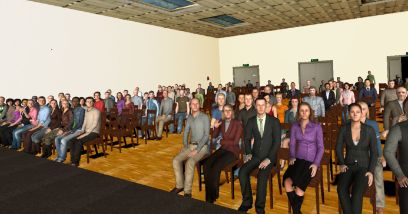
A key competence in both social work and teaching is a confident appearance when communicating content in front of an audience. This training enhances the presentation skills of social work students and teachers.

 You stand in front of a virtual audience.
Participants in this VR training practice their presentation (e.g. PowerPoint) in front of a virtual audience.

Virtual home inspection

In some areas of social work, it is essential to visit clients in their homes to assess their living conditions. Assessments help determine whether an older person is still able to manage their household alone or whether a living situation is suitable for younger children. The VR training for home inspections teaches participants what to look out for during such assessments. The aim is to then be able to conduct real-life home visits with competence and confidence and to make informed decisions.