Circea – upcycling biogenic CO2 side-streams in the agri-food industry
Circea project develops processes to upcycle biogenic CO₂ emissions—originating as side‑streams from fermentation (e.g., wine or beer) and anaerobic digestion (e.g., biogas)—into value‑added products for the agri‑food industries.
Factsheet
- Schools involved School of Agricultural, Forest and Food Sciences
- Institute(s) Agriculture
- Research unit(s) Sustainability and ecosystem
- Funding organisation Others
- Duration (planned) 01.12.2025 - 31.12.2026
- Head of project Jean Valentin De Saussure
-
Project staff
Jean Valentin De Saussure
Prof. Dr. Michael Hans-Peter Studer - Partner Gebert Rüf Stiftung
- Keywords carbon, circular economy, biogenic, defossilisation
Situation
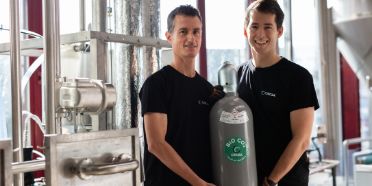
Every year, breweries and wineries in Switzerland emit around 25,000 tonnes of biogenic carbon dioxide from fermentation. At the same time, breweries purchase roughly the same amount of fossil‑based CO₂ for their operations. Biomethane plants release up to 60,000 tonnes of CO₂ unused into the atmosphere. Circea’s mission is to upcycle these abundant yet wasted resources of biogenic CO₂ into a valuable product for the Food & Beverage and agricultural sectors, combining innovative recovery, compression, and purification technologies with the creation of local market outlets. By starting with breweries and wineries, Circea demonstrates the feasibility of recovering and reusing small‑scale CO₂ streams as a sustainable ingredient, achieving recovery rates of up to 85%. Beyond these first pilots, the company is extending its model to biomethane plants, which provide larger, year‑round sources of CO₂. Circea’s approach rests on three pillars: (1) technological solutions adapted to decentralized production sites, (2) the development of local networks linking CO₂ producers and users, and (3) optimized processes ensuring logistics, traceability, and product quality. The ambition is clear: to eliminate imports of fossil CO₂ in Switzerland by building regional ecosystems for bio‑CO₂ valorization. In doing so, Circea reduces dependence on fossil resources, enhances supply‑chain resilience for manufacturers, and contributes to the transition toward a defossilized and circular economy.
Result
The project started in 2023 with a partner winemaker in Valais/Wallis, through the development of a prototype thanks to the Innobooster Living Labs for Decarbonisation, to test the technical feasibility of capturing the CO₂ and to conduct the first analyses on the quality of the gas and its impact on the wine (CO₂ > 99% vol.). With the First Ventures VALIDATE support and funding from the Canton of Vaud, Circea was able to create its first pilot project and install, in 2025, a system to collect, purify, store, and distribute CO₂ in order to validate its MVP in a brewery near Lausanne and prepare for deployment in wineries. In collaboration with BFH/HAFL, new projects have also been developed to apply this solution in the biogas sector, as well as to find synergies with greenhouses (to replace fossil CO₂ with locally produced bio‑CO₂). The start‑up Circea was officially founded at the beginning of 2024. Having confirmed the interest of wineries and breweries, Circea is now expanding the deployment of its CO₂‑recovery solution and strengthening collaborations with academia and companies to build a circular carbon economy.