ReUseB91: Development of a Technology for the Reuse of Concrete Railway Sleepers
The reuse of old concrete railway sleepers can reduce CO2 emissions by more than 80% and preserve resources. Innovative testing methods enable safe and cost-effective circular economy practices in railway construction.
Factsheet
- Schools involved School of Architecture, Wood and Civil Engineering
- Institute(s) Institute for Building Materials and Biobased Products IBBM
- Research unit(s) Materials and Life Cycle Assessment group FGWO
- Funding organisation Innosuisse
- Duration (planned) 01.02.2026 - 28.02.2029
- Head of project Dr. Anita Katheras
- Project staff Leonhard Seidl
- Partner Vigier Rail AG
- Keywords Circular Economy, Reuse of Concrete Railway Sleepers, CO₂ Emission Reduction, Life Cycle Assessment (LCA), Railway Infrastructure
Situation
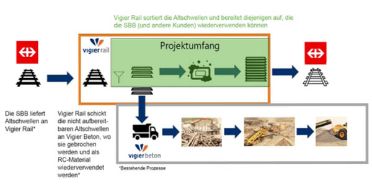
Switzerland’s railway infrastructure comprises approximately 13 million sleepers. This includes around 4.4 million B91-type concrete sleepers, which have been in use on the Swiss standard-gauge network since 1991 and are now Vigier Rail’s leader product. The oldest will reach their projected service life of approximately 40 years in the coming years. However, experience has shown that many B91 sleepers could remain suitable for further use. Currently, when tracks are dismantled, concrete railway sleepers are usually crushed and recycled as concrete aggregate. While recycling helps preserve raw materials, the production of new sleepers still relies on energy and CO2-intensive manufacturing processes. Reuse can allow resources and manufacturing energy to be utilised for longer. In the context of SBB’s climate targets and the planned reduction in Scope 3 emissions, the extension of the service life of existing infrastructure components is gaining relevancy. The reuse of concrete sleepers offers great potential in this regard: compared with the production of new sleepers – including those made from recycled concrete aggregate – CO2 emissions can be reduced by over 80 per cent and natural resources conserved. Nevertheless, there is a lack of reliable and economically viable methods for assessment, estimation of remaining service life and the reconditioning of old sleepers. This project fills this gap by developing innovative methods, thereby laying the foundations for safe reuse.
Course of action
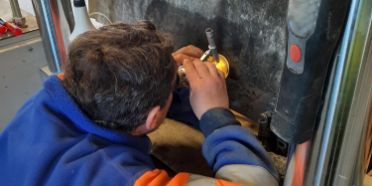
The project aims at developing a technology for the safe and economically viable reuse of old concrete railway sleepers. First, existing requirements and damage patterns are systematically analysed and compiled into a catalogue of criteria for the assessment of old sleepers. The removed sleepers then undergo extensive testing. This process involves integrating visual assessments, non-destructive testing, mechanical tests and any available usage and load data. On this basis, innovative methods for condition assessment are developed. These include AI-supported image analysis for the automated detection of damage, a standardised quality protocol and a probabilistic decision model for the assessment of remaining service life. At the same time, processes for refurbishing the sleepers are developed, including cleaning, replacing plastic dowels, retrofitting with under sleeper padding, labelling and RFID-based tagging for traceability. The methods developed will be validated in real conditions during a field trial. In addition, environmental and economic impacts will be assessed using life cycle assessment (LCA) and cost-benefit analysis. The objective is to provide a solid foundation for the industrial implementation of a resource-efficient and economically viable circular solution for the construction of railway infrastructure.
Result
The success of the project will be measured by demonstrating the technical, environmental and economic viability of reusing concrete railway sleepers. A key prerequisite will be to substantiate through durability assessments that the removed sleepers do not exhibit any critical damage and are, in principle, suitable for further exploitation phases. In addition, the project will provide tools that enable a reliable and objective assessment of old sleepers. These tools will include methods for automated damage detection, standardised quality criteria and models for the assessment of remaining service life. The solutions pursued should ensure a high level of reliability, practicality and efficiency. The technical feasibility of reuse will need to be verifiable and an economic advantage over new production clearly shown. Furthermore, a life cycle assessment will quantify the environmental impact of reuse, thus providing transparency regarding the achievable resource savings and CO2 reductions. The project will be deemed a success once the procedures developed have been validated in real conditions and a framework has been established for the industrial implementation of sleeper reuse.
Looking ahead
The project aims to lay the foundations for a circular economy for concrete railway sleepers. Furthermore, it will open up new prospects for a resource-efficient railway infrastructure. If its implementation proves successful, it will be possible to apply the methods developed to other types of sleepers and to railway networks in Switzerland and abroad. These methods will also offer potential for further applications. In the future, non-destructive testing methods and AI-based condition assessments could be used to evaluate sleepers in situ or other concrete components. The project could also become a model for the construction industry. The collaboration between Vigier Rail, as the manufacturing entity, and SBB, as the primary client, offers ideal conditions for establishing a functional circular economy. The life cycle assessment conducted as part of the project aims to quantify the environmental impact of reuse and highlight the contribution that circular solutions can make towards achieving CO2 reduction targets. Should implementation prove successful, the insights and methods gained could become a model for other construction products and circular value chains. The results will not only support the decarbonisation of the rail sector, but also back the transition of the construction industry towards a resource-efficient circular economy.