

Quality development
We are a learning organisation that strives for high quality standards. This guides our strategy, structure and culture, and our teaching, continuing education, research, consulting services and operations.
In 2024, our institution underwent institutional reaccreditation by the Swiss Accreditation Council.
Quality management
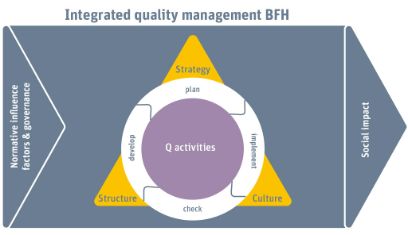
Integrated quality management (QM) concerns all BFH members in a whole institution approach and forms the overarching framework for ensuring and continuously developing quality at BFH. The QM system is aligned with the BFH Strategy and supports the systematic implementation of its objectives and the long-term positioning of the university.
The Quality Development Office is responsible for developing and reviewing the quality strategy at the overall institutional level in collaboration with the BFH Quality Officer and the Quality Development Committee. The heads of schools and the President’s Office, consisting of the Vice-Presidents’ Offices, the General Secretariat and Communications, and the Administrative Director, are responsible for the operational implementation of the quality strategy.


Quality strategy
We consistently align our quality management with the BFH Strategy and recognised standards.
QM makes a measurable contribution to the implementation of the BFH Strategy and is an integral part of strategic management. We are guided by statutory requirements as well as national and international standards.
BFH’s QM creates a binding framework that leaves room for schools and organisational units to determine their own subject-specific structures. Cooperation between centralised and decentralised QM strengthens our quality culture and drives forward the development of our institution.
By measuring ourselves against the best, we reinforce BFH’s position as an innovative, high-profile and impact-driven university of applied sciences.
We make our performance and impact visible and develop quality through comparisons with good practices and, where available, relevant benchmarks. QM fosters innovation, distinction and social impact. We take into account the needs and perceptions of students, staff and external stakeholders.
We promote an active quality culture and a learning organisation.
We anchor the quality guidelines as principles that govern our attitude and behaviour and enable members of the university to reflect on and actively shape a quality culture. The pursuit of dialogue with respect to results, challenges and optimisation measures strengthens the shared understanding of quality. In this way, QM becomes the foundation for an organisation that is continuously learning.
We ensure transparency, comprehensibility and participation in all quality processes.
University members are fully involved in planning, implementation and surveys. The systematic use of feedback and evaluation tools ensures a closed-loop control between objectives and results. We consistently translate evaluation insights into improvements and promote closed PDCA cycles.
We make quality management efficient, digital and future-oriented.
We use digital and AI-supported tools to simplify processes, obtain management information and support fact-based decisions. Here, the quality of data and information is the key basis for dependable action. Where appropriate, we standardise processes, boost efficiency and create scope for innovation and entrepreneurial action.
The quality strategy defines the objectives and fields of action of QM at BFH, establishing the framework to make QM operationalisable, visible and verifiable, to continuously develop it further and to reinforce BFH’s position as an attractive, future-oriented university of applied sciences.
Structures and processes
The University Executive Board (FHL) is responsible for QM at BFH. For the operational implementation of quality management, key objectives and measures are derived, operationalised and integrated into a rolling milestone plan in the Quality Development Office. This is done in consultation with the BFH quality officer. The Quality Development Committee – made up of the quality officers from the individual schools and units – supports this process.
For operational implementation, all tools for planning, ensuring and developing quality are further developed along the Plan-Do-Check-Act process logic.
| Plan | BFH plans its QM on the basis of relevant principles, taking into account the available resources and the measures taken. |
|---|---|
| Do | quality objectives and measures are concretised and conceptualised, implemented and integrated. Clear responsibilities, resource management and process-oriented action ensure targeted implementation in all service and support areas. |
| Check | the achievement of objectives is regularly and systematically reviewed in order to ensure transparency and create a sound basis for decision-making. |
| Act | the findings from the review are concretised as measures to drive forward the further development of BFH in a systematic, impact-oriented manner. |
Process management
Process management ensures that quality-relevant processes are described transparently, regularly reviewed and continuously improved. The management, core and support processes are recorded in a process map and provide BFH with a clear, university-wide structure. Responsibility lies with the Quality Development Office, which provides for a coordinated further development process in line with the strategic goals. The purpose and standards are defined in the BFH Process Understanding and link process organisation with continuous development. BFH uses the Signavio tool, among others, for these activities.
Quality management tools
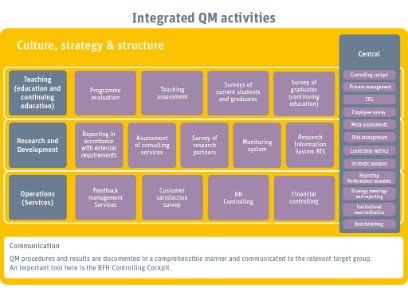
Various instruments (e.g. surveys, key figures, databases, strategy discussions) are used to create a broad data basis for quality management.
The main data sources are listed along the service areas Teaching (education and continuing education), Research and Development, and operations (Services). Many QM tools are managed centrally and implemented throughout BFH. Further concepts and guidelines are available on BFH’s intranet.
EFQM
An important orientation framework for quality management is the EFQM model, which BFH has adapted to suit university-specific requirements and deploys for specific purposes. The model forms the basis for a comprehensive analysis of BFH as an organisation. It focusses on customer benefits, an ecosystem perspective, the organisational culture and flat organisational structures. Concrete measures are derived on the basis of the results of the self-assessments carried out in the individual organisational units. This provides the University Executive Board with a dynamic, future-oriented mindset.
Further information
Institutional accreditation
Following the Federal Act on Funding and Coordination of the Swiss Higher Education Sector (HEdA) , institutional accreditation has become mandatory for all types of higher education institutions. This replaces the previous programme accreditation.
BFH was the first public university of applied sciences to achieve accreditation at overall institution level based on the accreditation process conducted by the Swiss Agency of Accreditation and Quality Assurance (AAQ) . BFH was successfully reaccredited in 2024.