



- Story
Our bridges are reaching the end of their design life
09.06.2026 In Switzerland, the number of renovated bridges largely exceeds those that are fully replaced. The degree programme in Civil Engineering at BFH places an emphasis on resource-efficient infrastructure maintenance. In our interview, BFH professors Dirk Proske and Robert Wagner explain why such renovations raise fascinating questions and outline what future bridge engineers are focusing on.
Key points at a glance
-
Old bridges must comply with current standards in order to remain in service. Structural assessments are therefore necessary.
-
The quality of historical documentation for ageing bridges has been shown to decrease over time. That makes the work both challenging and fascinating.
-
Structural maintenance will continue to grow in importance in the future, as will reuse, the circular economy, recyclability and digitalisation.
At BFH, the scope of bridge construction covers a wide range of subjects. What are your core areas of expertise?
Dirk Proske: We cover a wide range of subjects indeed, from bridge construction to bridge maintenance. In addition, we work with all kinds of building materials, including reinforced concrete, steel, timber, as well as wire and rope structures.
Robert Wagner: Our bachelor’s degree programme trains students in the design and construction of new bridges, while our master’s programme is primarily focused on conservation and monitoring. In Switzerland and Europe, the number of renovated bridges largely exceeds those that are fully replaced.
What did your work focus on in recent years?
Proske: On behalf of Swiss Federal Railways (SBB) and the Federal Roads Office (FEDRO), we inspected around 13,000 bridges and worked out a risk assessment. With the data provided by the infrastructure managers, we calculated the probability of a bridge collapse and analysed its implications for the overall system. We did the same thing in Germany for the motorways and the national railway company (Deutsche Bahn). In total, we inspected around 70,000 bridges and are now well placed to assess the condition of bridges managed by various infrastructure managers.
The assessment of the bridges’ structure and condition is becoming increasingly important. Why is that?
Wagner: Bridge owners are required to ensure that their structures still comply with existing SIA standards. Over the decades, these standards have evolved. A bridge that was built hundred years ago must comply with current standards to remain in service. Periodical structural assessments are therefore necessary. Our assessments also address issues relating to sustainability and the circular economy.
Proske: A significant proportion of our bridges were built in the 19th and 20th centuries and are now reaching the end of their design life. We can either demolish and rebuild them, or continue using them, which is clearly more sustainable.

“We can either demolish and rebuild old bridges, or continue using them, which is clearly more sustainable.”
What aspects of projects involving old bridges do you find particularly interesting?
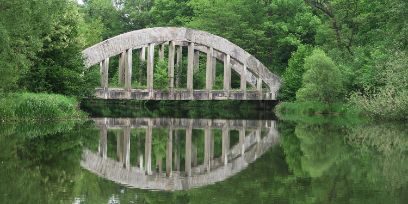
Proske: I will use the example of an arched bridge built in 1850. Often, there is a lack of documentation. Mays some parts contain concrete or steel. So we need to survey the structures and drill boreholes to figure this out. In my lectures, I compare older bridges to cars built in the 1930s. Every 30 or 40 years, such cars are fitted with a brand new mudguard, engine and suspension. When applied to bridges, one could easily say that we are assessing a century-old patchwork of construction history
Wagner: Such projects often require a certain amount of detective work: the older the bridge, the poorer the documentation. We are dealing with 80-year-old steel and must first figure out whether it might actually be older and determine its material properties. We fumble around before getting the bigger picture. It is a rather complex task – and a fascinating one!
How do you convey this knowledge in your lectures?
Proske: We offer a lecture on the subject of arched bridges. With the students, we look at plans and inspect bridges on site. The students carry out various calculations to determine whether the bridge will remain structurally sound in the next few decades and is suitable for various modes of transport. Two years ago, during a Special Week, we travelled to Vienna to study the collapse of the Reichsbrücke. Throughout my career, I have produced many assessments and I often share anecdotes. For instance, concrete was once mixed with fabric softener on a prestressed concrete bridge south of Berlin. As a result, it didn’t set.
Wagner: The lecturers regularly share insights into real-world practice, and anecdotes always go down well with our students. Major events such as the bridge collapse in Genoa are also discussed. Broadly speaking, our remit is to ensure that young people graduate with the skills needed for the workplace. With us, students start by learning the basics, for instance how to design, engineer and build a bridge or a load-bearing structure, and how to make all the calculations. As the bachelor’s degree programme progresses, the number of project assignments increases, enabling students to apply the knowledge they have learnt. In addition, there are always projects involving students from the various disciplines of civil engineering, timber construction and architecture. Students can specialise further in the subsequent master’s programme or undertake a continuing education programme like the CAS in Railway Construction or the CAS in Sustainable Infrastructure.
“Major events such as the bridge collapse in Genoa are also discussed.”

What will research and teaching focus on in the future?
Proske: Civil engineering maintenance will experience sustained growth in significance. The question is: how can we keep the bridges and infrastructure systems running with the limited resources available? Research into new, durable building materials is also a key issue, and so is digitalisation. It is imperative that we equip students with the necessary skills to evaluate and analyse the calculations and solutions generated by artificial intelligence.
Wagner: I believe that, alongside maintenance, issues such as reuse, the circular economy and recyclability are becoming increasingly important. How will civil engineers design bridges so that, upon dismantling, the materials can be separated and recycled according to the types of materials used? Digitalisation will play an important role in this. Structures must be properly documented so that, hundred years from now, no one has to wonder what they contain.
Burgdorf Bridge Building Day
The next Burgdorf Bridge Building Day takes place on 17 September 2026. Swiss bridge engineers will discuss innovative approaches to the maintenance and expansion of modern transport systems. Modern societies are characterised by the large-scale movement of people, goods and energy. The infrastructure facilities required for this often reach the end of their planned design life and are unable to meet the growing demands without increasing limitations.