


- Story
Research centred on people and the environment
26.08.2026 BFH research projects in the field of ‘Caring Society’ address pressing issues of our time, such as ageing in place, the future of endangered Alpine settlements and the shortage of skilled workers in the wood sector. The focus is on a society that looks out for the wellbeing of all. Transdisciplinary collaboration is crucial in this context, according to William Fuhrer from the School of Architecture, Wood and Civil Engineering.
Key points at a glance
- ‘Caring Society’ is a strategic thematic field at BFH. The focus is on a society that looks out for the wellbeing of all.
- Researchers at BFH are addressing pressing issues of our time and bringing together diverse perspectives.
- Transdisciplinary collaboration is an effective way to address complex social challenges in research projects.
Switzerland’s ageing population poses a significant challenge, impacting both politics and our society. There is an increasing demand for age-appropriate housing. High-rise blocks are a popular choice of residence amongst older people. Yet, many were built in the postwar period and are in need of renovation. “Older persons have specific housing needs,” says Tannys Helfer, a research associate at BFH’s School of Health Professions. For instance, if an older person wishes to go shopping on their own, they need a path that is free of obstacles.
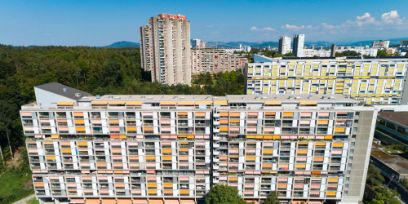
As part of the ‘Healthy Up High’ project, an interdisciplinary research team at BFH investigated options for revitalising two high-rise housing complexes in Bern with the needs of older residents in mind. The team identified several useful measures, such as reopening communal living spaces, installing non-slip sign-posted paths or improving nutritional care, e.g. through shared lunch schemes. “Many of these measures have the potential to reinforce one another. As for shared lunch schemes, they foster mobility and social integration,” adds project manager Tannys Helfer. Some of the measures are currently being implemented by the two participating building cooperatives in Bern West. In the follow-up project ‘Healthy up High in Switzerland’, the local measures were expanded to include topics such as protection from high temperatures and biodiversity in green spaces, and were adapted for use throughout the country.
Thematic fields: Caring Society
In the thematic field ‘Caring Society’, we focus on the relationships between health, lifestyle and social circumstances. Promoting the quality of life and health of people of all ages is the goal of a caring, inclusive society.
Four focus topics
- Generations and old age
Factors that promote well-being and social participation for people of all ages. - Mental health and well-being
Promotion of mental health through social participation, destigmatisation and social support. - Caring Spaces
Research on how different types of space serve users while also contributing to solidarity, social inclusion and care. - Social justice, diversity and participation
Approaches to overcoming social inequalities and enhance participation in a diverse society.
A BFH strategic thematic field
Both projects aim to foster a caring society – a society that looks out for the wellbeing of all while taking into account social, health, technological, environmental and economic concerns. ‘Caring Society’ is one of BFH’s strategic thematic fields.
To date, around ninety research projects at BFH have received funding in this field. William Fuhrer, from the School of Architecture, Wood and Civil Engineering, was involved in the follow-up project ‘Healthy up High in Switzerland’, alongside experts from the School of Health Professions and the School of Social Work. He emphasises the importance of transdisciplinary collaboration: “Achieving comprehensive and sustainable solutions to complex problems in research projects is only possible by analysing them from different perspectives and in collaboration with the public.” People and the environment must therefore be at the heart of the research projects. William Fuhrer, a member of the Stadtlabor Biel, is committed to putting the needs of the population at the heart of urban planning projects. Through practical examples, students at the lab learn how to develop solutions in collaboration with the local authorities, interest groups, professional associations and the general public.

«To achieve comprehensive and sustainable solutions to complex problems in research projects, it is essential to analyse them from different perspectives and in collaboration with the public.»

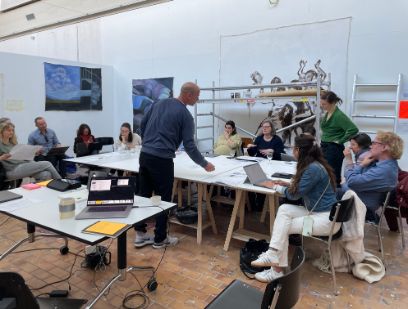
William Fuhrer emphasises that a healthy environment is also important for a caring society. The School of Architecture, Wood and Civil Engineering attaches particular importance to this, not least in its research into and further development of timber, which is understood not merely as a renewable building material, but also in the context of value chains, circular practices and the built environment. The school also plays a pivotal role in shaping the conversation on renewable materials, the responsible management of existing resources and the design of liveable spaces. The core objective is to develop solutions that support people and their environment in the face of current social and environmental challenges.
Shortage of skilled labour and settlements under threat
In the thematic field ‘Caring Society’, two other projects are on the verge of being launched under the leadership of Norbert Winterberg, head of subject-area group at BFH’s Institute for Digital Construction and Wood Industry. Both projects were initiated by Stefan Lobsiger, research associate at the institute. The ‘Brennen statt Ausbrennen’ project addresses the persistently severe shortage of skilled workers in the wood sector, particularly in the technical and manual trades. “In this project, we will conduct a systemic analysis of how leadership culture, work-time models, future prospects and mental health in the workplace affect the shortage of skilled workers,” says Norbert Winterberg. “Among other things, the goal is to identify concrete courses of action for SMEs in the wood sector that will enable them to attract, develop and retain skilled workers over the long term,” adds Stefan Lobsiger.
«The goal is to identify concrete courses of action for SMEs in the wood sector that will enable them to attract, develop and retain skilled workers over the long term.»

‘Hauswärts’, a collaboration project with the School of Social Work, explores ways to ensure the long-term viability of Alpine settlements in areas prone to natural hazards. The focus is on resettlements and other adaptation strategies, their social consequences and the participatory design of these processes. “It’s not just a matter of resolving planning and construction issues, but also of determining how the legitimacy of such processes can be strengthened through approaches that are transparent, participatory and understandable to those affected,” emphasises Norbert Winterberg. Stefan Lobsiger also emphasises the importance of safeguarding the identity, mental well-being and social participation of the people affected.
«It’s not just a matter of resolving planning and construction issues, but also of strengthening the legitimacy of such processes.»

Daily physical activity: a source of motivation
Henriette Lutz also explored the goals of a caring society at the BFH Institute for Urbanism, Architecture and Construction. A research project on architectural design and its role in promoting physical activity sought to ascertain how the design of flats and living environments can help older adults remain mobile for longer and age in place. The same observations were made as in the projects referenced above. To summarise, physical activity exerts a direct and positive influence on health, and it facilitates social interaction and connection. “It is essential that incentives are positive and motivating, and that physical activity becomes a natural part of everyday life,” stresses Henriette Lutz. Her work highlighted numerous points of convergence and synergies with the ‘Healthy up High in Switzerland’ project. Foundations, municipalities and property owners have shown great interest in the results. As part of the model project ‘Healthy Housing Stock: Affordable and Social Transformation in Bern’ (Gesund im Bestand: Bezahlbare und soziale Transformation in Bern), BFH is currently developing collaborative strategies for healthy, affordable and socially responsible densification.