


- Story
Spatial development: transformation as a future challenge
25.06.2026 How can our towns and countryside be designed so they continue to provide space for good quality of life and a prosperous economy in the future? An interview with experts Manuel Fischer and William Fuhrer.
Key points at a glance
- Many different needs compete for Switzerland’s limited space, from housing and industry to agriculture and leisure.
- Current challenges in spatial development include socially compatible densification and the sustainable structuring of our living spaces and mobility, including adapting to climate-related hazards.
- BFH is assuming responsibility for this transformation process and placing a strong emphasis on interdisciplinary collaboration and close links with partners from the public sector, business, civil society and science.
Why is spatial development such a core issue for Switzerland?
William Fuhrer: Spatial development is a creative challenge that affects people’s wellbeing and future in very different ways. How do we live and how do we spend our free time? How is the economic area structured and how do we earn our living? How does this impact the environment? These are all aspects of spatial development that are closely connected and influence one another. And they are by no means all the dimensions that should be taken into account in spatial planning.
Manuel Fischer: All of this takes place on a limited resource: the land. Conflicts of use are unavoidable, for example between economic and environmental interests, whereby the various levels interact with each other. High levels of biodiversity, for example, also have a positive effect on people’s wellbeing. These conflicts need to be mediated.
What makes it exciting is that there’s nothing static about spatial development and some things simply can’t be planned. For example, you can plan down to the last detail how you think people should use an urban space, but ultimately they end up creating their own well-trodden paths or using the space differently from what you intended. Spaces are constantly evolving.
About the interviewees
Manuel Fischer is a qualified regional development specialist and heads the strategic thematic field Sustainable Development at BFH.
Professor William Fuhrer is an architect and heads the Urban Transformation group at BFH.
What are the biggest challenges currently facing spatial development?
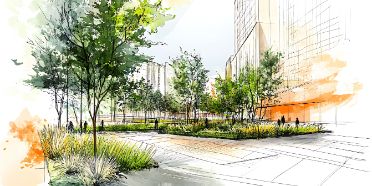
William Fuhrer: A major issue at the moment is the plan to transform settlements to make them more compact and efficient. This could be through a mix of usage types, for example, meaning that housing and workplaces are in close proximity to one another. This reduces commuter traffic, which is important for the climate. If even more greenery is introduced into the city and the temperatures are more bearable as a result, the climate mitigation strategy then becomes a climate adaptation strategy.
Manuel Fischer: That’s right, climate adaptation is increasingly becoming an issue. Even if greenhouse gas emissions were to miraculously drop to zero overnight, the climate would continue to warm for decades to come. So we have to adapt to that. At BFH, we are conducting research into solutions for urban greening, for example, and are exploring the concept of the ‘sponge city’, which is better equipped to cope with heavy rainfall and summer heat than the grey cities we have today. We also urgently need to transform our mobility habits.
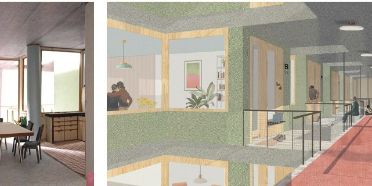
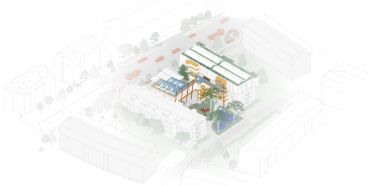
William Fuhrer: Another big issue at the moment is affordable, good-quality housing in central locations. With the towns and cities having already been built, what’s needed now is densification. But how can we achieve densification in a form that is socially compatible? We are currently investigating this question as part of a project funded by the federal government, in collaboration with the Bern City Planning Office and other partners. Above all, we want to examine how the existing housing stock – that is, existing residential neighbourhoods – can be developed without knocking down and replacing the buildings.

There is no single, universally applicable ideal model, but there is such a thing as an ideal consensus-building process.

Why are we suddenly talking about developing existing building stock? Wouldn’t it be easier to build from scratch?
Manuel Fischer: Historically speaking, people have always developed existing building stock, quite simply because a completely new building was too expensive. What is currently giving the development of the housing stock a renewed boost is the issue of ‘grey energy’. This refers to the greenhouse gas emissions and resources that are saved if you don’t demolish and rebuild from scratch. In reality, however, there is still a lot of demolition and new building going on, as the concept of a circular economy is still a niche issue in many sectors and many people’s thinking.
William Fuhrer: What makes the redevelopment of the existing building stock so special is the social aspect. Alongside all the planning, technical and construction issues, there are the people who already live there – with their livelihoods and ecosystems. If you take the further development of the existing building stock seriously, it becomes first and foremost a cultural challenge, because you have to build with the residents in mind. This can mean renovating without the residents having to move out. Or maybe also engaging local businesses to do the refurbishment and regeneration work.
What would be the ideal image of an urban neighbourhood or a landscape? And who defines this ideal?
Manuel Fischer: There is no single, universally accepted ideal model of how residential neighbourhoods should look. But there is such a thing as an ideal consensus-building process. And this includes the participation of those who live in and make use of the place in question. Non-human stakeholders, too, such as flora and fauna, should also have a say in these processes. Participation allows the residents to identify with the development, as demonstrated by a research project currently being carried out by BFH in the field of building culture (see Info Box). A space can create an identity that endures despite changes. Society changes, land uses change and the landscape can change too – just think of what a landslide can do.
William Fuhrer: What is needed is what we call ‘transformative resilience’. So it’s not just about weathering individual shocks and stressors, but about proactively adapting in order to cope better with future challenges. It’s about addressing the issue of change and seeing the potential for change as a creative opportunity. During the Covid pandemic, we saw that a mix of different functional uses is fundamental in this respect. Stress was lower in places where living, shopping and leisure were not separated. It helps to view neighbourhoods as systems – not just houses and streets, but the relationships and activities of people and the ways in which they interact. So the question is: what must the residential context offer to relationships and the system?
Baukultur: our research projects
Built environment encompasses the entire man-made environment and our interaction with it. It is not merely architecture, but brings together buildings, open spaces, infrastructure, urban planning and landscapes. As a holistic process, it encompasses planning, conservation, use and sustainable development. The Swiss National Science Foundation is currently running National Research Programme 81 on the built environment. Within this framework, the BFH is involved in three projects:
How can this kind of integrated planning be successful in practice?
William Fuhrer: That’s the big question. Traditionally, spatial development tasks have been split up between different sectors and disciplines, each of which has its own processes, requirements and budgets. A publication we recently produced in collaboration with the SDSN sustainability network shows that there is often a lack of local capacity to translate interdisciplinary knowledge effectively into planning and design. But there are positive approaches from which we can learn.
Manuel Fischer: Urban development is a task for society as a whole – everyone of us needs to play our part. On the one hand, of course, it is up to politicians to provide the framework. But Switzerland also offers many opportunities for participation and we should make the most of them. And yes, an interdisciplinary approach is important. At BFH, we focus on spatial development in the fields of architecture and construction, agriculture, the transformation of economic regions, the structuring of the social environment – including artistic elements, by the way – and even the management of natural hazards.
A village is also an urbanised system, albeit a less densely populated one.

We’ve talked a lot about the city, but hardly at all about the country. Is that indicative of the nature of spatial development?
Manuel Fischer: You have to look at the bigger picture. Every village is fairly close to a small town, and both face challenges such as urban sprawl and traffic. In Switzerland, it is particularly difficult to draw a clear distinction between urban and rural areas. People talk about the peri-urban area. How can the central plateau adapt to increasing urbanisation whilst ensuring that productive agricultural land is preserved? This is another of the issues in our research into baukultur.
William Fuhrer: Nor should we forget that ‘city’ or ‘urban’ is often used in specialist discourse as a synonym for the built-up area. A village is also an urbanised system, albeit a less densely populated one. In fact, Switzerland has been urbanised since the 1980s, and over 80 percent of the population live in urban agglomerations. If you want to achieve an impact, this offers greater leverage than in smaller spatial structures.
What is the PIONEER University Alliance?
The EU has supported international alliances between universities since 2020. Its aim is to make European universities fit for the future by promoting interdisciplinary, transdisciplinary and international collaboration.
Along with nine other European universities, BFH is actively involved in the PIONEER Alliance for the City of the Future. PIONEER brings together internationally successful European universities such as the Gustave Eiffel University, the Università Iuav di Venezia and the TH Köln - University of Applied Sciences.
The partners combine technical and socio-cultural disciplines to address pressing issues relating to the sustainable development of urban areas. These include aspects of societal sustainability such as health promotion and safety, as well as ecological and technical challenges such as energy supply and mobility.
What are your hopes for Switzerland’s spatial development in the future?
William Fuhrer: (laughs) Good question! There are plenty of things I wish would happen. I’d like to see more dynamism and the courage to go off the beaten track, to just try stuff out. It would be helpful to have scope for experimentation, such as specific development zones or provisions in the building regulations that explicitly allow for or anticipate innovative solutions.
Manuel Fischer: My wish for Switzerland is that it would have the courage to think outside the box and break free from narratives that are holding it back. At BFH, we would like to take responsibility for the transformation of public spaces. Thanks to our interdisciplinary and transdisciplinary research and our wide network of contacts in the professional world, we are well placed to do so. Participation in the PIONEER European University Alliance (see info box) also opens up further exciting opportunities for collaboration and mutual learning at an international level.