
Resilient Cities and Communities

Help shape the cities of tomorrow. As an urban change agent, you will work with cities and local authorities to make urban areas more adaptable and resilient in dealing with current crises and profound change.

You will learn how to understand complex urban systems, identify risks and opportunities at an early stage, and develop sustainable solutions in collaboration with others. You will work in interdisciplinary and transdisciplinary settings with businesses, public authorities and civil society, combining local practice with international perspectives.

MSc Resilient Cities and Communities
The programme aims to develop skills at the intersection of spatial planning, climate, society, economics and governance.

Start your studies in the autumn semester 2027.

Factsheet

  • Title/Degree Master of Science Resilient Cities and Communities
  • Mode of study Full-time (4 semesters)
    Part-time (6–8 semesters)
  • Start date September 2027
  • Application deadline 31. July 2027
  • ECTS credits 120 ECTS
  • Teaching language English
  • Location Biel/Bienne and Bern
  • School School of Architecture, Wood and Civil Engineering

Focus areas

In the Master Resilient Cities and Communities, you will analyse urban systems in the context of major global trends and develop strategies to make cities, metropolitan areas and neighbourhoods more resilient and liveable.

What you will gain with your degree

Climate and biodiversity crises, demographic shifts, structural and social transformations present cities and municipalities with complex challenges. Effectively tackling these issues requires professionals who can bring together different perspectives and develop sustainable solutions. We train urban change agents, who work hands-on on current transformation projects, actively helping to shape sustainable, liveable and resilient cities and communities.

  • You will develop core planning skills for urban and neighbourhood development, engaging with spatial development, social change and economic transformation.
  • You will develop competencies in the areas of systems analysis, project management, participation and governance. These skills will enable you to develop and implement effective and inclusive solutions within interdisciplinary and transdisciplinary teams.
  • You will learn to identify vulnerabilities and risks at an early stage, mitigate them using transformative solutions, and turn them into opportunities for positive change.
  • You will develop a comprehensive understanding of urban development by integrating environmental, social, economic, spatial and institutional perspectives.
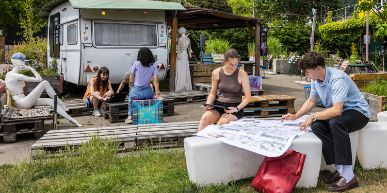
  • You will work on real-world projects in living labs, collaborating with experienced partners and civil society groups to develop practical solutions that will boost the resilience of cities and communities.

International exchange and double degree

The degree programme is part of the PIONEER European University Alliance and draws on a broad network of partner universities. Through joint modules, summer schools and projects, you will collaborate in international, interdisciplinary teams on current challenges facing European cities. In the longer term, you can benefit from double degree options and semester-long exchanges with selected partner institutions, further sharpening your profile for an international career.

Career prospects

As a graduate, you will act as an urban change agent, supporting and shaping transformation processes in collaboration with public institutions, planning offices, consultancy firms and NGOs, thereby contributing to equitable and sustainable urban development.

This master’s programme is designed for individuals seeking meaningful work and wishing to play an active role in the sustainable transformation of cities and communities. Thanks to the project-based nature of the programme and our extensive network of partners in industry and academia, you will start building a professional network from the outset to support your future career.

Ready for leadership and expert roles?

This master’s programme is designed for individuals seeking meaningful work and wishing to play an active role in the sustainable transformation of cities and communities. Thanks to the project-based nature of the programme and our extensive network of partners in industry and academia, you will start building a professional network from the outset to support your future career

The master’s programme opens up a wide range of career paths, including:

  • Project management and consultancy in urban and regional development
  • Positions in public institutions and planning offices
  • Roles at the intersections of climate adaptation, social space, mobility, housing and governance
  • Functions in real estate development, infrastructure firms and companies specialising in urban transformation
  • Positions in NGOs, foundations and international organisations
  • Research and development relating to sustainable planning and urban resilience at universities or research institutes

Duration + content

The programme combines living labs, collaborative project work and hybrid modules with European partner universities.

Full-time or part-time?

The master’s degree can be completed on a full-time basis (4 semesters) or part-time (6–8 semesters). If you are studying part-time, we recommend that you work no more than 50 per cent and study full-time during the first semester.

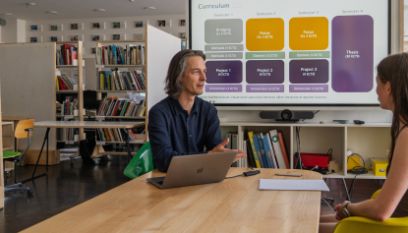
Programme schedule

  • 1st semester: Foundations and practice-oriented project work
  • 2nd & 3rd semesters: Practice-oriented project work with thematic focus modules
  • 4th semester: Thesis project
  • In addition: international summer schools and optional modules

Study modules

The study modules build systematically on one another and combine theoretical foundations, individual specialisations, international perspectives and practice-driven work.

The programme is committed to the United Nations’ Sustainable Development Goal 11: ‘Make cities and human settlements inclusive, safe, resilient and sustainable’.

  • The Basics modules provide the methodological, analytical and conceptual foundations of sustainable, inclusive and resilient urban and spatial development, including key analytical and planning approaches and methods of transdisciplinary collaboration.

The Focus modules are compulsory electives designed to expand your knowledge, explore international best practices and apply insights from various disciplines and contexts to concrete urban issues. The modules are divided into five thematic areas:

  • Climate adaptation
  • Habitat, housing and land use
  • Mobility and infrastructure
  • Social cohesion and changing societies
  • Governance and economies

The Immersion modules are international summer or winter schools held in European cities. They enable participants to deliberately change their perspective and environment. The focus is on comparative learning and critical reflection on international approaches, as well as transferring experience to the Swiss context.

The Project modules form the core of the programme. Working in small groups, students tackle real-world problems using applied case studies. The projects become progressively more complex in terms of the diversity of stakeholders involved and the level of responsibility required.

The master’s thesis is the fourth and most comprehensive project. You will independently address a complex, real-world problem relating to resilient urban and spatial development and propose scientifically grounded solutions that can be applied in practice.

In addition, students may take a further 6 ECTS of courses from the BFH Diagonal programme or, from other BFH master’s programmes, subject to individual agreement.

Tuition language

Courses are taught primarily in English. You are required to have reached a proficiency level of at least B2.

Interdisciplinarity in practice

The Master’s programme Resilient Cities and Communities brings together the expertise of seven BFH schools. It combines perspectives from urban planning, social work, ecology, economics and governance.

Participating schools:

Admission requirements

Having successfully completed your bachelor’s degree, you now want to broaden your specialist knowledge and skills in an interdisciplinary context and deepen your understanding of urban development.

Academic requirements

You are admitted to the programme if you have completed a bachelor’s degree in the following fields:

  • Architecture, civil engineering and planning
  • Social work
  • Business and services
  • Agriculture and forestry
  • Design
  • Music, theatre and other arts
  • Healthcare
  • Engineering and IT
  • Other fields related to urban development (e.g. geography, social sciences)

Admissions based on your academic background and performance (‘sur dossier’) are possible for holders of other bachelor’s degrees who can provide evidence of relevant practical experience.

Application

Secure your place on the programme early.
Any missing documents can be submitted later.

Application dates

  • Application deadline: 31 July 2027
  • Start date: September 2027

Start your degree programme in autumn 2027

Applications to study will be accepted from August 2026.

Application documents

You will need to make PDF or JPG copies of the following documents:

  • ID or passport
  • Passport photo that meets international passport requirements
  • Bachelor’s degree certificate
  • CV in tabular form
  • Proof of at least three months’ practical experience
  • Proof of in-depth study of a subject with a specialist focus on social, spatial, environmental and/or economic aspects of urban development during the previous degree (e.g. seminar project, bachelor’s thesis or specific course modules)
  • Motivation video

The costs for the programme comprise application, tuition and examination fees plus the cost of course materials and excursions.

Costs

At BFH, different fees apply for programmes and examinations.

Application fee (per application)* CHF 100

Tuition fee for domestic students (per semester)

CHF 850

Tuition fee for international students (per semester)

 
  Reasons for residence other than study when starting studies BFH
    Transitional arrangements for students who started their studies at BFH before autumn 2026 (until change of degree programme)
    Stay for study purposes at the start of studies at BFH (payment in instalments available)


CHF 850
CHF 1050
CHF 2'550

Examination fee (per semester) CHF 80
Fee for social, cultural and sport offerings (per semester) CHF 24
Membership fee for the Bern University of Applied Sciences Student Association (VSBFH) (per semester) CHF 15

Subject to change without notice.


* plus CHF 10 processing fee if paying by paying-in slip/paper invoice. A new application fee of CHF 150 will be implemented for registrations for the spring semester 2027.

Advice + information

Do you have any questions about the degree programme? We would be happy to advise you in person.

Advice

Choosing a degree programme is an important decision. We will be happy to arrange a face-to-face chat to answer your questions and advise you on the requirements for your chosen programme.

Head of project

Beratung Studiengänge

Personal advice

Just a few clicks to the Student Advisory Service: Tobias Baitsch is on hand to answer any questions you may have about your studies.

Book an appointment now!