



Content + Structure
Learn how to use the potential of collaborative robots (cobots) to automate manual production processes
Short Advanced Studies (SAS)
Short Advanced Studies (SAS) are courses that take 30 to 160 hours (1 to 9 ECTS – can be credited towards DAS or MAS). Participants acquire in-depth, industry-relevant insights and skills on current topics in a short space of time. Students who do not wish to take SAS competency assessments are awarded a course certificate (no ECTS in that case).
Portrait
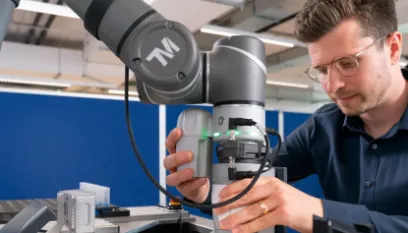
Collaborative robots (or Cobots) have been on the market for over a decade. Designed to integrate easily into the existing work environment, they help support operators in their daily tasks, without requiring major transformation of workstations or processes. Unlike conventional industrial robots, Cobots stand out for their flexibility, ease of use and ability to interact directly with humans in a safe environment.
The field of application for Cobots is vast: logistics, quality control, machine tending, mechanical or electronic assembly, welding, and more. Despite their potential, Cobots are still under-exploited or not used in many companies. An installation with a single Cobot is limited in the tasks it can perform. Effective deployment requires a complete system to be put in place, including sensors, component feeders and appropriate safety equipment. It is therefore essential to be familiar with the various technical possibilities available to design a coherent solution tailored to the task being automated.
As today’s production faces a shortage of qualified personnel, the targeted automation of simple tasks is indispensable. Tasks that require little attention are prone to human error, which can go undetected and result in high repair or compensation costs. Automation reduces the need for new personnel while minimizing human error. Relieving the workforce of simple repetitive processes enables their skills to be employed on more complex tasks.
The aim of this course is to help you identify the tasks that are best suited to collaborative automation within a company, and to provide you with the tools you need to develop concrete solutions. Evaluating the economic profitability of an automation project is an integral part of the training.
You will have the unique opportunity to test your own manufacturing use cases on real Cobotic cells at the Swiss Cobotic Competence Center (S3C). This hands-on experience will enable you to assess the technical feasibility of your use-case in conditions close to industrial reality.
The successful integration of a Cobot cell depends as much on the robustness of the technical solution as on the involvement and commitment of the players concerned. At the end of this course, you will be prepared to present your automation project to your company's various stakeholders, considering technical, economic, organizational, and human aspects.
Career opportunities
On completion of this course, you will be able to:
- analyze manual manufacturing processes and identify those suitable for Cobot integration.
- select the optimal components for a Cobotic cell for a particular use case.
- evaluate the implementation costs of a Cobotic cell and calculate a comprehensive return on investment to support a decision process.
- take an active part in industrial automation and innovation projects.
- support technological change within your company, accounting for technical, economic, organizational, and human aspects.
Education goals
This course enables you to acquire the following knowledge or skills:
- Understanding Cobots’ capabilities and necessary ancillary equipment.
- Analyzing manual manufacturing processes and evaluating whether they are suitable to be performed by a Cobotic system.
- Estimating the investment and profitability of using a Cobotic cell.
- Successfully integrating a Cobot into a production considering technical, economic, organizational, and human aspects.