



- Story
Decent work from canopy to kitchen
23.07.2026 How can food systems create decent work while remaining productive, sustainable and politically feasible? This question shaped the 7th Cecchini Institute Annual Event, held at BFH-HAFL in Zollikofen as part of the 3rd International Symposium on Work in Agriculture.

The Cecchini Annual Event seeks to bring together researchers, practitioners, development organisations, investors and food-system actors to discuss relevant topics. This year`s topic was about the labour behind the food we grow, process, transport, sell, prepare and share.
Held for the first time as a part of the International Symposium on Work in Agriculture, the event also offered a moment to pass on gratitude to the people who produce food, and to ask what decent work means in value chains shaped by insecurity, climate stress, migration, technology and market pressure.
What are we willing to accept?
In her keynote, Prof. Dr Eva-Marie Meemken explored three central trade-offs.
First, improving wages, safety and worker voice is essential, especially for migrant, informal and unregistered workers, but can place new pressure on farmers if standards, enforcement and market conditions do not evolve together.
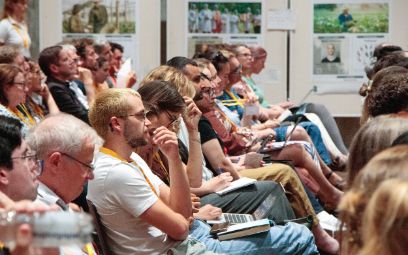
Second, demographic change and political resistance to migration and trade raise a practical question: who will do the work that food systems depend on? Labour-intensive crops such as fruit and vegetables already rely heavily on migrant and seasonal workers.
Third, technology can reduce dangerous or poor-quality work, but may also reshape employment, displace workers and shift opportunities towards those with different skills.
A clear message emerged: decent work requires coherent agricultural, labour and trade policies. It also requires better compliance with existing regulations, legal pathways for labour migration, and greater public awareness of the working conditions behind food.
From Principle to Practice
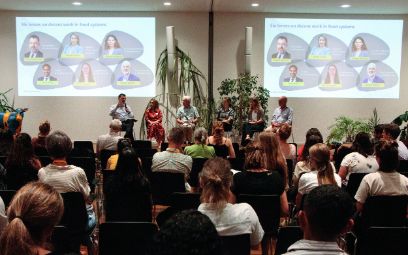
The panel discussion, moderated by Carsten Schulz, bought together perspectives from research, labour, development cooperation, philanthropy and investment. Ingrid Fromm, Nora Langguth, Simon Winter, Roland Decorvet and Arabela Philipona each looked at decent work from a different point in the food system, from worker voice and value chains to finance, land rights and industrialisation.
Nora Langguth brought the ILO perspective, underlining the importance of social dialogue between employers, workers and labour organisations. She also pointed to the reality behind the principle: organising seasonal, informal and migrant workers is difficult, especially when incentives, borders and market pressures do not align.
Ingrid Fromm widened the lens to global value chains, stressing that farmers and workers need real incentives to stay in agriculture, raise productivity and adopt more sustainable practices. Simon Winter focused on investment as a lever to strengthen local food systems and create more value where food is produced.
Arabela Philipona reminded the audience that decent work is also about dignity, identity, land rights and community values. Roland Decorvet added a sharp business perspective, arguing that Africa needs investment, industrialisation and job creation, rather than charity alone. For decent work to last, he stressed, it must also be economically viable.
Again and again, the discussion came back to incentives. Who pays for decent work? How much are consumers willing to pay for food produced under fair conditions? And how can subsidies, price signals, finance and public policy support sustainable production without leaving the bill with those who have the least power?
Four Ways Into the Future of Agricultural Work
The panel questions were taken into four breakout sessions, where participants explored how decent work can be strengthened in practice.
One session, facilitated by Malte Reshöft, asked whether the system can finance the women who help feed it. Through the example of agricultural SMEs such as Golden Pot in Tanzania, participants discussed how access to finance and technical assistance can help women-led businesses reduce post-harvest losses, strengthen local food systems and create decent work.
Boris Orlowsky’s session focused on weather-informed agriculture and the challenge of making technological innovations last beyond time-bound funding. Participants considered what is needed for tools that support decent work, sustainable livelihoods and economic opportunity to be adopted, maintained and scaled.
A third session, facilitated by Isaac Castello, examined occupational safety and health in agriculture. It asked how agricultural labour can be safe and healthy when workers operate in systems shaped by insecurity, climate stress and value-chain pressure.
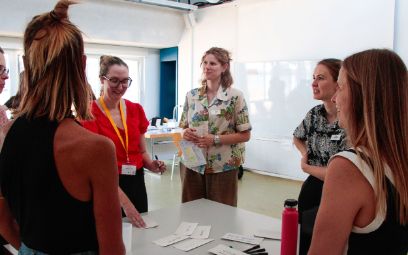
Finally, Moira Senti invited participants to work with stories to explore inclusion in agriculture. The session looked at how the sector can become a profession where immigrant workers feel valued, included and able to build a future.
The Annual Event showed that decent work cannot be treated as a narrow labour issue. It is linked to migration, technology, investment, gender equality, land rights, market power, consumer prices, climate resilience and the future of farming itself.
A third session, facilitated by Isaac Castello, examined occupational safety and health in agriculture. It asked how agricultural labour can be safe and healthy when workers operate in systems shaped by insecurity, climate stress and value-chain pressure.
Finally, Moira Senti invited participants to work with stories to explore inclusion in agriculture. The session looked at how the sector can become a profession where immigrant workers feel valued, included and able to build a future.
The Annual Event showed that decent work cannot be treated as a narrow labour issue. It is linked to migration, technology, investment, gender equality, land rights, market power, consumer prices, climate resilience and the future of farming itself.
Find out more
Category: International