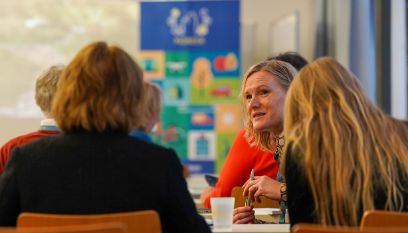
BFH International Staff Week 2025

During International Staff Week 2025, themed "pathways to sustainable cities and communities", BFH will present itself as an active partner and expert institution within the PIONEER Alliance. Join us in Bern!


  • When: 24-27 November 2025 
  • Where: On site at the Bern University of Applied Sciences, Switzerland

What to expect

What lies ahead: a variety of engaging, PIONEER-relevant interactive workshops, networking opportunities, and an inspiring keynote. Participants will have the chance to learn more about BFH as a place for studying, teaching, and research through visits to various BFH sites across the Canton of Bern, including labs and research facilities.

With a strong research focus on SDG 11, Sustainable Cities and Communities, the thematic core of the PIONEER Alliance, BFH actively fosters innovation. As an entrepreneurial university, BFH collaborates closely with the local innovation and entrepreneurship ecosystem, a connection that will be highlighted throughout Staff Week.

The sessions and site visits will be structured around thematic clusters, covering key areas such as: 

  • Smart Cities and the Public Sector: for example, smart technologies to optimize resource use in urban settings.

  • Health Science: for instance, the The Swiss Center for Care@home, an initiative led by BFH and supported by the Canton of Bern. 

  • Built Environment and Food Systems: experience amongst others the Urban Future Lab (living lab) exploring co-creative approaches to sustainable housing and food systems. 

Additionally, an intensive half day workshop will focus on challenge-based education, a core priority of the PIONEER Alliance, featuring a dedicated train-the-trainer workshop. 

Beyond the formal sessions, Staff Week offers an excellent opportunity to connect with peers from partner institutions—all in the beautiful, historic setting of Bern. 

We look forward to welcoming you to Bern for an inspiring exchange with colleagues from BFH, the PIONEER Alliance and beyond! 

Target group

Representatives of PIONEER partner institutions, including teaching staff, researchers and International Office staff, as well as members of the PIONEER project management team and representatives of other partner institutions. 

Programme and registration

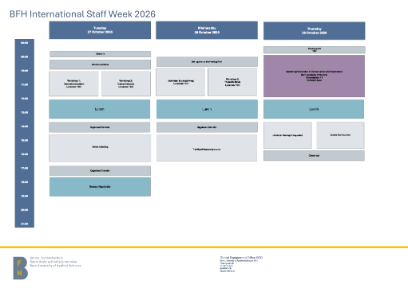
There is a multitude of workshops, sessions and networking opportunities on offer. Here you can find an overview of the programme and details of the individual workshops and site visits, and register to Staff Week.

Registration

The registration to the Staff Week and the payment takes place on the event platform Nunify, which is fully GDPR compliant. Please contact pioneer@bfh.ch should you have concerns in that regard or any problems with your registration.

Project Space

Project Space is a session taking place on Tuesday afternoon of the BFH International Staff Week, where BFH staff present their project ideas and actively seek interested individuals from the PIONEER alliance for potential collaboration.

Please be sure to read the project descriptions carefully and remember to sign up for this time slot as you register for the Staff Week. Partners from outside the PIONEER Alliance can participate in the Project Space as well, provided that their teaching or research focus is closely aligned to the project descriptions.

Project descriptions

BFH Schools

Architecture, Wood and Civil Engineering; Health Professions; Social Work; Agricultural, Forest and Food Sciences; Engineering and Computer Science

Description

Decision-making in today’s complex and risk-laden world cannot rely solely on risk assessments but must also consider the concept of benefit — with quality of life emerging as a key evaluative standard beyond purely economic considerations. Quality of life metrics have been successfully adopted across a wide range of disciplines, though their proliferation has led to increasing fragmentation and specialisation — for instance, medicine alone uses nearly 1,500 such indicators. This disciplinary divide runs counter to the original vision of using quality of life as a holistic, postdisciplinary decision-making tool. Engineers often rely on objective, rational inputs, while medicine frequently incorporates subjective assessments, both of which can crucially shape outcomes. To return to a more integrative approach, a shared understanding among all users of quality of life parameters is essential — requiring familiarity with concepts and limitations from other disciplines, as is being explored in both research and teaching across all departments at the Bern University of Applied Sciences (BFH).

Target groups

Students and researchers

Planned output

The project offers interdisciplinary educational modules and research projects that deepen students’ understanding of quality‑of‑life parameters. Students explore both their own discipline and others—for example, engineering students learn about sociological questionnaires, and vice versa. A circular “Top–Down–Top” structure begins with a holistic overview, drills into specific indicators, and reconnects to the wider concept. Researchers lead learning through theory and hands‑on case studies across health, engineering, social, and environmental fields. Finally, students create integrative assessment proposals, honing both technical expertise and post‑disciplinary communication skills.

Category

☒ Challenge-based Education for Sustainable Cities and Communities
☒ Research and Development into Sustainable Cities and Communities
☐ Transformative Leadership
☐ Mobility and Internationalisation
☒ Entrepreneurial University and Stakeholder Relationships in the Field of Sustainable Cities and Communities

BFH Schools

Business; Academy of the Arts; Sociologie de l’Université de Genève

Description

REUCIT (unige.ch), harnesses music, visual arts, performance and civic action to reclaim public spaces and foster inclusive urban citizenship. A central strand of the research highlights the pivotal role of young female artists and cultural professionals in advancing social justice. The project adopts a co‑creative methodology—engaging youth actors, civil society and policymakers—to produce grounded recommendations for inclusive urban governance and public‑space co‑management. As a Swiss‑Senegalese endeavour, it also opens doors for collaboration with European universities and cultural institutions around participatory urban design, youth empowerment, intercultural dialogue, commons stewardship and the peace‑building potential of the arts

Target groups

Researchers and students, in particular in the fields of culture and art, architecture, responsible management and leadership who are interested in:

  • participatory urban design,
  • youth empowerment,
  • intercultural dialogue,
  • responsible management of the commons, and
  • the role of the arts in fostering peaceful and respectful coexistence in urban settings.

Planned output

This presentation and exchange seek to spark concrete collaboration opportunities—ranging from joint research and development projects to COIL initiatives. The goal is to co-develop innovative project ideas and to identify suitable funding sources for their realization.

Category

☒ Challenge-based Education for Sustainable Cities and Communities
☒ Research and Development into Sustainable Cities and Communities
☐ Transformative Leadership
☐ Mobility and Internationalisation
☐ Entrepreneurial University and Stakeholder Relationships in the Field of Sustainable Cities and Communities

BFH Schools

Business; Health Professions; Social Work; Agricultural, Forest and Food Sciences; Engineering and Computer Science; Offices of the Vice-Presidents Research and Teaching

Description

Each year, a significant number of well‑educated refugees arrive in Europe, many of whom wish to begin or continue their studies. Universities of Applied Sciences, with their strong practical focus and local ties, are ideally placed to support their integration. However, obstacles such as unclear academic records, language barriers, legal and financial uncertainty, psychosocial strain, and insufficient guidance complicate access. While numerous European institutions have developed promising initiatives—from targeted preparation courses to peer mentoring—these efforts often lack structured cross‑institutional exchange. Our PIONEER Staff Week workshop aims to identify and connect partner universities with successful refugee‑student programmes to share best practices and build a robust network.

Target groups

Programme leaders, teaching heads, educators, project managers, mentors, admissions, rectorate staff, researchers

Planned output

  1. Biannual low-barrier information exchange: Discuss challenges and diverse approaches
  2. Shared open-access repository: House information, toolkits, and concept documents
  3. Explore joint activities: Potential for online modules, summer schools, and conferences
  4. Investigate collaborative research: Develop joint research in the field

Category

☒ Challenge‑Based Education for Sustainable Cities and Municipalities
☒ Research and Development on Sustainable Cities and Municipalities
☐ Transformative Leadership
☐ Mobility and Internationalisation
☐ Entrepreneurial University and Stakeholder Relations in the Field of Sustainable Cities and Municipalities

BFH Schools

Architecture, Wood and Civil Engineering; Health Professions; Social Work; Agricultural, Forest and Food Sciences

Description

Europe’s ageing population presents pressing challenges for health, social care and housing policy, especially as demand grows for age‑friendly living spaces and the revitalisation of 1960s–70s tower blocks. In response, "Healthy up High in Switzerland" builds upon the original BFH "Healthy up High – Healthy Ageing in High‑rise" project, which developed practical recommendations for two revitalisation‑needed tower estates in Bern to better support ageing in place. The follow‑up project has expanded and validated those recommendations on a national scale for Swiss housing estates requiring renovation, incorporating nutrition, mobility, social inclusion, climate resilience and biodiversity. These enhanced guidelines provide extensive insight for housing cooperatives, authorities and architects, emphasising both elder health and ecological considerations such as heat protection and greenspace biodiversity. They are currently being used to secure a Swiss practice partner for implementation and evaluation, aiming to advance healthier ageing environments and contribute to more sustainable urban development.

Target groups

Seeking partnerships with PIONEER universities that are interested in implementing and further developing the existing recommendations with practical partners in their country.

Planned output

The existing recommendations—focused on health promotion and integrating social, ecological, and economic sustainability in urban settings—are now at a stage where they can be implemented in collaboration with practical partners. Consequently, implementation projects are planned in Switzerland and potentially in other European countries through participating PIONEER universities.

Category

☐ Challenge-based Education for Sustainable Cities and Communities
☒ Research and Development into Sustainable Cities and Communities
☐ Transformative Leadership
☐ Mobility and Internationalisation
☐ Entrepreneurial University and Stakeholder Relationships in the Field of Sustainable Cities and Communities

BFH Schools

Agricultural, Forest and Food Sciences; Engineering and Computer Science

Description

Cocoa and coffee value chains are vital to the livelihoods of millions of smallholder farmers but often involve unsustainable agronomic practices, low farmgate prices, limited socioeconomic conditions, environmental risks, and carbon-intensive logistics. Meanwhile, cities—the main centers of consumption—face growing pressure to create more sustainable, resilient, and inclusive food systems. Most urban residents remain disconnected from the origins and social/environmental impacts of their coffee or cocoa consumption. There is an urgent need to realign these value chains to support smallholder resilience and climate-smart agriculture, reduce emissions, food waste and inefficiencies in supply chains, and promote ethical consumer behavior and sustainable consumption. Sustainable transformation is essential not only for coffee and cocoa-growing communities but also for ensuring the long-term future of the coffee and chocolate industries. This project aims to develop resilient and inclusive coffee and cocoa value chains by bridging rural producers with urban markets through sustainable, ethical, and climate-resilient practices

Target groups

Researchers with expertise in one of the following subjects:

1. Urban sustainability, circular economy, and innovation

  • Urban-rural linkages in food systems
  • Circular economy models and lifecycle assessments
  • Urban entrepreneurship and innovation ecosystems
  • Food citizenship and citizen engagement

2. Strength in international economics, trade policy, and development finance

  • Trade regulations and EU sustainability directives (e.g., Deforestation-Free Regulation)
  • Inclusive business models and value distribution
  • Economic modeling of value chain interventions

3. Experience in North-South knowledge exchange and capacity building

  • Research-into-practice translation
  • Co-development of training modules for producers, youth, and entrepreneurs
  • Institutional collaboration with partners in coffee/cocoa origin countries

Planned output

Different types of research output such as scientific papers, policy briefs etc.

Category

☐ Challenge-based Education for Sustainable Cities and Communities
☒ Research and Development on Sustainable Cities and Communities
☐ Transformative Leadership
☐ Mobility and Internationalisation
☐ Entrepreneurial University and Stakeholder Relationships in the Field of Sustainable Cities and Communities

BFH Schools

Health Professions; Engineering and Computer Science

Description

This project aims to develop a clinical decision support system (CDSS) focused on pain classification and pre-assessment. Utilising a three-part model encompassing pain type, pathophysiological entity, and phenotype (nociceptive, neuropathic, neuroplastic), the system integrates structured clinical reasoning. The primary objective is to convert patients' subjective pain perceptions into clinically actionable insights via a dedicated mobile application. This app enables patients to document pain details—such as location, intensity, chronicity, frequency, quality, and additional contextual factors—which are then analysed to provide preliminary pain classification. The system not only assists in sorting pain data but also actively supports clinical decision-making by suggesting diagnoses and prioritising therapeutic approaches, thereby enhancing standardisation and communication between patients and healthcare providers.

Target groups

Researchers

Planned output

The project aims to achieve three key outcomes:

  1. Develop a decision algorithm based on a structured clinical model.
  2. Create an integrated mobile prototype application for capturing and analysing patient data.
  3. Conduct testing in a simulated environment to assess feasibility and provide recommendations for evaluating the suitability of such a system in clinical practice for healthcare providers (e.g., primary care facilities, clinics, pain, rehabilitation, and physiotherapy centres).

Category

☐ Challenge-based Education for Sustainable Cities and Communities
☒ Research and Development on Sustainable Cities and Communities
☐ Transformative Leadership
☐ Mobility and Internationalisation
☐ Entrepreneurial University and Stakeholder Relationships in the Field of Sustainable Cities and Communities