

- Story
Circular construction: buildings as material banks
26.08.2026 BFH’s School of Architecture, Wood and Civil Engineering is a key player in the circular economy. It is continually expanding its course offerings and promotes networking among various stakeholders in the construction industry. However, practical implementation has proven to be challenging. The introduction of a digital product passport under the new Construction Products Act is likely to be a significant step in the right direction.
Key points at a glance
-
The circular economy plays a central role in sustainable construction. It addresses every phase of a material’s life cycle, promoting its reuse and recycling.
-
Research projects show the necessity for customised frameworks in order to further advance circular construction and enable its implementation.
-
Equally important is the training of skilled workers, as new job roles will emerge in this field.
The construction and building sector consumes a great deal of resources and generates a significant amount of waste and emissions during the construction, operation and demolition of buildings. In Switzerland, it accounts for half of material consumption, one-third of carbon dioxide emissions and over 80 percent of waste. In the face of mounting resource scarcity and a growing commitment to sustainability, the circular economy is gaining prominence.
However, practical implementation has proven to be challenging. According to Aude Chabrelie, professor for Sustainable Construction at the School of Architecture, Wood and Civil Engineering of Bern University of Applied Sciences BFH, this is because the industry still largely follows a linear economy model: “For circular construction to become a practical reality, the entire value chain in the construction industry must be reconsidered.” In order to determine the necessary adjustments, insights from pilot projects are required.

“For circular construction to become a practical reality, the entire value chain in the construction industry must be reconsidered.”

Circular economy applied to railway sleepers
BFH is conducting research on the circular economy through a number of projects. One of these is the ReUseB91 project, which is funded by Innosuisse and led by Aude Chabrelie. The objective is to establish procedures for inspecting, refurbishing and safely reusing old concrete railway sleepers.
The project will serve as a model. According to Chabrelie, the collaboration between Vigier Rail, the manufacturing entity, and SBB, the primary client, offers ideal conditions for establishing a functional circular economy. If reuse proves successful in this relatively simple system, it could pave the way for similar approaches with other building products and bring about tangible progress towards a circular economy in the construction sector.
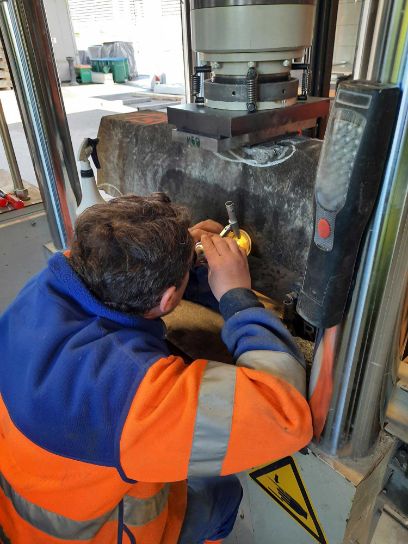
Life cycle assessment plays a key role in this. It is intended to measure the environmental benefits of reuse and demonstrate how circular solutions can contribute to achieving climate goals. The potential is considerable, with the reuse of old railway sleepers expected to result in at least 80% carbon dioxide savings.
“The reuse of concrete railway sleepers offers an opportunity to combine climate protection and resource efficiency with economic benefits. Our objective is to lay the scientific and technical foundations for a practical circular economy solution,” says Aude Chabrelie. However, a number of economic, technical and regulatory issues still need to be addressed, in particular quality assurance, traceability and compliance of reused products: “At present, there is no suitable framework for the implementation of circular economy solutions.”
Mandatory digital product passport
An important step forward is the entry into force of the new EU Construction Products Regulation (CPR 2024) in early 2025, which forms the basis for the ongoing revision of the Swiss Construction Products Act and the Ordinance on Construction Products. The phased introduction of the digital product passport (DPP) for building materials is at the heart of the revision. “Regulations can help improve the traceability of resources and provide information throughout the entire life cycle of construction products,” says Aude Chabrelie. “Reliable information on characteristics, maintenance, repair and disassembly facilitates the reuse of old building materials and components.”
However, networks such as ‘Netzwerk Bern Baut Zirkulär (NBBZ)’ are also important for promoting circular economy solutions. The network was set up and is coordinated by Urs-Thomas Gerber and Stephan Wüthrich. The two BFH professors bring together various stakeholders from the building sector, thereby facilitating
“Regulations can facilitate improved traceability of resources and provide information throughout the entire life cycle of construction products.”
Specialised training and continuing education
“We are seeing the emergence of new skill sets for the reuse of building components and materials. This is an area that requires well-trained professionals,” says Aude Chabrelie. BFH is therefore continuously expanding its course offering, also in continuing education, and integrating the circular economy into both teaching and practice.
Sustainable construction is firmly embedded in the bachelor’s and master’s degree programmes in Architecture, Wood Technology and Civil Engineering. Students explore reuse, renewable materials and various aspects of life cycle assessments. The training includes digital methods such as building information modelling (BIM), which can be used to assess environmental impacts and monitor buildings throughout their entire life cycle.
In 2022, BFH became the first institution in Switzerland to launch the interdisciplinary Master’s degree programme in ‘Circular Innovation and Sustainability’. Since 2025, bachelor’s students can supplement their degree with two minors: ‘Circular and Sustainable Construction’ or ‘Integrated Digital Construction’. Furthermore, the Bachelor in Landscape Architecture and the international master’s degree programme ‘Resilient Cities’, which is offered in collaboration with partner universities from the PIONEER Alliance, strengthen its expertise in sustainable and resource-efficient urban and landscape development. This also includes the circular management of water. In addition, BFH offers CAS programmes in ‘Circular Construction’ and ‘Sustainable Construction’, the latter also being a basic module of the MAS in ‘Sustainable Construction’. Sustainable development is a strategic focus area for the BFH, through which the university is continually expanding its range of courses in the field of sustainability.
The topic of the circular economy has led to a fundamentally shift in the training of students in Wood Technology, Architecture and Civil Engineering, says Aude Chabrelie. In the past, the primary focus was on the planning, structural integrity and construction of new buildings. “Now, the life cycle of buildings and materials is being integrated more comprehensively into the curricula. Students are being taught how to manage the existing building stock and how to reuse, convert or further develop existing structures.”
“In the future, buildings will be regarded as material stocks that must be preserved and transformed.”
Rising demand for life cycle assessments
Furthermore, BFH conducts life cycle assessments and sustainability analyses for businesses. According to Professor Chabrelie, demand in this field has increased significantly over the past five years. The services on offer range from the assessment of building products to the evaluation of entire buildings and property portfolios, including the development of tailor-made tools – for example, to automate life cycle assessments for large volumes of products via a connection to the client’s ERP system. BFH also conducts frequent analyses of the environmental footprint of building structures for reuse, such as modular timber buildings. These analyses highlight the conditions under which reuse brings environmental benefits and provide a valuable decision-making tool in line with the principles of the circular economy.
Life cycle assessments also play a central role in several Innosuisse Flagship projects: SwissRenov, Think Earth and SWIRCULAR. They serve as a decision-making aid by providing a transparent comparison of the environmental impacts of various construction, renovation and reuse strategies. This makes it possible to identify the most effective measures for conserving resources and reducing greenhouse gas emissions.The results will offer a scientific basis for the sustainable transformation of industrial brownfields (SwissRenov), for regenerative construction using wood and clay (Think Earth) and for the development of digital solutions to promote a circular construction industry (SWIRCULAR).


Future prospects
What will a fully circular construction project look like in the future? “Buildings will be regarded as material banks that must be preserved and transformed,” says Aude Chabrelie. Due consideration will be given to the durability of each building material, as well as to the feasibility of dismantling, reusing or recycling it without any loss of quality. The buildings will be documented fully digitally, enabling the identification of all materials used and their potential for a second life. Ultimately, modular construction will become more widespread: “This will allow buildings to be easily adapted, converted or dismantled.”