


- Story
Wood and clay: rethinking traditional building materials
16.04.2026 Building with renewable materials is a key focus area at Bern University of Applied Sciences (BFH). The combination of wood and clay offers tremendous potential. Whereas timber construction is highly developed in Switzerland, clay construction is still in its infancy. Now research, teaching and practice are working hand-in-hand to help it become established.
In brief
- To protect our climate, it is important to reduce the carbon footprint of our building materials.
- A multi-generational house in Altendorf (SZ) demonstrates that wood and clay are extremely well-suited for this purpose.
- The reuse and recycling of building materials also play an important role. A research project funded by Innosuisse is currently investigating the circularity of wood and clay.
The construction industry is responsible for a substantial proportion of carbon emissions in Switzerland. It will take a fundamental shift in thinking to achieve the net-zero target by 2050. BFH is actively committed to sustainable construction and places a major emphasis on the use of renewable materials.
Wood and clay are particularly interesting building materials in this respect. Whilst timber construction is booming, clay construction is still in its infancy, as Stanislas Zimmermann, Head of the Master’s Programme in Architecture at BFH, explains. “A third of the world’s population lives in earthen buildings.” This construction method is widespread; above all in South America, Africa, India and China. In Switzerland, however, it was by and large forgotten with the advent of industrialisation. Yet the advantages of clay are plain to see: it is often found directly at the building site in excavated material and, unlike concrete, steel or brick, does not need to be fired or melted at high temperatures. It also provides sound and fire insulation, stores heat and regulates humidity. Its biggest disadvantage: it has limited load-bearing capacity – which, on the other hand, is the strength of timber. This is precisely why the two materials are such an ideal combination.

“A third of the world’s population lives in earthen buildings. In Switzerland, this building method was by and large forgotten with the advent of industrialisation.”
Ceilings made of robot-tamped clay
A good example of a combination of clay and timber is the multi-generational house in Altendorf (SZ), built by the architectural firm Jomini & Zimmermann, of which Stanislas Zimmermann is a co-owner. The aim was to create a sustainable and affordable house in which multiple generations of the family could live together. The two architects designed a timber-frame building with timber-clay ceilings. The ceilings, manufactured by the Zurich-based startup Rematter, consist of timber frames into which clay was compacted using robots.
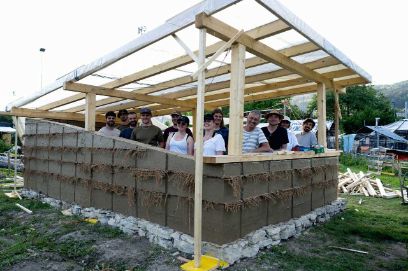
During a Special Week, Stanislas Zimmermann and BFH students treated the exterior façade using the Japanese yakisugi technique. This involves controlled charring of the timber surface to make it weather-resistant. There had already been several Special Weeks on the subject of timber and clay during the course. During the first such week, the students travelled throughout Switzerland to visit existing clay buildings. They then experimented with various methods to construct walls using timber, clay and natural fibres. Among other things, this resulted in a pavilion made of poured earth and coconut fibres on the Gurzelen site in Biel.
Choice of materials a team decision
Renewable building materials play an important role in all degree programmes. In the Bachelor’s and Master’s programmes in Wood Technology, the main focus is already on wood, whilst the Master’s in Architecture places particular emphasis on regenerative architecture and wood. Each semester, students from various disciplines plan a project using natural materials. They have already designed high-rise buildings for Biel and a watch factory for Omega. In most cases, the load-bearing structure was made of timber; clay was chosen for fire and sound insulation, natural fibres for thermal insulation, and natural stone was used for the foundations.
When students from different disciplines such as architecture and civil engineering work together, it becomes clear how important interdisciplinary exchange is for choosing the right building material. “The architect is responsible for the quality of the space, the engineer for the load-bearing structure. But the material must be right for both,” says Stanislas Zimmermann. The students are very interested in building with natural materials. “They know that it makes sense from an ecological and energy perspective and will become increasingly important in the future.”
“Already today, individual cities and cantons require that grey energy be calculated in building applications, and that limit values be adhered to. This will soon become the norm.”
Recycled timber is not necessarily more sustainable
To build sustainably, however, it is not enough just to use renewable materials – reusing them is just as important. This is the focus of Heiko Thömen, Professor of Wood-Based Materials Technology at BFH and a project partner in ‘Think Earth’, a research project funded by Innosuisse. He leads one of ten sub-projects investigating the reuse and recycling of waste timber.
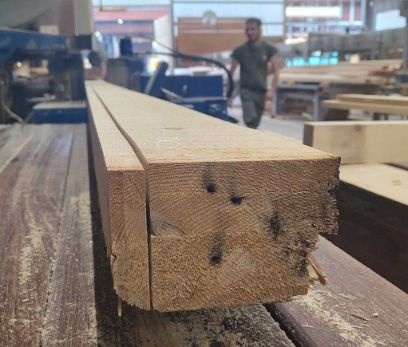
Currently, almost all waste timber that is not used for thermal energy is processed into chipboard. The aim of the sub-project is to lay the foundations for higher-value utilisation of waste timber. However: “Waste wood is not necessarily more ecologically friendly,” says the scientist. Especially when it comes to transport. Whilst fresh timber is normally transported once from the forest to the sawmill and from there to the construction site, waste timber is often transported in small quantities only and may therefore have a larger ecological footprint. “It is important not to make decisions based on gut feeling, but on concrete figures,” Heiko Thömen stresses.
“It is important not to choose a building material based on gut feeling, but on concrete figures.”
Taking the entire life cycle into account
Life-cycle assessment is an important component of both teaching and the service portfolio at BFH. Students learn to calculate a product’s environmental impact from raw material extraction to transport, production and use, all the way through to disposal. This enables them to make decisions based on facts. Researchers advise on and carry out projects in the fields of circular economy, life-cycle assessments and sustainability analyses. The experts at BFH consider the environmental impacts across the entire life cycle, from resource extraction to recycling or disposal.
Heiko Thömen and Stanislas Zimmermann agree that much has changed in this regard in recent years. “When we were students, nobody was interested in how much grey energy was contained in a concrete slab,” says Stanislas Zimmermann. Nowadays, the entire life cycle of a building material is taken into account: where and how was it produced, how long-lasting is it, and can it be reused? “Already today, some cities and cantons require that grey energy be calculated in building applications and that limit values be adhered to,” he says, and is convinced that this will become the norm.