



- Research Project
Inequality, poverty and the welfare state
Together with its partners, BFH is setting the course for addressing issues of inequality and poverty and assessing the effectiveness of welfare state instruments in Switzerland.
Factsheet
- Institute(s) Institute for Social Security and Social Policy
- Strategic thematic field Thematic field "Caring Society"
- Funding organisation Schweizerischer Nationalfonds
- Duration (planned) 01.04.2019 - 31.12.2026
- Head of project Prof. Dr. Oliver Hümbelin
-
Project staff
Prof. Dr. Robert Fluder
Dr. Maurizio Strazzeri
Olivier Tim Lehmann
Rulla Sutter
Tanja Schindler -
Partner
University of Bern Institute of Sociology, Prof. Dr. Ben Jann and Dr. Rudolf Farys
Caritas Switzerland, Marianne Hochuli, Aline Mase - Keywords Inequality, poverty, welfare state, administrative data
Situation
Globalisation, digitalisation and crises such as the COVID-19 pandemic are changing the opportunities for participation in economic life, and with them the risks of poverty. In line with the 2030 Agenda, Switzerland has also set itself the goal of combating poverty. Furthermore, the welfare state aims to cushion the impact of social risks and ensure the conditions for an inclusive society. BFH is examining phenomena relevant to poverty reduction in several research projects. Its aim is to establish a solid foundation of facts on inequality, poverty and the workings of the welfare state in Switzerland. This will provide a basis for authorities to monitor the population’s financial situation and craft policies to combat poverty.
Objectives
We aim to answer the following questions:
- What mechanisms lead to unequal economic opportunities? What role do institutional frameworks play in this, and to what extent can the principles of equal opportunities be upheld?
- How widespread is poverty?
- What are the risk factors for poverty? How are these changing in response to social upheaval?
- How effective is the welfare state in reducing inequality and poverty?
- How can the evidence base for strengthening democratically made decisions be improved?
Approach
Our ongoing research projects rely on linking cantonal tax data with other administrative and survey data. We use this data to design meaningful indicators, creating a new basis for the study of economic inequality and poverty in Switzerland. This foundation overcomes the shortcomings of previous approaches and opens up new opportunities for a deeper understanding of the living conditions of vulnerable population groups and the functioning of the welfare state.


Poverty monitoring – the tool to fight poverty
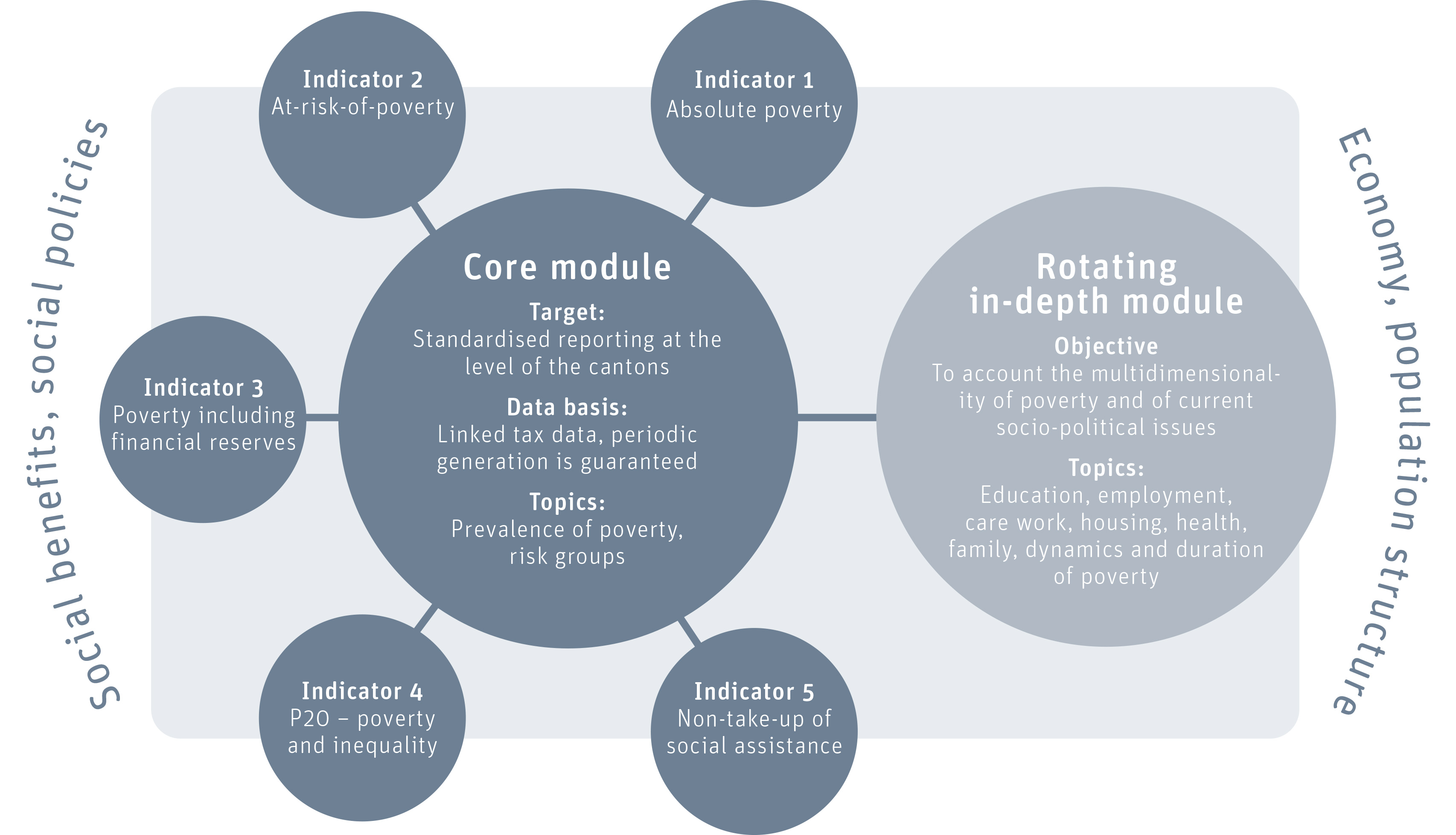
Statistics show that around 743,000 people are living in poverty in Switzerland, their income keeping them below the subsistence level. In order for these individuals and families to receive the support they need, systematic monitoring of the national poverty situation is crucial. The cantons play a decisive role in determining welfare policy, which is why the tools used to fight poverty vary across the country. Though some cantons produce social or poverty reports, the reporting is often sporadic and based on non-standardised indicators. Other cantons focus on the level of social benefits received and neglect that poverty should be defined more broadly. In certain cantons, the poverty situation is completely unknown. As a result, cantonal data is virtually incomparable. This fragmented field presents real challenges to authorities attempting to craft targeted poverty policies.
Poverty monitoring capabilities have improved significantly thanks to technological advances in data processing. Administrative data can now be used for poverty research. Tax data provides an important basis, which is then linked with further administrative data on housing and need-based welfare benefits. This linked data paints a detailed picture of the financial situation of the Swiss population. The administrative data – continuously generated as part of various government functions – is simple to use for the purpose of poverty monitoring. However, it is necessary to determine which methods and concepts are employed to calculate relevant indicators. To that end, BFH and Caritas Switzerland offer a helpful model. Informed by the latest in national and international research, they have developed basic principles that allow cantons to easily establish systematic poverty monitoring in order to gain important insights into the situation on the ground.
Poverty policy must keep its finger on the pulse of societal developments. A significant improvement to the patchy poverty monitoring in Switzerland could be achieved if cantons used existing databases in a uniform way. Thanks to the BFH and Caritas model, it is finally possible to establish a nationwide poverty monitoring system that takes Switzerland’s federal structure into account.
Articles and reports
Inequality and poverty in Switzerland

Attention to issues of social inequality has increased considerably in recent years. Some see such political events as BREXIT, the 2016 US presidential election and the strengthening of the right-wing populist German party AfD as the consequence of growing economic inequalities and the lack of functioning democratic means to counter them. French economist Thomas Piketty’s bestseller, Capital in the Twenty-First Century, has also increased awareness of inequality. Based on a historical analysis of fiscal data, Piketty argues that capitalism has a tendency to increase inequality. His historical research is also supported by recent developments: In recent decades, there has been a rise in wealth inequality, which is particularly prevalent in Switzerland. This is evident, among other things, in the concentration of wealth and real estate, as well as in changes to the tax system that reinforce existing structures, such as the gradual abolition of inheritance tax for direct descendants.
The BFH research project – conducted in cooperation with the University of Bern – demonstrates the prevalence of income and wealth inequality in Switzerland. It also explores the question of whether technological change necessarily increases inequality.
The project shows that social science research can contribute to an understanding of these current societal developments by revealing the extent to which inequalities exist, how they change and which factors play a role in the change. New results are posted regularly on the project website.
Articles and reports
Non-use of social benefits and the limits of the welfare state
Those who fall below the subsistence level in the modern welfare state may receive social assistance to protect them from poverty. However, this right is not always exercised. For a long time, there were only estimates of the proportion of people who do not claim social assistance and other benefits from the Swiss welfare state.
BFH has developed a model that provides that information. It can be used to estimate entitlement for all Bern households by placing basic needs for subsistence, health care and housing costs alongside tax data on income and assets. The number of eligible persons determined in this way can then be compared with the social assistance statistics of the federal government.
Conclusions: A quarter of those entitled do not apply for social assistance in the canton of Bern. Significant regional differences became apparent. BFH used these differences to explore whether social norms influence the use of welfare benefits. The researchers inferred social norms from the level of urban development, language region and municipal voter shares of left- and right-wing parties. Using multiple regression analyses extended with robustness checks, BFH was able to demonstrate that social norms have an influence on individuals’ tendency to apply for social assistance.