Valorization of Swiss Food-Grade Hemp Hurd for Hempcrete Applications
The project evaluates Swiss food-grain hemp hurd for hempcrete (HLB), assessing retting, decortication and brick formulation to enable consistent, low-impact Swiss production and establish a local hemp hurd supply chain.
Factsheet
- Schools involved School of Architecture, Wood and Civil Engineering
- Institute(s) Institute for Building Materials and Biobased Products IBBM
- Research unit(s) Materials and Life Cycle Assessment group FGWO
- Strategic thematic field Thematic field "Sustainable Development"
- Funding organisation Innosuisse
- Duration (planned) 01.10.2026 - 30.04.2027
- Head of project Dr. Ali Shalbafan
- Project staff Yara Steiger
-
Partner
Flowhemp
Vindica - Keywords Hempcrete, Hemp hurd, local resources, food grade, novel retting
Situation
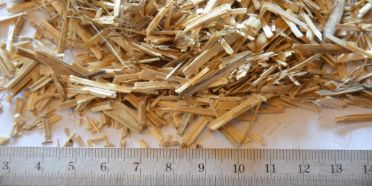
Reducing embodied energy and greenhouse gas emissions in buildings requires alternatives to conventional, carbon intensive materials. Hemp–lime bricks (HLB), also known as hempcrete, offer low density, thermal insulation and moisture buffering, but their broader adoption in Switzerland is limited by the absence of a consistent, locally produced supply of construction grade hemp hurd. Swiss food grain hemp produces 7–8 t/ha of hurd, yet most of this biomass remains underutilized. Previous BFH studies have shown that hurd from grain-food hemp has strong potential for hempcrete production. However, the processing quality of the hurd, including particle size distribution, fiber and dust content, cleanliness and water absorption, critically influences compaction behavior, binder demand, interfacial bonding and ultimately the density, strength and hygrothermal performance of hemp–lime bricks.
Course of action
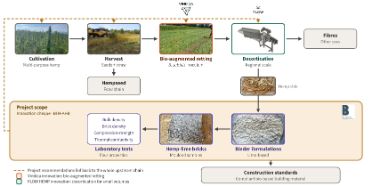
The project integrates feedstock processing with material development to establish a new Swiss supply chain for construction grade hemp hurd. BFH, FlowHemp and VINDICA will collaborate to process food grain hemp using a novel decortication technique and to evaluate how field retting guided by bioaugmentation (including bacterial inoculation) and mechanical decortication affect hurd yield and quality. The resulting hurd fractions will be characterized and incorporated into hemp–lime brick formulations. By systematically varying hurd properties, hemp varieties and hurd to binder ratios, the project will link agricultural processing parameters directly to brick performance. This approach aims to define a technically viable hemp–lime brick formulation and the process parameters required for a locally produced Swiss hemp construction material, thereby establishing an integrated value chain from cultivation to final product - something not yet available at industrial scale in Switzerland.
Result
The project is expected to deliver a technically validated hemp–lime brick formulation derived from systematically characterized hemp hurd feedstock. Quantified hurd properties, such as particle size distribution, water absorption and fiber content, will be linked to brick performance by varying hemp variety, hurd to binder ratio, particle characteristics and key processing parameters. The produced bricks will undergo standardized testing for density (EN 1602), compressive strength (EN 459 2) and thermal conductivity (EN 12667) to establish the performance envelope of mixtures based on Swiss food grain hemp. A central outcome will be the identification of a robust formulation and corresponding process parameters that enable reproducible manufacturing of hemp–lime bricks using locally sourced hurd. This will demonstrate the technical feasibility of upgrading Swiss grain hemp from a secondary crop to a functional construction material.
Looking ahead
Beyond the material itself, the project aims to establish a locally sourced value chain for Swiss hemp construction materials: grain hemp cultivation → retting → decortication → hurd preparation → mixture formulation → hemp–lime brick production. Such an integrated pathway does not yet exist at industrial scale in Switzerland. Future work will focus on optimizing hurd preparation and brick formulation specifically for retted, non standardized feedstock, addressing a critical development gap. Establishing this pathway will support the long term goal of positioning Swiss grain hemp as a major domestic crop and enabling the emergence of a regional, sustainable hemp based building material industry.