


- News
Construction of hotel cabins using an eco-design method
19.08.2025 As part of an interdisciplinary research project, Bern University of Applied Sciences developed an innovative concept for sustainable hotel cabins together with Heima. The aim was to create accommodation that can be flexibly adapted to different climate zones while leaving a minimal ecological footprint. The basis for this was an eco-design that takes a holistic approach to planning, construction and operation.
Key points at a glance
- Together with business partner Heima, the researchers developed modular hotel cabins for different climate zones.
- An eco-design approach ensures reduced emissions and scarce resource consumption.
- A prototype is planned in the Mediterranean rim.
Tiny houses have become very popular
Living in a compact space without harming the environment is an appealing concept for an increasing number of people. The idea of the tiny house can also be applied to hotel cabins for tourists. The aim of the project was to develop these cabins into a high-quality and sustainable product. A key consideration in their design was the ease with which they can be erected and dismantled, ensuring minimal environmental impact. The cabins were also to be designed according to the principles of eco-design: Each component is designed with longevity in mind, along with a clearly defined strategy for recycling or disposal. Furthermore, thorough planning was undertaken to ensure the feasibility of the cabins in any location in the world, regardless of the climate. Due to the very distinct climatic conditions and varying materials availability, thorough investigations were necessary in order to develop a concept that could withstand the various conditions.
Research project: Development of sustainable hotel cabins
The project developed an innovative concept for sustainable hotel cabins together with Heima. The aim was to create accommodation that can be flexibly adapted to different climate zones while leaving a minimal ecological footprint. The basis for this was an eco-design that takes a holistic approach to planning, construction and operation.
Development of sustainable hotel cabins for different climate zones
Efficient construction, and flexible design
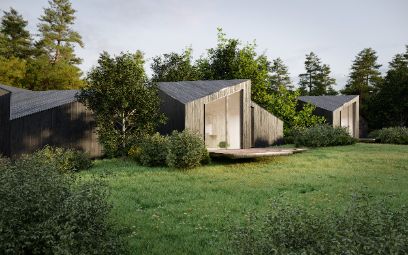
The technical development includes a construction principle for efficient assembly and dismantling, wall, floor and roof structures for different climate zones and a transport-optimised modular design. All components fit into two shipping containers. The construction is based on European certified materials (e.g. FSC, PEFC) and was systematically balanced using life cycle analyses (LCA). The concept is further supported by potential power supply scenarios, including scenarios in which the power is entirely grid-sourced, partially grid-sourced with support from a photovoltaic system or fully self-sufficient with photovoltaics and battery storage systems.
The measurable impact of eco-design
As demonstrated by the LCA, greenhouse gas emissions were reduced by nearly 15 % compared to the base model thanks to the eco-design concept. Operating energy usage remains the primary driver of emissions. However, the integration of photovoltaic systems has the potential to reduce CO₂ emissions by up to 50 %. A specially developed CO₂ calculator for resorts enables a comprehensive assessment of the ecological footprint, including electricity consumption, nutrition and mobility of guests. The tool supports strategic decisions and underlines Heima’s positioning in the field of regenerative tourism.
Prototype in planning
The design of the cabins reflects modern timber construction. Nevertheless, it goes beyond by optimising the materials in terms of cost, availability and sustainability criteria. The construction of a first prototype is planned in Italy. It will be adapted to the climatic conditions of the Mediterranean rim.