

TECCO FLEXNAIL - Slope Stabilisation
The TECCO FLEXNAIL was developed as an alternative to rigid anchors for use in a flexible slope stabilization system. It requires less material and offers advantages in terms of installation, load-bearing capacity, and sustainability.
Factsheet
- Schools involved School of Architecture, Wood and Civil Engineering
- Institute(s) Institute for Infrastructure and Environment IIU
- Research unit(s) Geotechnics and Special Civil Engineering group FGGS
- Strategic thematic field Thematic field "Sustainable Development"
- Funding organisation Innosuisse
- Duration (planned) 01.08.2023 - 31.12.2026
- Head of project Prof. Roman Gallus
-
Project staff
Prof. Roman Gallus
Dr. Katharina Schwarz-Platzer
Christoph Hert
Gabriel Bächler
Theres Imhof-Klimm - Keywords Natural hazards, protective nets, large-scale field trial, slope stability
Situation
Unstable slopes pose a risk to people, settlements, and transport infrastructure. Factors such as steep slope angles, water, vegetation, or increasingly extreme weather events can trigger slope movements and landslides (1). To mitigate these hazards, geotechnical stabilization measures are employed. While conventional solutions such as shotcrete walls are often material- and energy-intensive and may affect the landscape, flexible stabilization systems using soil nails and steel wire meshes have become established in recent years as an efficient and more environmentally sustainable alternative. As protective systems must perform reliably when needed, their assessment under realistic conditions is of considerable societal importance. Laboratory tests on individual components of the flexible stabilization system allow a detailed evaluation of load-bearing capacity. In addition, large-scale tests make it possible to investigate the behavior of meshes and nails prior to a failure event and to identify weaknesses in the overall system already during product development.
Course of action
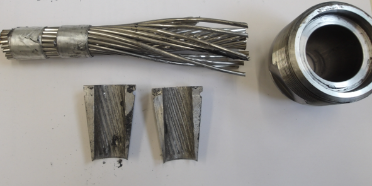
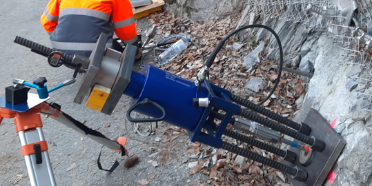
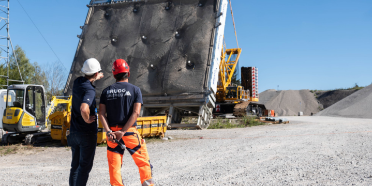
Initially, various prototypes of the tendon and nail head were tested in the laboratory to assess their internal load-bearing capacity. Additional laboratory tests investigated the bond between the tendon and different grout materials. Furthermore, the bond behaviour of the complete nail with the surrounding ground was evaluated in situ through pull-out tests. These tests confirmed sufficient external resistance and demonstrated quality assurance procedures for construction sites. In a large-scale field test, the interaction between the newly developed TECCO FLEXNAIL, the flexible mesh and the ground, as well as the behaviour of the overall system, were investigated. The artificial slope was constructed within a 12 × 10 m tiltable steel frame. By gradually increasing the inclination in 5° increments, different slope angles could be simulated. The slope surface was secured with a steel wire mesh connected to the TECCO FLEXNAIL via special bearing plates. Deformations of the mesh and nail heads were measured using a laser scanner, while nail forces were continuously monitored with load cells. Several tests with different soil conditions and nail patterns were carried out to investigate the influence of varying boundary conditions. The installation of the TECCO FLEXNAIL was assessed in three pilot projects. The experience gained and feedback from the construction firms was directly incorporated into the further optimisation of the product.
Result
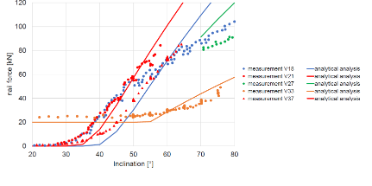
The large-scale field tests made it possible to realistically simulate slope instability under controlled conditions and to systematically investigate the interaction between TECCO FLEXNAIL, the steel wire mesh and the soil. The measurements provided valuable insights into the load bearing and deformation behaviour of the slope stabilisation system. The highest nail forces occurred in the area of the potential failure surface. Even under steep slope inclinations and high loads, the nails remained fully load bearing. No nail failure was observed in any of the large-scale tests, even at nearly vertical slope inclinations. The results demonstrate that the combination of flexible nails and steel wire mesh is an effective method for stabilizing landslide-prone slopes. Based on the mechanical behaviour of the new TECCO FLEXNAIL investigated in laboratory tests, a new design approach for the slope stabilization system was developed. This approach accounts for the high flexibility of the nail and a load-bearing behaviour dominated by axial tensile forces. Measurements from the large-scale field tests confirmed a high level of agreement between the calculated and the actual nail forces. In addition to providing high safety and serviceability under extreme conditions, the newly developed soil nailing system offers advantages over conventional solutions in terms of weight, handling, material consumption and, consequently, CO₂ emissions.
Looking ahead
To assess the applicability of the developed design approach beyond the conducted large-scale tests, additional investigations were carried out using numerical finite element analyses. The focus was on potential shallow slope instabilities in unconsolidated soils. The simulation results showed good agreement with the analytical design approach, both in terms of the maximum nail forces and the location of the assumed failure surface. The analytical design approach could thus be verified not only through large-scale field tests but also through numerical analyses. The results of the research project provide a solid basis for the future application of the TECCO FLEXNAIL and the associated design method in the planning and construction of slope stabilization systems. The TECCO FLEXNAIL was launched on the market in September 2026. The industry partner, Geobrugg AG, looks forward to supporting the planning and implementation of the first projects using the new soil nailing system. In addition, the industry and research partners are sharing the development of the product and the design approach with the professional community through various publications and conferences. The industry partner also plans to file patents for selected components of the soil nailing system.