


- Research Project
The global hospital Reproducing healthcare through entanglements of labour, mobility and knowledge in Switzerland and Austria
The local hospital as a global workplace: We examine how employees from different countries, with their diverse experiences, practices, and forms of knowledge, shape hospital care.
Factsheet
- Schools involved School of Health Professions
- Institute(s) Nursing
- Duration (planned) 01.01.2026 - 31.12.2029
-
Head of project
Dr. Julia Rehsmann
Prof. Dr. Janina Kehr
Prof. Dr. Jelena Tosic -
Project staff
Tannys Helfer
Ursina Huber
Mara Köhler
Bernadette Richvalsky
Anita Prša -
Partner
Department for Migration Studies, University of St.Gallen
Department of Social and Cultural Anthropology, Health Matters Research Group, University of Vienna - Keywords Hospital, Mobility, Migration, Labour, Knowledge, Expertise, Ethnography, Collaborative research
Research Context
Medical care systems in Switzerland and Austria are facing major challenges due to staff shortages, which can often only be managed thanks to the work of employees from all over the world. With the concept of the “Global Hospital,” our research project foregrounds hospitals as nodes within global care chains: as social spaces in which care and service practices, as well as bodies of knowledge from different socio-cultural contexts, intersect through the diverse migration/mobility biographies of hospital workers.
While research has predominantly focused on medical professionals and patients, it is above all nursing staff, nursing assistants, as well as maintenance staff such as kitchen and cleaning personnel who make clinical care possible in the first place. They not only mediate between doctors and patients but also create the very foundations of a functioning healthcare system. This is where our project intervenes: through ethnographic research, we examine the everyday work practices, migration trajectories, and forms of knowledge of these often-overlooked professional groups in Switzerland and Austria. By studying care and maintenance staff together, we deliberately transcend traditional occupational boundaries in research.
The project is funded by the Swiss National Science Foundation (SNSF) and the Austrian Science Fund (FWF).

Aims
Our aim is to make visible how labour, migration, and knowledge are globally entangled in Swiss and Austrian hospitals—from the perspective of the workers themselves. We are also interested in the effects of this labour migration on countries of origin, particularly in the post-Yugoslav region and in Colombia.
Our central questions include:
- Which educational and mobility pathways lead into hospital work?
- Who performs which tasks?
- How is knowledge transmitted and exchanged?
- And how do these dynamics shape everyday hospital life?
The research findings will be published in academic outlets as well as presented in a publicly accessible digital exhibition—addressed both to hospital staff and to a wider audience.
Approach
Our research approach focuses on three key aspects of entanglements: (1) the collaboration, division, and negotiation of labour between medical and non-medical hospital workers; (2) different forms of mobilities and migration shaping hospital work and care practices; and (3) the diverse forms of knowledge that circulate with people into, within, and beyond the hospital.
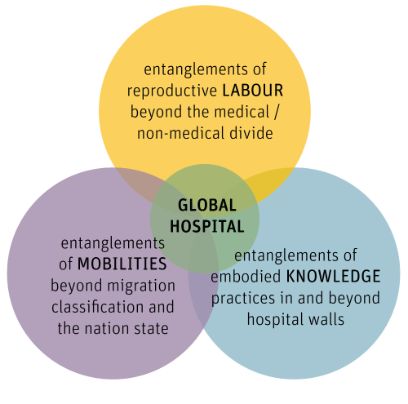
The project comprises four sub-projects in Switzerland and Austria—two neighbouring countries facing similar challenges but pursuing different strategies in personnel recruitment. At the Bern University of Applied Sciences (BFH), PI Dr. Julia Rehsmann leads two of these sub-projects: Sub-project A “Entangled Care” and Sub-project D “Exhibiting Entanglements.”
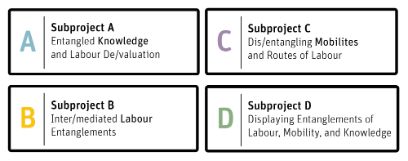
Subproject A: Entangled care
How do nursing professionals, assistant staff, housekeeping, and hospitality services collaborate in everyday hospital work?
Led by PI Julia Rehsmann, doctoral researcher Ursina Huber uses ethnographic methods to study everyday work practices in a Swiss hospital and conducts interviews with staff from different professional areas. The focus lies on how these diverse activities interlock and collectively enable daily healthcare provision.
Subproject B: Inter/mediated entanglements
How do outsourcing and international recruitment reshape collaboration between care and maintenance staff in everyday hospital work?
In Austria, doctoral researcher Mara Köhler examines how outsourcing and international recruitment are reshaping hospital work. Over a twelve-month period, she accompanies care and maintenance workers in Viennese hospitals, investigating how they collaborate despite increasing division of labour and external mediation. This sub-project is led by Co-PI Prof. Dr. Janina Kehr (University of Vienna).
Subproject C: Dis/entangling routes of labour
Which pathways lead hospital workers from abroad to Switzerland and Austria? How do recruitment processes operate, both through for-profit agencies and informal networks?
Postdoctoral researcher Anita Prša traces these transnational routes—from hospitals back to countries of origin. She examines both established diasporic networks in the post-Yugoslav region and emerging recruitment pathways from Colombia. Of particular interest to her is how the experiences of hospital staff shape the various transnational social and hospital contexts. This sub-project is led by Co-PI Prof. Dr. Jelena Tošić (University of St. Gallen).
Subproject D: Exhibiting entanglements
How can the often invisibilised labour of this diverse workforce be made visible?
Led by PI Dr. Julia Rehsmann, design researchers at BFH collaborate with hospital staff during the final two years of the project to develop a hybrid exhibition—both online and on site. Through participatory design research, the exhibition offers a perspective on the global hospital from those who keep it running on a daily basis.
Team
- Ursina Huber, MA, Doctoral researcher
- Tannys Helfer, MSc, Project coordination
- Dr. Julia Rehsmann, PI
- Prof. Dr. Jelena Tosic, Co-PI
- Anita Prša, PhD, Postdoctoral researcher
- Bernadette Richvalsky, Administration
- Prof. Dr. Janina Kehr, Co-PI
- Mara Köhler, MA, Doctoral researcher
Scientific Advisory Board
- César Abadía-Barrero, Associate Professor, Department of Anthropology, University of Connecticut
- Fanny Chabrol, Research Fellow, Institute for Sustainable Development and Research, Center for Population & Development, Paris
- Tomás Sánchez Criado, Ramón y Cajal Senior Research Fellow, CareNet Research Group, Open University of Catalonia
- Janine Dahinden, Professor, Maison d'analyse des processus sociaux (MAPS), Université de Neuchâtel
- Anna Elsner, Associate Professor, University of St.Gallen
- Mariña Fernández Reino, Ramon y Cajal Research Fellow, Spanish National Research Council
- Rita Kesselring, Assoziierte Professorin, University of St. Gallen
- Patrícia Alves de Matos, Invited Assistant Professor, NOVA University of Lisbon
- Marta Stojić Mitrović, Senior Research Associate, Institute of Ethnography, Serbian Academy of Sciences
- Sabine Strasser, Professor, Institute of Social Anthropology, University of Bern
- Cecilia Vindrola, Professorial Research Fellow, Department of Targeted Intervention, University College London
Further informations

Project partnerships