


- Research Project
Smartphone Indoor Localization
Unauthorized mobile phones pose a major security risk in prisons. The developed system monitors buildings around the clock and enables active mobile phones to be located precisely.
Factsheet
- Schools involved School of Engineering and Computer Science
- Institute(s) Institut für Optimierung und Datenanalyse IODA
- Duration (planned) 01.08.2024 - 31.07.2027
- Head of project Tobias Zaugg
- Project staff Prof. Dr. Rolf Vetter
-
Partner
Kontron
Eternia AG - Keywords Indoor Localisation, Mobile Communications, Signal Processing, Security
Baseline
The unauthorized use of mobile phones in prisons has repeatedly made headlines in recent years and poses a serious security risk. So far, there is no fully satisfactory solution to prevent this. With today’s communication technology, inmates can contact the outside world without being detected. This may support the planning of escapes, the destruction of evidence, or even the coordination of further criminal activities.
Regular cell and inmate searches by prison staff are time-consuming and do not reliably uncover all hidden mobile phones. Technical systems for locating active mobile phones are available, but they often rely on costly specialized hardware. As a result, existing systems have typically been implemented with as few antennas as possible. This limits their use, especially in densely populated areas.
Because mobile phone signals cannot be sharply confined to a defined surveillance area, signals from the immediate surroundings of a prison are also detected, for example from passers-by, residents, or neighboring buildings. This technical and economic limitation is the starting point for the current development: the project focuses on a proprietary software-defined radio platform that reduces system costs, provides additional receiver channels, and enables new signal processing approaches.
More information
Goals
The goal of the project is to develop an economically viable system for the automatic localization of mobile phones in security-critical buildings. The system is based on a custom-developed hardware platform tailored to the specific requirements of building-based mobile phone localization. It is designed to support common mobile communication standards such as 4G and 5G and to be easily extended to future standards such as 6G. Indoor localization is performed using fingerprinting: received signal characteristics are compared with building-specific reference data to determine the position of active mobile phones within the monitored area. In addition, the system is intended to better distinguish external cellular signals from relevant signals inside the building. This creates the basis for reliable deployment even in densely populated areas.
Course of Action
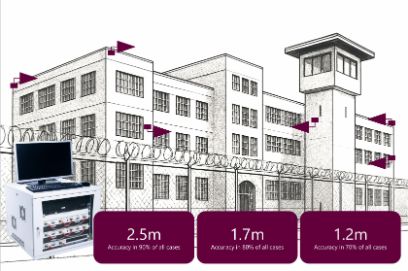
The localization system is designed as a distributed sensor system. Several permanently installed antennas on the building facade continuously detect electromagnetic signals from active mobile phones. The antennas are placed in inaccessible locations, protecting them from vandalism and tampering. The receiving hardware provides significantly more parallel receiver channels than previously used standard solutions. As a result, more antennas can be operated simultaneously, and spatial signal information can be evaluated more precisely. The additional receiver channels enable the use of active antenna systems with modern signal processing techniques such as beamforming and direction finding. Signals from the surrounding environment can be captured selectively and used as an external reference. This makes it easier to distinguish relevant signals inside the monitored building from external cellular signals. The indoor localization itself is performed on a local server using fingerprinting, where received signal characteristics are compared with building-specific reference data.
Results
Two localization systems have already been installed at the prison of Thorberg in the canton of Bern. Together, they monitor two building complexes with well over 100 cells around the clock. The existing system can detect and locate active mobile phones across all common cellular standards and frequency bands. In 90 percent of cases, the deviation from the phone’s actual position is 2.5 meters or less.
Building on this validated foundation, the system is now being further developed. The prototype of the new software-defined radio platform uses state-of-the-art broadband signal reception and high-speed data processing technologies. Compared with previously used standard solutions, the new hardware provides approximately three times more parallel receiver channels, higher performance, and lower hardware costs. This enables the localization system to scale much more effectively, both technologically and economically. The new hardware platform reduces investment and operating costs for potential customers while also expanding the system’s potential areas of application.