


Range of services
At the SCC, we develop sustainable and cost-effective Care@home models with our lead partners. We clarify role profiles and the need for training and continuing education. We also run the numbers for specific financing models and promote an optimal flow of information across IT system boundaries. We use new technologies in ways that make sense and offer educational and informational services for patients and their relatives.
Would you like to stay informed about news and projects, or participate in the development of Care@home models? Get in touch with us!
Definition of Care@home
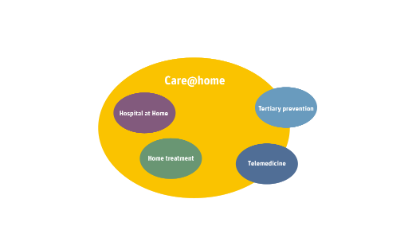
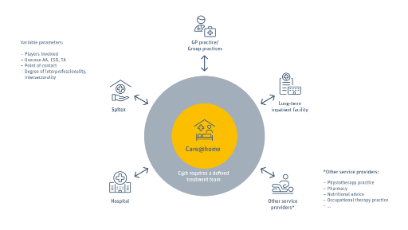
Care@home models are integrated, interprofessional, frequently intersectoral and hospital-equivalent healthcare models that enable patients of all ages to receive high-quality acute medical, nursing, therapeutic and social care at home.
Care@home includes hospital-at-home activities, in which hospital-equivalent somatic care and psychiatric care are provided, as well as situations involving tertiary prevention where there is a high risk of deterioration. Care@home also offers healthcare models that utilise telemedicine.
The goal of Care@home models is either to avoid a hospital stay (admission avoidance), to shorten the length of the stay in a hospital (early transfer) or to ensure timely care in peripheral regions (timely access).
Community
The SCC offers interested institutions from the healthcare sector a dynamic network including representatives from clinical practice, academia, research, industry and politics, in which they can play an active role. This network is crucial for the development and sustainable implementation of Care@home models. We therefore gladly welcome additional lead partners who wish to actively participate in the network. Healthcare professionals from all care settings are also invited to help shape the Care@home models by participating in project submissions with their institutions.
Work packages
The work packages of the SCC develop the foundations for the sustainable development of Care@home models in Switzerland.
You can find the work package report on patients and relatives in Care@home settings here. More reports will follow.
Profession development
- In order to implement Care@home models effectively, efficiently and appropriately, it is essential to clarify the required role profiles, organise the collaboration across various settings and determine the needs for training and continuing education.
- The objectives are to analyse the current and target situations from the perspective of stakeholders in Switzerland, to identify problems and develop appropriate solutions, and to clarify and describe the need for intervention and the available options in consultation with stakeholders. The final objective is to synthesise recommendations for profession development.
Financing models
- To enable billing that reflects the realities of Care@home services, there is a need to develop specific tariff models and promote their implementation in Switzerland.
- The SCC takes into account the special circumstances of the Swiss healthcare system and analyses the strengths, weaknesses and cost coverage of international Care@home tariff models.
Digitalisation and technology
- One significant challenge of Care@home is ensuring the seamless flow of information. Integrating and linking the various IT systems that are used by hospitals, Spitex and other organisations involved is essential. In addition, data from mobile tele-monitoring and diagnostic devices should be integrated into these systems and made accessible to patients and their relatives.
- The aim is to develop standardised interfaces and data platforms that optimally meet the information needs of all stakeholders.
Patients and relatives
- Patients and their relatives are at the heart of Care@home. To ensure safe and satisfactory care, they need certain skills and specific knowledge.
- The SCC is therefore examining the educational needs and offerings for patients and their families, including topics such as disease management, nutritional advice, psychosocial support, coordination, and financial and legal advice.
Project funding
Through annual project funding (calls for proposals), benefit aspects are studied and developed from various perspectives, e.g. better patient outcomes, prolonged professional retention by healthcare professionals or optimised intersectoral information flows, as well as central practices of innovative Care@home models. It is important to test new care processes and technologies, as well as to examine the impact of Care@home models on healthcare provision (key concept: ‘outpatient care before inpatient care’).