From Crisis to Resilience with Close-to-Nature Forest Management in Ukraine

We address the severe impacts of climate change and war on Ukraine’s forests by strengthening forest resilience through Close-to-Nature Forest Management. The project combines Swiss expertise with Ukrainian forest practice to support climate-adapted forest ecosystem management, biodiversity conservation and sustainable timber production.

A joint project of BFH-HAFL and Ukrainian forestry universities, NGOs and government agencies.

Factsheet

  • Funding organisation Velux Stiftung
  • Duration (planned) 01.01.2025 - 31.12.2029
  • Head of project Prof. Dr. Christian Rosset (Co-Lead, BFH-HAFL)
    Dr. Mariana Melnykovych (Co-Lead, BFH-HAFL)
  • Project staff Dr. Mariana Melnykovych (BFH-HAFL)
    Prof. Dr. Christian Rosset (BFH-HAFL)
    Dr. Anne Sanz (BFH-HAFL)
    Dr. Ganna Lobchenko (WWF-Ukraine)
    Dr. Iaroslav Teleshun (WWF-Ukraine)
    Yulia Novoseltseva (WWF-Ukraine)
    Inna Gaizhuk (WWF-Ukraine)
    Dr. Oleksandr Soshenskyi (NUBIP)
    Lesya Loyko (FORZA)
    Natalia Voloshyna (FORZA)
    Yuriy Derbal (FORZA)
    Prof. Dr. Vasyl Lavnyy (UNFU)
    Liubov Kondratiuk (UNFU)
    Dr. Petro Diachuk (PNU)
  • Partner National University of Life and Environmental Sciences of Ukraine (NUBIP)
    WWF Ukraine
    Ukrainian National Forestry University (UNFU)
    Polissia National University (PNU)
    Agency for Sustainable Development of the Carpathian Region (FORZA)
    Bern University of Applied Sciences (BFH)

Forests under pressure: crisis and recovery in Ukraine

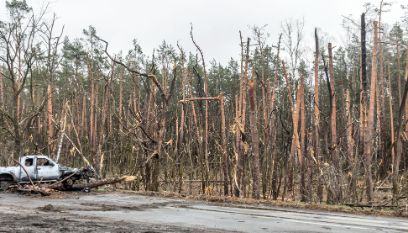
Ukraine’s forests are under severe pressure due to the combined impacts of climate change and war-related damage. Approximately one third of forest areas are affected by disturbances, degradation or destruction. At the same time, the demand for timber is rising sharply due to wartime needs and future reconstruction.

The project aims to equip forest management in Ukraine with up-to-date knowledge and practical skills to strengthen forest resilience in the face of war-related damage and climate change. It promotes the implementation of Close-to-Nature Forest Management through knowledge exchange, capacity building, and hands-on application.

Specific objectives:

  1. Strengthen forest management in Ukraine by integrating international expertise, with a focus on Swiss Close-to-Nature practices.
  2. Provide accessible educational resources to support effective implementation nationwide.
  3. Enable practical application through demonstration sites and digital learning tools.
  4. Build a national Close-to-Nature Forestry Network to foster shared understanding of environmental, social, and economic benefits among practitioners, decision-makers, and academic staff.
     
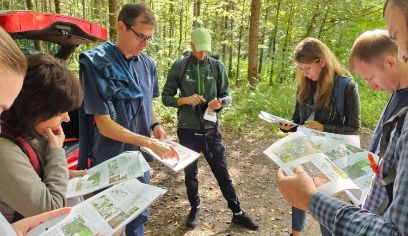
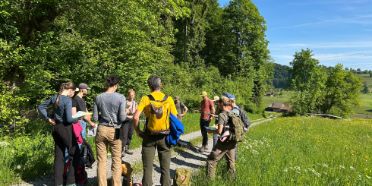
Participants of the Training School discuss close-to-nature forestry methods during an interactive field session organised by HAFL in the forest.
Participants of the Training School discuss close-to-nature forestry methods during an interactive field session organised by BFH-HAFL in the forest.

From science to practice

Swiss expertise in close-to-nature forestry is combined with Ukrainian forest realities to develop accessible educational resources, practical training formats and long-term knowledge-sharing structures.

Close-to-Nature Forest Management as a solution

As Ukraine progresses towards EU accession, forest management must respond to ecological, economic and institutional challenges. There is an urgent need for sustainable, resilient forest management approaches that balance biodiversity conservation, climate adaptation and sustainable timber production.

Close-to-Nature Forest Management (CNFM) offers a scientifically proven and practice-oriented approach to increase forest resilience. By promoting structural diversity, natural regeneration and site-adapted species composition, CNFM strengthens forests against climate extremes while maintaining their productive and ecological functions.

In Ukraine, the implementation of CNFM is still limited and uneven. Knowledge gaps, lack of training opportunities and insufficient demonstration sites hinder wider adoption.

This project follows a “from science to practice” approach. It aims to equip Ukrainian forestry researchers, practitioners, decision-makers and youth with the knowledge, skills and tools needed to implement Close-to-Nature Forest Management both during the current crisis and in the context of post-war recovery.
 

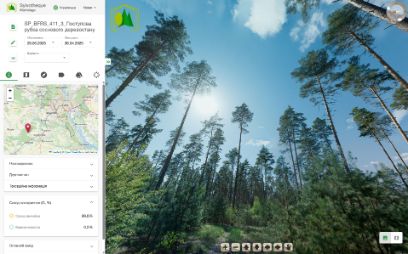
Marteloscope plot established by Oleksandr Soshenskyi, National University of Life and Environmental Sciences of Ukraine, published on the MSC internet platform (martelage.sylvotheque.ch)

Focus Areas

We focus on developing a shared, practice-oriented understanding of Close-to-Nature Forest Management (CNFM) in the Ukrainian context. By jointly translating international CNFM principles into locally relevant guidance and strategic directions, we establish a common foundation for action among practitioners, experts, and decision-makers. This approach emphasises alignment between science, practice, and policy, ensuring that CNFM is positioned as a core element of Ukraine’s forest recovery and reform agenda.

Key outputs

  • A guidebook on Close-to-Nature Forest Management practices, adapted for Ukraine, in both printed and digital formats.

  • A roadmap for integrating CNFM practices into Ukraine’s national forestry recovery plan.

We focus on strengthening professional knowledge, practical skills, and collaboration related to the application of Close-to-Nature Forest Management. By combining expert-led workshops with international exchange, we foster a learning environment that connects science, practice, and policy. This approach supports mutual learning, trust-building, and the translation of CNFM knowledge into practical action across institutional and regional contexts.

Key outputs

  • A strong professional network in Ukraine to support Close-to-Nature Forestry.

  • Six workshops and seminars with international and local experts, providing practical training on CNFM.

  • Exchange visits and a training school in Switzerland involving forestry professionals and early-career Ukrainian forest practitioners.

We focus on establishing demonstration plots as long-term learning spaces where CNFM principles can be tested, discussed, and adapted under real forest conditions. Through hands-on training and joint, field-based decision-making, we link theoretical knowledge with everyday forest management practice. The marteloscopes serve as shared reference sites that support continuous learning and applied experimentation across diverse forest contexts.

Key outputs

  • A network of 36 demonstration plots (marteloscopes) in Polissia and the Carpathians, the most forested regions of Ukraine.

We focus on creating a structured and sustained space for knowledge sharing and exchange related to CNFM implementation. By connecting Ukrainian and international forestry professionals, researchers, and practitioners, we support continuous collaboration beyond individual project activities. This enables the consolidation of experience, joint reflection, and the generation of evidence to inform both practice and policy, while ensuring that knowledge and experience are widely shared within Ukraine.

Key outputs

  • An open-access online course for forestry practitioners, focusing on the practical application of CNFM principles.

  • Peer-reviewed research publications outlining the benefits and challenges of implementing CNFM in Ukraine.

Contribution to the Sustainable Development Goals (SDGs)

Forests play a central role in climate mitigation, biodiversity conservation and sustainable development. By promoting resilient and sustainable forest management, the project contributes to the implementation of the Agenda 2030.
 

Sustainable Development Goals, SDGs
The 17 Sustainable Development Goals (SDGs) are the core of the 2030 Agenda and are to be achieved worldwide by all UN Member States by 2030. All countries, including Switzerland, share equal responsibility for jointly addressing and overcoming the world’s most pressing challenges.

This project contributes to the following SDGs

Project Co-Lead

Discover the Forest Science groups at HAFL