


- News
Award for excellence in university teaching goes to three innovative projects
03.07.2026 The die is cast. On 30 June, the jury panel for the Citizens’ Commune Bern selected the three winners of its 2026 Teaching Award in recognition of their excellent teaching methods and forward-looking approaches.
Key points at a glance
- On 30 June, the jury panel for the Citizens’ Commune Bern selected the three winners of the 2026 Teaching Award in recognition of their excellent teaching methods and forward-looking approaches.
- The award-winning teaching modules use blended and challenge-based learning approaches.
- They all stand out for their multi-layered structure, integrated reflections and strong practical relevance.
The higher education landscape is changing, and with it the requirements for modern teaching methods. Every year, the Teaching Award of the Citizens’ Commune Bern honours three outstanding teaching projects. These projects serve as prime examples of how students are optimally prepared to meet challenges of the future through practical relevance, the integration of technology and social engagement.
Teaching Award of the Citizens’ Commune Bern
The Teaching Award of the Citizens’ Commune Bern was awarded in this form for the first time in 2025. The prize honours didactically outstanding educational initiatives. The prize money amounts to a total of 10,000 Swiss francs and is distributed among the top three ranks. Third place is awarded CHF 2,000, second place CHF 3,000 and first place CHF 5,000.
The jury panel, headed by Dominique Herren, Product Owner University Didactics at BFH’s Virtual Academy, assessed the winners based on clearly defined quality criteria. The official award ceremony will take place on Teaching Day on 3 September 2026 in Bern.
On 30 June 2026, the three finalists presented their work to the jury panel, which comprised seven important representatives of Bern University of Applied Sciences. “The selected finalists confirmed their competency. All three teaching modules presented displayed a high level of quality and extremely diverse didactic approaches,” stressed jury chairman Dominique Herren. In the final round, the projects were ranked as follows:
- Thiemo Wambsganss (W-HAIS)/ Roman Rietsche (W-IDTM), Module DPE – Prompt Engineering: Innovation Through Generative AI
- Rulla Sutter (S), Bottom-up Social Security Practice: NGOs, Grassroots and the Swiss Welfare State, specialised module
- Silvia Zingg (HAFL), Module BCUf224 Biodiversity and Habitat

We set ourselves two objectives for prompt engineering skills: a) to develop practical skills and b) to instil the right attitude and character.
Thiemo Wambsganss and Roman Rietsche: Prompt Engineering – designing innovations with AI
The module addresses a current technological development, whereby the lecturers combine technical expertise with a clear didactic approach. It aims to enable students not only to use generative AI technologies, but also to apply them in a reflective, responsible and innovation-oriented manner. The teaching concept is based on a blended learning approach in which class-based and online tuition phases are purposely harmonised. Working in teams, students develop their own prototypes using prompt engineering to tackle specific problems they encounter in their everyday lives.
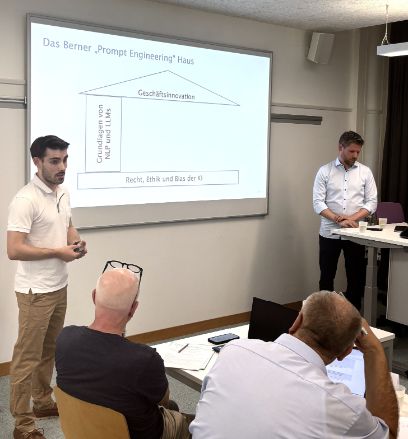
The course programme is in particular characterised by the integration of AI feedback loops into the learning process. Rflect, a tool developed specifically by the lecturers, generates feedback for the students. It is deliberately combined with feedback from peers and lecturers, encouraging critical reflection on AI statements. The teaching award acknowledges this approach to teaching skills for the future. Prompt engineering is taught as a strategic, creative and responsible practice.
The students greatly appreciated the opportunity to engage with the experts and the civil society organisations.
Rulla Sutter: Bottom-up Social Security Practice – engaging with and shaping civil society
The English-language specialised module ‘Bottom-up Social Security Practice: NGOs, Grassroots and the Swiss Welfare State’ transforms learning into an experiential space. It addresses key aspects of the Sustainable Development Goals and illustrates what sustainable teaching can look like in practice. The module stands out with four innovative teaching approaches:
- ‘Engaged university’ put into practice: structured field visits to organisations such as Kirchliche Gassenarbeit or Caritas Bern provide opportunities for direct encounters with practitioners and service users.
- Digitally mature: a separate criterion assesses critical reflection on the use of AI (e.g. scrutinising the output, data protection).
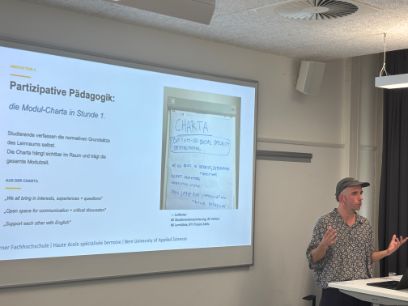
- Participatory pedagogy: together, students and teaching staff draw up a module charter that outlines principles such as openness and respect and fosters a learning environment based on trust.
- Interdisciplinary integration: the teaching team consists of experts from the fields of social work, political science, law, business administration, data science and sociology.
Rulla Sutter’s didactic concept also follows a blended-learning approach, systematically combining online preparation (Moodle) with class-based sessions, all of which creates the right conditions for in-depth and lasting learning. The jury also commended the wide range of teaching and learning methods used, as well as Rulla Sutter’s willingness to develop her role as a lecturer in response to feedback.
We are moving further and further away from an input-oriented approach and handing responsibility over to the students.
Silvia Zingg: Developing biodiversity in practice – challenge-based learning in urban areas
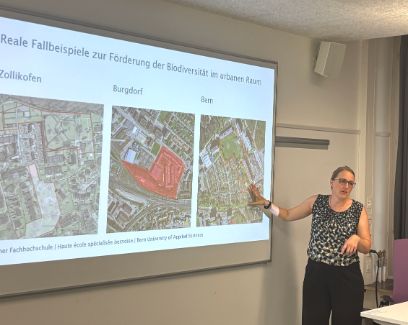
With the module BCUf224 Biodiversity and Habitat, the lecturer is setting new standards for student training on the BSc in Environmental and Resource Management. Challenge-based learning, which is far more than simply teaching theory, lies at the heart of the module. Students work on case studies in urban areas and analyse them directly on site. The structured process comprises:
- Definition of system boundaries and indicators: introduction to environmental indicators.
- Inventory: mapping habitats, surveying biodiversity and holding discussions with local stakeholders.
- Development of measures: development of specific recommendations for action.
- A concluding workshop in which the results are discussed and prioritised with local stakeholders (residents, administration, maintenance staff).
This approach fosters not only subject-specific skills, but also social and methodological skills. Students experience the impact of their work first-hand, develop communication and facilitation skills, and gain an understanding of the complexity of real-life decision-making processes.
Congratulations to all the winners on their outstanding achievement and their commitment to innovative higher education! We wish to express our gratitude to the Citizens’ Commune Bern, without which this teaching award would not exist.