About continuing education at the School of Engineering and Computer Science

Upgrade your skills in technology, leadership and innovation – and set the path for a highly successful future.

Six reasons why you should follow a continuing education programme at BFH’s School of Engineering and Computer Science

1. Industry relevance

  • Participants gain real-world skills thanks to interactive tuition, workshops and supervised living cases, ensuring direct application in the working environment.

2. Our alumni strongly recommend us.

  • You’ll find it extremely rewarding to invest time and money in our continuing education programmes.

3. Mix of face-to-face and online teaching

  • Good balance between learning progress and individual preferences

4. Mix of continuing education programmes in technology, leadership and innovation

  • Fellow students from a wide range of backgrounds
  • Continuing education programmes and projects that are genuinely interdisciplinary

5. Lecturers from industry, business and engineering and computer science institutes

  • We provide practical, real-world skills and focus on the very latest knowledge

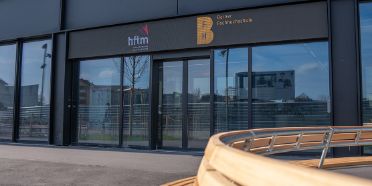
6. State-of-the-art facilities close to the railway station and lake

  • Excellent public transport links
  • Refreshingly close to bathing spots and stand-up paddle boarding in Lake Biel


Programme structure – from courses to master’s thesis

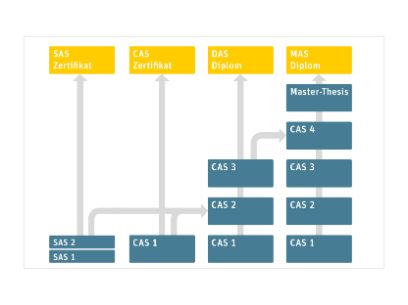
Diverse, flexible and individual: our continuing education programmes have a modular structure which means they can be adapted to meet specific requirements.

Benefit from an individualised, interdisciplinary approach to your studies and organise your time very flexibly:

Grafik Studienablauf Enlarge image
  • Short Advanced Studies (SAS) are courses that take 30 to 160 hours (1 to 9 ECTS – can be credited towards DAS or MAS). Participants acquire in-depth, industry-relevant insights and skills on current topics in a short space of time. Students who do not wish to take SAS competency assessments are awarded a course certificate (no ECTS in that case).
     
  • A Certificate of Advanced Studies (CAS) is our main continuing education module covering extensive new knowledge in a specific area. A CAS programme earns participants 12 ECTS, takes one semester (around 20 weeks) and comprises about 300 hours (lectures, self-study and transfer work). The programmes begin in April (CW 17) and October (CW 43).
     
  • Participants are awarded a Diploma of Advanced Studies (DAS) after successfully completing three related CAS. The composition of the three CAS required for a DAS is indicated on the relevant website or in the master plan. Participants may take breaks between the individual CAS – a DAS can be obtained within a period of 1.5 years to a maximum of 5 years depending on candidates’ professional and life circumstances.
     
  • Candidates are awarded the Master of Advanced Studies (MAS), covering 60 ECTS, after successfully completing four related CAS and the master’s thesis. Successful completion of the recognised MAS will pave the way for your next career step. The composition of the four CAS required for a MAS is indicated on the relevant website or in the master plan. Participants may take breaks between the individual CAS – a MAS can be obtained within a period of 2.5 years to a maximum of 8 years depending on candidates’ professional and life circumstances.
     
  • Discover our Books, a publication outlining the final-year theses written by our graduates. The innovative prowess and levels of personal motivation demonstrated by our students are truly inspiring.

The wide range of modules for CAS, DAS or MAS programmes available for download.

Contact

Head of CAS