


- Story
Innovation born from coconut fibres
27.10.2026 How does a research project turn into a company? With NaturLoop, BFH master’s graduate Daniel Dinizo is developing sustainable panels made from coconut fibres. In our interview, he talks about innovation, the circular economy and the journey from startup to the international market.
Key points at a glance
- NaturLoop originated from a research project at BFH and uses Cocoboard® to manufacture sustainable panels made from coconut fibres.
- The circular economy begins as early as material development and extends far beyond recycling.
- Successful innovation is driven by the combination of research, market proximity and strong partnerships.

Daniel, what inspired the creation of NaturLoop?
While studying and working in the field of wood and sustainable materials, I became increasingly aware of how many valuable resources remain unused around the world. At BFH, I took part in a research project that explored whether principles from the wood-based materials industry could be applied to coconut fibres. The aim was to develop a high-performance material. Michail Kyriazopoulos had already helped initiate the product’s development and driven the first steps toward a spin-off. Building on this research conducted at BFH, we founded NaturLoop together. Our goal was to further develop the product, industrialise the technology and, in the long term, apply these approaches to other natural fibres that have so far been underutilised.
Daniel Dinizo: from BFH graduate to startup founder
Daniel Dinizo is the co-founder and CEO of the startup NaturLoop. A graduate of the Master’s programme in Wood Technology at Bern University of Applied Sciences (BFH), he is developing innovative panel materials from coconut husk fibre and other underutilised resources through his company. With Cocoboard®, he aims to bring sustainable materials for furniture and interior design to the market and advance the circular economy.
What exactly is Cocoboard®?
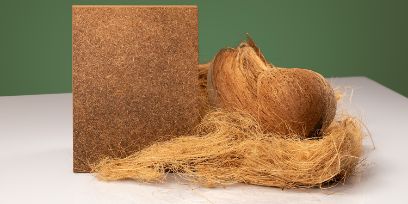
Cocoboard® is a bio-based panel material made from coconut husk fibre and a bio-based binder. It is suitable for a variety of applications in furniture and interior design where wood-based panels are typically used – for example, cabinets, tabletops, doors, wall panelling or room dividers. Our goal is not to replace wood. Rather, Cocoboard® provides an additional material alternative and contributes to a more sustainable construction and design industry.
The circular economy is a widely discussed topic. What are the implications for your company?
For us, the circular economy begins as early as material development. We use a raw material that is generated as a by-product in many places. At the same time, we look at the entire life cycle, from the selection of materials to how the product can remain in use for as long as possible. Our goal is to develop a durable material while also considering possibilities for future reuse and resource recovery. For us, the circular economy doesn’t end with recycling. It begins by asking how materials are designed, what resources they use and what environmental, economic and social value they can create.
What impact do you hope to achieve beyond the material itself?
We want to demonstrate that resources that have so far been underutilised can generate not only sustainable products, but also economic and social value. The raw materials for Cocoboard® come from regions where coconuts play an important role. When additional value is created there, it benefits not only companies but also the people and communities along the supply chain. We believe sustainability encompasses more than environmental aspects. It includes fair economic prospects and positive impacts on society. It is precisely in this interplay of environmental, economic and social effects that we see the true impact of our work.
What role did BFH play in your journey?
An extremely important one. NaturLoop originated in a research setting. BFH gave us access to infrastructure, laboratories, expertise and a strong network. At the same time, we were able to develop our ideas in an environment that fosters innovation and entrepreneurship. Without this combination of research, practice and openness, our journey would have been considerably more difficult.
NaturLoop was among the early projects of BFH’s Timber Start-up Incubator. What did you get out of it?
The funding helped us make the transition from research to practice. For material innovations in particular, this transition can be challenging because developing, testing and bringing new materials to market takes considerable time. One of the most valuable aspects was engaging with people who have experience in innovation, entrepreneurship and market development. Later, we were fortunate enough to find partners who contributed not only capital, but also their knowledge, experience and networks. This is particularly valuable for a young company.
Looking back, do you think BFH also benefited from your journey?
Yes, I believe so. NaturLoop was one of the projects that highlighted the kind of support technology-focused startups actually need. Our experience has contributed to the further development of support programmes, which have been made more responsive to the needs of startup teams. That is particularly meaningful to me, as future startups will benefit from it as well.
Today, your company operates internationally. How have you managed to achieve that?
Our startup brings together a range of strengths. Research, development and innovation remain closely linked to Switzerland. At the same time, we work with partners in regions where the raw materials are available and where production can be carried out efficiently. Our market is currently primarily in Europe. This international cooperation relies on trust, shared goals and common values. It is precisely this interplay that makes our solution possible.
What do you consider to be the most important factor for success in innovation?
Understanding the market. Many innovations fail not because of the technology, but because they do not address a specific need. It is therefore essential to talk to potential customers and industry partners early on. Research and the market must not be separate worlds. The sooner the two come together, the greater the chances that an idea will actually have an impact.
What advice would you give to young innovators?
You have to get better before you can go faster. Especially with a new material. It takes time to test it, improve it and understand what the market really needs. That’s why it’s important to get out of the lab as early as possible and talk to the people who will eventually be working with the product. Also, you don’t have to do everything yourself. We chose to work with established industry partners and to make use of existing production infrastructure. Innovation is rarely a one-person effort. It is strong partnerships that transform research into real-world industrial solutions.


