

- Story
Mobile shade providers with a database
24.06.2026 Trees help to bring temperatures down during hot spells in cities. The MobileGreen solution provides shade in places where it was previously unavailable. It is based on a BFH research project.
Key points at a glance
- Trees can cool urban heat islands by as much as 19 °C.
- However, trees cannot be planted in all locations, for example if cables or pipework have been installed underground.
- MobileGreen provides a flexible solution that uses data modelling to predict cooling performance.
The sun is scorching, the air is shimmering and the heat is building up. That is what summer days in the city often feel like. Climate change means these conditions are being experienced earlier and earlier in the year and well into late summer. This has an adverse impact, especially in areas with extensive sealed surfaces. “Trees produce a cooling effect in three different ways in such situations,” explains Sebastian Mühlemann, an expert on urban green landscaping at the ‘Baumschule Bauer’ tree nursery in Bottmingen. “Firstly, they provide shade. Secondly, they carry out moisture and, thirdly, they have a psychological effect on people, making the temperature feel lower that it actually is when there are trees around.”
Trees in short supply
Unfortunately, there is a severe lack of trees in many places and urban spaces. One reason is that a different approach to urban planning was adopted in the past. There were previously fewer days of high temperatures and less torrential rainfall. Concepts like ‘sponge city’, where trees play a major role, had not yet been created. In ‘sponge cities’, rainwater is not immediately carried away by drainage systems, but is instead stored locally. This protects cities from flooding and means the reserves can be used to water the trees during hot spells.
Sub-terrain in great demand
Planting trees in the ground is often not feasible in urban areas. “They can’t be planted if cables and pipework or underground parking have been installed beneath surface level. Sometimes trees create obstructions during events or when clearing snow in winter,” explains Sebastian Mühlemann. In some places, trees can be planted but it can take around 15 years before they provide sufficient shade whereas it is required immediately in these locations. The MobileGreen solution, developed by BFH in collaboration with the ‘Baumschule Bauer’ tree nursery, tackles this issue.
Providing shade rapidly
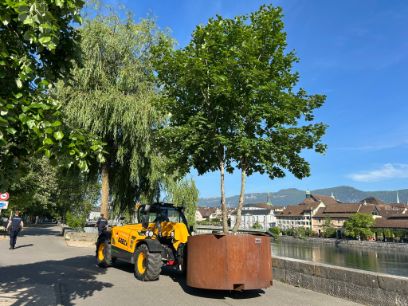
The principle is very simple: mature trees seven to ten metres in height are inserted in smart planters of 2m x 2m. A forklift truck is used to install the trees at the selected location – and they can be relocated if required. The planter contains everything the tree needs to survive: a substrate rich in nutrients based specifically on the type of tree and local conditions. There is also a tank containing over 500 litres of water. The tree roots continually draw on this water via capillary matting. The tank has to be refilled every two weeks to ensure there is always enough water available even during periods of extreme heat. The gardener receives this information via an app. A sensor is installed in the planter to measure temperature and water level.
At first sight, the difference between MobileGreen and conventional urban greening solutions would appear to be the size. MobileGreen uses mature trees whose crowns provide extensive shade. More in-depth analysis reveals that MobileGreen is a highly sophisticated system providing high-level expertise for optimal planting. The irrigation system provides major cost benefits for customers thanks to high-performance usage and monitoring.

MobileGreen only needs to be filled up with water for 5 minutes every 14 days.
Focus on plants and costs
“The plants and maintenance costs take top priority at MobileGreen,” reveals Sebastian Mühlemann, outlining what makes the solution so extraordinary. “Gardening staff have to visit conventional planters every two days in summer to check the need for watering by carrying out a finger test. MobileGreen only has to be filled up with water for 5 minutes every 14 days – a task that can be performed by non-specialists.” Lower staffing costs can soon cut maintenance expenditure by a four-figure amount per plant over the course of the year. The fact that less staff are required during the holiday period is also welcomed by town gardeners. “The trend clearly shows that mobile planting solutions means additional space can be covered without increasing headcount. MobileGreen focuses on relieving the workload of specialist staff. Tree sponsorship schemes are also an option and easy to run thanks to smart monitoring,” indicates Sebastian Mühlemann.
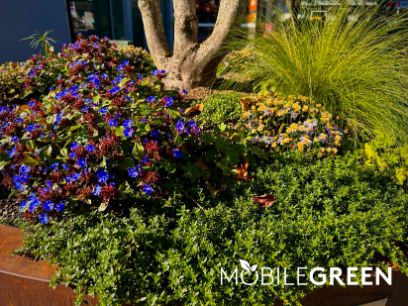
MobileGreen’s expertise extends well beyond irrigation. “City authorities previously used empirical data to estimate the number of plants required for urban landscaping. However, optimal cooling performance does not necessarily depend on having the maximum number of trees. Significant procurement and maintenance costs are involved. MobileGreen enables the optimal shading solution to be simulated and planned in advance,” explains Sebastian Mühlemann.
Sophisticated data model
MobileGreen is based on a data model developed as part of an extensive research project in partnership with BFH and with funding from Innosuisse. “A preliminary project was launched in 2023,” explains Stefan Jack, an industrial engineer and Professor of Digital Manufacturing at BFH’s School of Architecture, Wood and Civil Engineering. The project, which has now entered its final stages, covers four key areas of activity. In addition to the School of Architecture, Wood and Civil Engineering, the School of Agricultural, Forest and Food Sciences and the School of Social Work were involved in the project too.
Extensive research project
The first step is to assess which types of potted trees are particularly well suited to urban cooling. The heat resilience of the tree species is a key factor in promoting biodiversity, which is why priority is given to indigenous species such as the maple. Academic studies and practical experience were used to work out how much substrate is required to achieve a long-term impact, how much water is needed, especially on hot days, and how companion planting can improve environmental performance and urban spatial design.
Modelling the cooling effect
The next stage is the measurement and modelling of the cooling effect. Comprehensive measurements were carried out: “A weather station was positioned beneath the analysed trees to measure temperature, wind and humidity. An instrument called a global thermometer was used to measure human thermal sensation. Additional tools recorded the growth of trunk thickness and rate of sap flow beneath the bark. The rate of water consumption and evaporation was measured too,” explained Stefan Jack. “What really impressed me was the incredible cooling performance of the almost fully mature trees of 13 to 19°C at 2pm.”
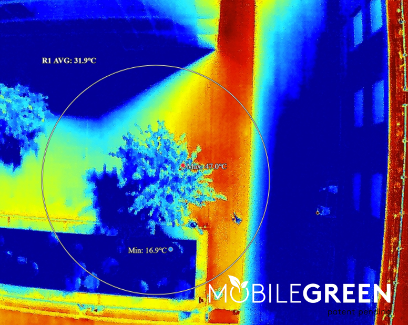
This data was used to model the cooling effects of individual trees, while spatial models helped with planning and forecasting at the district and street level. Various locations were intentionally analysed to enable widespread use of the model – regardless of whether they have a sealed surface, gravel surface or have already been greened. “As far as we are aware, this is the only database based on real measurements and which has modelled 1440 use-case scenarios for validation,” explains Stefan Jack, whose team is currently working on the final adjustments to optimise the data model.
Social impact and business case
In parallel, the social impact of mobile greening was analysed too. Various types of space were analysed in Solothurn, Wohlen (AG) and Reinach (BL): pedestrian zones, meeting points and transit areas. The analysis focused on perception, social benefits, changes in user behaviour and differences to permanent greening. Data was gathered through counting, observations and interviews. The results confirm how much people appreciate and benefit from mobile greening.
This is also evident in practice. In Wohlen AG, for example, the waiting area in front of the bus stop on Bahnhofsstrasse was enhanced with three trees. “A little more comfort, some shade and a bit of cooling on the roof of the underground car park. Where there isn’t room for ‘real’ trees, MobileGreen can be a good option,” sums up Roger Isler, Head of Environment and Energy for the municipality of Wohlen.
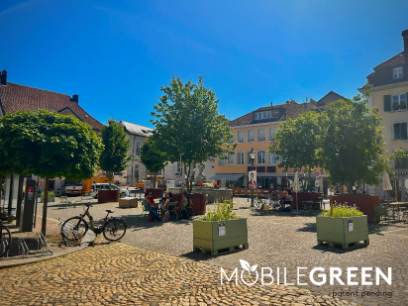
In Solothurn, five trees were installed on a sealed surface. “What fascinates me is that, although the trees are in pots, they are very large and green and have grown quite a lot,” explains Lea Wälti, Project Manager for Spatial Planning at the City of Solothurn. “This sets them apart from other products. They really stood out – we were asked about them on numerous occasions. Many members of the public and local residents were delighted by the greenery in the otherwise barren old town.”
Successful collaboration
The results indicate that MobileGreen could also be used in other scenarios: the system could be used to test the optimal configuration for the permanent planting of trees, possibly in relation to the expensive desealing of surfaces. The research project also produced a business model and marketing strategy for the mobile-green.ch website to successfully position the service on the market. Sebastian Mühlemann was delighted with the collaboration with BFH. “Everything ran so smoothly,” he said recalling his first meeting with Stefan Jack, “I knew instantly that BFH had plenty of substance to offer.”
Everything ran so smoothly – I knew instantly that BFH had plenty of substance to offer.
MobileGreen is now being used by 26 customers and has installed 70 planters in total. They are not just being used in Switzerland, but in the Netherlands too. “It’s great to see our expertise being used abroad too,” indicates the tree specialist. MobileGreen is also currently being deployed in Burgdorf and Solothurn. The acquisition of additional locations is ongoing. This improves the prospect of making hot spells less unbearable for Swiss municipalities.