


- Story
Thinking technology together
11.06.2026 Innovation through participation: Bern University of Applied Sciences is looking to involve affected persons in the development of digital assistive technologies. A quick peek at the RETHINK project.
The key points at a glance
- The RETHINK project at Bern University of Applied Sciences is building on the participation of those who are personally affected and seeking their support in the development of digital assistive technologies. This will result in solutions being developed that are tailored to real-world needs.
- Observations of people’s experience with a robotic arm to date show that technological innovations can only be successful if they are tested in collaboration with the target groups and further refined in iterative steps.
- With the strategic approach of Humane Digital Transformation, Bern University of Applied Sciences puts people at the centre of everything it does: innovation should not be an end in itself, but should promote dignity, independence and quality of life.
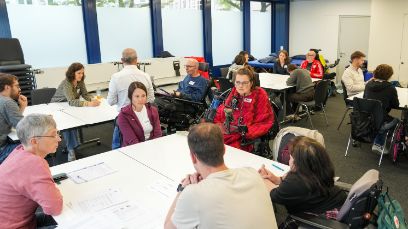
‘Wiping my mouth’, ‘feeding the cat’, ‘using the computer’ or ‘opening the window’: the cards on the table show at a glance where the people gathered around it desire greater autonomy. These are everyday needs, expressed directly by people with upper limb impairments.
On this particular afternoon, they are taking part in an ideation workshop as part of the RETHINK project run by Bern University of Applied Sciences (BFH). The project is funded under the strategic thematic field of Humane Digital Transformation – along with six other projects. “We put people at the heart of the digital transformation” is the strategic principle followed consistently by BFH. The focus of the research and development of digital solutions is on a people-friendly approach and the upholding of clearly defined values: technology should be designed in such a way that it respects and promotes human dignity, rights, social relationships and wellbeing.
Participants wanted for an online survey
To gain as comprehensive a picture as possible of the needs with respect to assistive technologies, we are conducting a wide-ranging online survey.
We are looking for people with upper limb impairments – regardless of the diagnosis, be it ALS, MS, spinal cord injuries, stroke, cerebral palsy, muscular dystrophy, amputations, osteoarthritis or age-related impairments or anything else.
We are dependent on your support and would be very grateful if you could complete the survey or forward it to anyone with an impairment of this kind.
A robotic arm that makes a real difference – or maybe not?
This is where the RETHINK project, led by Prof. Dr Anja Raab, comes in. It builds on the previous BFH-FAIR project run jointly by the School of Health Professions and the School of Engineering and Computer Science, which saw an interdisciplinary team develop a robotic arm with and for people with tetraplegia between 2023 and 2025. The assistive system won the jury prize at the Cybathlon 2024, a competition organised by ETH Zurich. In the next stage, the assistive technology was tested over a period of several months in the users’ own homes.

We’re used to making plans. But there’s always a desire for independence and spontaneity lurking in the back of your mind.

However, the evaluation of the trial phase showed that the robotic arm is used less frequently in the test subjects’ daily lives than had been hoped. According to the feedback, it was still too big and too complicated to use. It became clear to the project team that assistive technology requires further improvement if it is to benefit the target group in a meaningful way. That is why the project is now being re-examined from a conceptual perspective under the banner of ‘RETHINK’: The project team takes a self-critical look at its work to date and widens its horizon. Its aim is to meet the needs of those affected much more effectively in the future.
Pause, reflect and refocus the research
This is now possible thanks to seed funding provided by the BFH’s strategic thematic field of Humane Digital Transformation. RETHINK is expanding the group of participants: the project team not only assesses the needs of people with tetraplegia, but also takes into account the needs of anyone with an upper limb impairment. The first step in this process is a wide-ranging online survey; the second is the ideation workshop mentioned above. Health-economic perspectives will also be considered.
Participation in practice
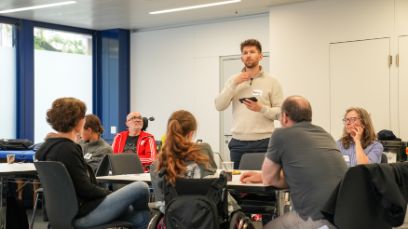
The workshop brings together six people with various disabilities, as well as health and technology professionals, family members, carers and experts from a range of disciplines. The aim of the afternoon is to articulate and prioritise needs, and to brainstorm possible solutions.
I don’t see the problem; I see the solution.
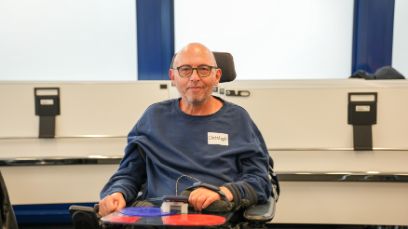
Participation in the four workshop groups is lively, with plenty of ideas being put forward and discussed. The participants are at different stages in this process. Christoph Mutzner, a former journalist who is personally affected by impairments, brings a wealth of expertise to the table. “I don’t see the problem; I see the solution. With my company, I myself develop assistive technologies in collaboration with partners and have been getting to grips with what we’re talking about today for quite a while.” For other participants, this is the first time they have spoken about their experiences in a larger group.
Putting people at the heart of digital transformation
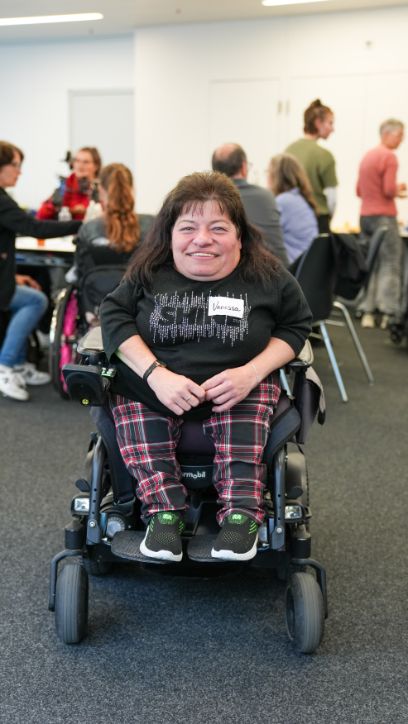
During the workshop, it became clear that spontaneous needs are particularly important and should be supported by assistive technology: getting a cup of coffee, picking something up off the floor, or opening the window. The discussion also touched on the limitations of technology. Vanessa Grand, a member of BHF staff that is also personally affected: “For anything to do with personal hygiene – showering, going to the toilet, and so on – I prefer to have a real person helping me. But I’m happy for everything else that can be handled by assistive technology.”
The product ideas developed jointly by the participants range from a multifunctional tool like a kind of Swiss Army knife, to programmable chips and sensors, to exoskeletons and – in a more futuristic vein – the control of assistive technology via thought.
Innovation as a response to real needs
The ideas generated during the ideation workshop will be incorporated into the project team’s ongoing work. As Vanessa Grand commented: “The brainstorming session was really fascinating, but it also highlighted just how regimented our lives are as people with disabilities. We are very used to making plans and accepting help. Even so, there’s still a desire for greater independence and spontaneity lurking in the back of your mind.”
Patients’ needs and abilities vary considerably from person to person. Not everyone is able to use the same assistive technology.
An occupational therapist with 40 years’ professional experience underscores this statement: “The common denominator among all my patients with disabilities is their desire for greater independence. At the same time, everyone’s needs and abilities are very different. Not everyone is able to use the same assistive technology.”
This insight into the RETHINK project serves as a prime example of the uppermost priority for research in the field of Human-Centred Digital Transformation and for Bern University of Applied Sciences as a whole: innovation must not be an end in itself. Achieving high-quality, high-impact results requires an iterative process and the ability to observe, reflect and readjust – working closely with the target group.