



- Story
Tunnel construction, the backbone of Switzerland’s infrastructure
12.10.2026 Around 920 rail and road tunnels connect regions across Switzerland, supporting mobility, economic activity and national connectivity. Building and operating this infrastructure in a sustainable manner requires innovative technologies, efficient processes and practice-oriented research.
Key points at a glance
- Tunnel construction has been a defining feature of Switzerland for over 140 years. New technologies have made it possible to build longer and deeper tunnels with greater safety during both construction and operation.
- Modern tunnel projects are increasingly complex and place high demands on safety, service life and materials management.
- At BFH, researchers and practitioners work hand in hand to continuously advance tunnel construction through innovative ideas and new technologies.
Despite its small size, Switzerland has one of the greatest concentrations of tunnels in Europe, with roughly 560 rail and 360 road tunnels. This is due to the alpine topography, which necessitated the construction of rail, road and utility tunnels. Tunnels are a vital component of Switzerland’s infrastructure. They play a key role in transportation, the economy and national connectivity, enabling year-round connections between regions, regardless of the weather conditions, thereby strengthening Switzerland’s cohesion. At the same time, increasing demands for safety, sustainability and resource efficiency, combined with the substantial resources required for the construction and operation of these structures, call for innovative solutions and sustained research efforts.
Burgdorf Tunnel Construction Day BFH: challenging tunnelling and lining concepts, 5 November 2026
The annual Burgdorf Tunnel Construction Day BFH brings together practitioners and researchers to discuss current topics in the field of tunnel construction. The event is aimed at professionals involved in the planning, construction, operation and maintenance of tunnels. The theme of this year’s event is ‘Challenging tunnelling and lining concepts’. Using selected new construction and maintenance projects as examples, the event will highlight approaches to managing complex geological conditions, stringent tunnel lining requirements and materials management issues.
Further information and registration: Burgdorf Tunnel Construction Day BFH 2026
History and records
The history of Swiss tunnel construction is closely linked to the need to overcome the Alpine barrier. The first major rail tunnels were built as early as the 19th century to promote trade and mobility. The Gotthard rail tunnel, which opened in 1882, was a significant milestone in tunnel construction with a length of approximately 15 kilometres (Göschenen–Airolo). Widely regarded as an engineering masterpiece at the time, it has permanently strengthened the connection between northern and southern Europe.
The expansion of Switzerland’s national highway network throughout the 20th century led to a growing emphasis on road tunnels, culminating in the opening of the Gotthard road tunnel in 1980.
The construction of the New Rail Link through the Alps (NEAT) marked the beginning of a new era of tunnel construction at the end of the 20th century. The Lötschberg Base Tunnel opened in 2007, the Gotthard Base Tunnel in 2016 and the Ceneri Base Tunnel in 2020. The 57-kilometer-long Gotthard Base Tunnel (Erstfeld–Bodio) is considered the longest railway tunnel in the world and is a symbol of the innovative strength of Swiss engineering.

“Underground projects are often unique due to their constraints, which create an attractive environment for innovation. Research and development in tunnel construction are therefore closely linked to engineering practice.”

Projects such as the Gotthard Base Tunnel would have been virtually impossible to carry out using 20th-century technologies. Advances in mechanised tunnel construction, digital surveying methods, geological forecasting and real-time monitoring have significantly pushed the technical boundaries of tunnel construction. They now make it possible to build longer and deeper tunnels while ensuring greater workplace safety. In addition, new data-driven methods help identify hazards early on and manage tunnelling operations more efficiently.
Current major projects and research in tunnel construction
Even after the opening of the Gotthard Base Tunnel, tunnelling remains a key pillar of Switzerland’s construction industry. Major projects such as the rail network upgrade between Zurich and Winterthur and the expansion and refurbishment of the A1 Zurich Northern Bypass are prime examples of how tunnel construction contributes to the sustainable enhancement of our rail and road transport services. Since 2025, another Swiss tunnel project of international importance has been underway at the Gotthard: the main excavation of the second road tunnel, which is scheduled to open in late 2032.
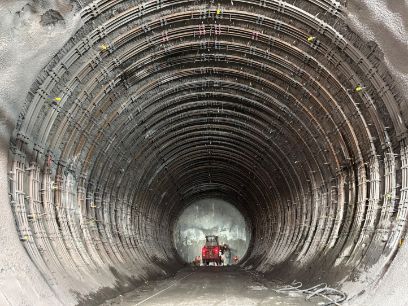
To ensure the successful execution of these major projects, continuous research is conducted into ways of improving tunnel construction. Experts at BFH focus in particular on safety engineering, sustainable building materials and the use of digital technologies to develop sound structural solutions for complex geological conditions. To this end, BFH collaborates with industrial partners, including through student projects.
Bachelor studies with a practical focus
The close interplay between research, education and practice is equally evident in students’ final theses. A recent example is Marcel Häusler’s bachelor’s thesis, which he submitted as part of the Tunnelling subject area of the Civil Engineering degree programme.
In his thesis, Marcel Häusler investigated the underground excavation of a logistics cavern in the southern main section of the second Gotthard road tunnel. He systematically analysed the drilling data from preliminary boreholes and developed a predictive model for the rock compressive strength in the section under investigation. The thesis partner Marti Dienstleistungen AG provided the necessary drill rig data as well as laboratory tests on the rock compressive strength of rock samples used in the tunnelling operations. The objective of the study was to investigate whether rock strength can be reliably determined using drilling data, with the aim of supplementing or reducing cost-intensive laboratory tests in the future. The bachelor’s student succeeded in showing that the rock compressive strength in the section under investigation can be reliably estimated based on the drill data. This approach thus represents a promising tool for real-time advance exploration during tunnelling. The full abstract of the thesis is available (in German) in the brochure Graduation Theses in Civil Engineering 2026 (PDF).
Innovation set to play a pivotal role in tomorrow’s tunnel construction
While significant advances in geotechnical prediction methods, tunnelling techniques and construction site logistics have been made, the potential for innovation in tunnelling is far from exhausted. New projects are becoming increasingly complex as they place higher demands on safety, sustainability and resource efficiency. The long-term success of unique, cross-generational projects such as the implementation of deep geological repositories for radioactive waste depends on an innovative construction industry. At the same time, innovative technologies, in particular in the fields of information technology and materials science, are constantly opening up new possibilities for making construction processes more efficient and safer. Research and development in tunnel construction will therefore remain crucial in the future.