

- Story
When water becomes a challenge… and a solution
10.06.2026 Road runoff is far more than just rainwater: if left untreated, it carries pollutants directly into our waterways. At the same time, traditional drainage systems, especially in cities, are progressively reaching their maximum capacity as a result of climate change. Future approaches therefore combine road runoff management, numerical modelling and blue infrastructure into integrated solutions for clean water and climate-resilient cities.
Key points at a glance:
- Road runoff contains pollutants such as heavy metals, microplastics and particulate matter. Modern road runoff treatment facilities are therefore essential for protecting water bodies.
- Climate change is having an impact on drainage systems, with traditional combined sewer systems increasingly reaching their limits during heavy rainfall.
- Numerical modelling supports effective rainwater management and the creation of integrated solutions for climate-resilient blue infrastructure in cities.
Rain falls on streets, squares and rooftops, picking up particles, heavy metals and microplastics. It then flows directly through the drainage system into waterways without undergoing any treatment. What was long regarded as a purely technical disposal activity is now a key environmental and planning issue. Rainwater must be managed to minimise environmental impact and enhance resilience to climate change in cities, but how exactly?
From water drainage to water treatment
Road drainage has undergone significant changes in recent decades. Whereas the emphasis used to be on rapid drainage, the focus today is on targeted treatment. Road runoff contains a variety of pollutants, particularly heavy metals, fine particles and tyre wear, which is increasingly recognised as a microplastics issue. Without adequate treatment, these pollutants end up directly in surface waters and groundwater, the quality of which can be significantly impacted.
Water flows into the study programme
Key topics in climate-resilient water management include road drainage, road runoff treatment, the modelling of urban drainage systems and blue infrastructure. In the Master in Engineering programme with a specialisation in Civil Engineering, students gain practical expertise that enables them to actively contribute to the development of sustainable solutions for the future.
The above-mentioned topics are also part of the Bachelor in Civil Engineering programme and the CAS in Urban Drainage, thereby strengthening the entire educational pathway in civil engineering at BFH.
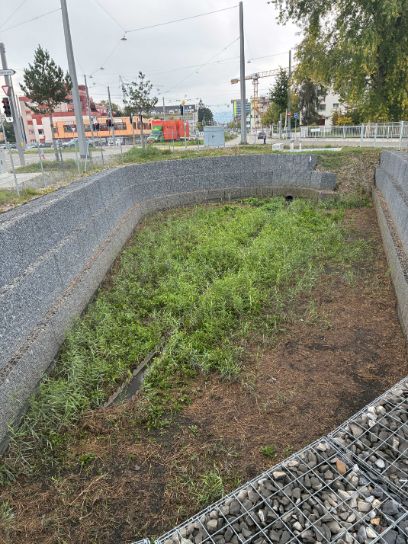
Modern treatment facilities for road runoff rely on multi-stage processes: sedimentation for separating solids, and filtration for retaining fine particles and dissolved pollutants, the goal being to retain them before they enter the natural water cycle. Alongside purification capacity, floor space requirements and investment and operating costs also play a crucial role. Compact, efficient solutions are particularly in demand in urban areas, where space is already limited.
The sizing of treatment facilities and drainage systems also plays a crucial role. The design must take into account precipitation events, drainage areas and pollution loads in order to ensure reliable functionality during normal operation and periods of heavy rainfall. As demonstrated by practical examples, well-planned infrastructures can significantly improve water quality and offer economic benefits over the long term. Field trips to existing facilities demonstrate that different solutions exist depending on the location.
Decentralised thinking, integrated action
In addition to centralised road runoff treatment facilities, decentralised treatment systems are gaining in importance. While they do not achieve the same purification results as centralised systems and incur higher maintenance costs, they do allow for flexible adaptation to local conditions. The challenge lies in coordinating these systems across the entire network, an aspect that is becoming increasingly important.

“In the absence of thorough analysis and simulation, future urban drainage will remain a patchwork solution. It is essential to adopt a systemic approach in order to plan water flows and make cities climate-resilient.”

Limitations of traditional sewage systems
Concurrently, existing drainage systems are under increasing pressure. In many places, rainwater is still discharged with wastewater. The higher frequency of extreme rainfall episodes driven by climate change is increasingly challenging the capacity of sewage networks. This results in more frequent discharges of combined sewage.
This is where the modelling of urban drainage systems can provide a valuable solution. Hydrological and hydrodynamic simulation models can be used to analyse complex interactions and project future scenarios. From this, a digital representation of the systems and their dynamics can be derived, facilitating understanding of how water flows and how reservoirs and pipelines interact.
Simulation modelling offers consistent answers to key questions such as: which areas are particularly vulnerable to intense rainfall? Which measures are most effective? And how can existing systems be efficiently expanded or adapted? At the same time, the models’ limitations also become apparent, often due to simplistic assumptions or uncertainties in the data. A purely normative approach, the relevance of which is increasingly being questioned in light of climate change, is supplemented by local and context-specific action.
“What flows off the road determines the quality of our waterways. This is why modern road runoff management is essential for water protection.”

Blue infrastructure is the solution
Rainwater management relying on blue infrastructure plays a key role in the development of new solutions. It integrates expanses of water, retention areas and infiltration elements into urban planning and complements technical systems with nature-based solutions. Concepts such as the ‘sponge city’ aim to absorb, store and use rainwater locally and release it gradually. They include in particular green basins, green roofs, open streams and permeable surfaces. These elements not only have a hydraulic function, but also improve the climate and quality of life in urban areas. Water becomes both visible and tangible, while also serving a practical purpose.
At the intersection of several specialities
This is where road runoff management, property drainage and modelling converge. The treatment of contaminated surface water is a key component of modern drainage systems, while modelling enables its optimal integration. Simulations help predict the performance of road runoff treatment facilities, optimise their design and understand their role within the overall system. At the same time, they demonstrate how decentralised treatment systems can be combined with elements of blue infrastructure to reduce peak runoff and improve water quality in a sustainable manner.
From technical details to an overall strategy
The shift in paradigm is evident. Road drainage is evolving from a technical necessity into a strategic tool for urban development. The integration of innovative treatment technology, data-driven modelling and blue-green concepts makes it possible to adapt water infrastructures specifically to meet future requirements
This ensures that water is safely drained away and can be used actively – as a resource for climate adaptation, a unifying element in urban spaces and the foundation for more resilient cities.