


- Story
Together towards a shared goal
10.11.2026 In the RETHINK project, digital technologies are developed with the people who will eventually use them. Just as important as technological innovation is the interaction of disciplines and perspectives.
Key points at a glance
- In the RETHINK project, BFH is developing assistive technologies with people who actually need them.
- Interdisciplinary collaboration and user needs are at the heart of the research project.
- The insights gained form the basis for the project’s future direction.
In the RETHINK project, an assistive technology originally developed around a robotic arm is being thoroughly reconceptualised. The project places the needs of individuals with hand and arm impairments at its core. In collaboration with healthcare professionals, technical experts and those directly affected, the research team is examining which approaches are most likely to generate tangible benefits in the future. Our report on the project is available here.
Within the scope of the project, teamwork is at least as important as the work itself, with researchers, students and experts from various disciplines contributing their experiences and working together to develop the next steps. In our interview, Anja Raab, project manager, and Sereina Rubin, student research assistant, discuss how this collaboration works in practice and what motivates them personally.
Anja, where does the RETHINK project currently stand?
Anja Raab: The project is progressing well. We began with a systematic review of the findings from the previous robotic arm project, analysing potential opportunities, challenges and development possibilities. In addition, Sereina’s master’s thesis examined the needs of people with reduced hand and arm function and identified assistive technologies that are already available today.
A key milestone was a workshop attended by people directly affected, relatives, healthcare professionals, engineers and experts from research and development. Together, we discussed the requirements that future assistive technologies should meet and explored which solution approaches hold the greatest potential.
We are currently preparing the next phase of the project, with a focus on technological developments and health economic issues. The insights gained from all project phases will guide its future direction and further development.

The needs of those affected are highly individual.
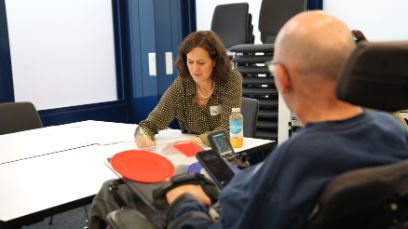
During the initial phase of the project, Sereina’s master’s thesis investigated the needs of people directly affected. Sereina, what are the main findings of your work?
Sereina Rubin: Overall, the needs of those affected are highly individual. This means that assistive technologies must be adaptable to individual requirements.
What has it been like working on the project, and how has it contributed to your studies?
Sereina Rubin: My master’s thesis marks the end of my studies. It is particularly rewarding to know that my work is not only academically relevant but also contributes directly to an ongoing research project and can make a tangible impact.
BFH places a great emphasis on fostering young talent. Anja, as a researcher and lecturer, where do you see your responsibilities in this regard, and what has your experience been?
Anja Raab: Supporting young talent is very important to me. Young, emerging researchers often bring new, unbiased perspectives that enrich research. At the same time, they contribute to shaping the future direction of our field.
I see it as my responsibility to support them on their journey, provide opportunities for growth and encourage them to contribute their own ideas and think critically. Working with students is one of the most fulfilling aspects of my job.
Good ideas don’t stem from a specific function, but from different experiences and viewpoints.
You work together on the project in different roles. What does cross-hierarchical collaboration mean to you in practice?
Anja Raab: It is important to me that students and early-career researchers can share their perspectives and are taken seriously. Good ideas don’t stem from a specific function, but from different experiences and viewpoints. I see collaboration as a mutual learning process.
Sereina Rubin: I felt like I was part of the team right from the outset. Although I am still a student, my views and findings were taken seriously. That showed me how valuable different perspectives can be in a research project.
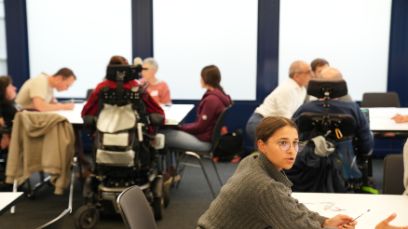
You are part of an interdisciplinary project team that includes specialists from the School of Health Professions and the School of Engineering and Computer Science. What are the pros and cons of this interdisciplinary approach?
Anja Raab: For me, the advantages clearly outweigh the challenges. Interdisciplinary collaboration is essential to the success of development projects. It must also include the people directly affected, as their perspectives are crucial to creating solutions that really meet their needs.
Obviously, adjusting to different disciplinary languages and mindsets takes time. However, it is precisely these different perspectives that lead to innovative and practical solutions.
Sereina Rubin: I found interdisciplinary collaboration challenging at first. There were often differing perspectives, and I had to make informed decisions about which aspects to consider in my work. Looking back, however, I see this as a great advantage, as different perspectives lead to better solutions.
Based on the data that has been collected, how do you plan to proceed with the project?
Anja Raab: We are currently still waiting for the results of the Horizon Scanning workshop held in October. After that, we will compile all the findings and draft an overall synthesis.
Based on this, we will decide whether to continue with the current approach to the robotic arm or whether a conceptual restart promises greater success. The results will also be incorporated into the planning of potential follow-up projects.
Sereina Rubin: With the completion of my master’s thesis, my involvement in the project comes to an end. However, I hope that the data collected will serve as a valuable basis for the next phases of the project.
What personal goals are most important to you in bringing this project to fruition?
Anja Raab: I have been working with people with spinal cord injuries and neurological disorders for many years. This experience has shown me just how important self-determination and participation are for people’s quality of life.
My goal is for our research to help people with such conditions gain greater independence in their daily lives. Technological solutions should create real added value and be tailored to the needs of the people who use them.
Sereina Rubin: Through my work, I want to help ensure that assistive technologies are better tailored to the needs of people with disabilities. If our findings can contribute to this, I would consider that a great success.


