

- Master of Science
Circular Innovation and Sustainability
As an expert in the circular economy and sustainability, you will develop and manage innovative transformations – thanks to BFH’s unique and interdisciplinary master’s programme. Your studies will be characterised by a strong practical orientation. You will combine your newly acquired knowledge of circular systems, resource efficiency and sustainable development with business management skills. Study full- or part-time and gain the qualification you need for a responsible specialist or management position.
«We’re closing the loop. Are you in?»
Factsheet
- Title/Degree MSc in Circular Innovation and Sustainability
- Specialisations none
-
Mode of study
Full-time (4 semesters),
part-time (6–8 semesters) - Start date For autumn start: calendar week 38
- Application deadline 30 April
- ECTS credits 120 ECTS credits
- Teaching language English
- Location Bern, Biel and Zollikofen
-
School
School of Architecture, Wood and Civil Engineering
School of Agricultural, Forest and Food Sciences HAFL
School of Engineering and Computer Science
Business School - Next info event Please see below
Keine Veranstaltungen gefunden.

Areas covered by the programme
The interdisciplinary master's programme in Circular Innovation and Sustainability combines business skills with a technical and ecological understanding of production cycles and the sustainable use of our natural resources.
What you will gain from this degree programme
Take responsibility today for the changes of tomorrow and play an active role in shaping the future. BFH’s first interdisciplinary master’s programme (business, life sciences and technology) provides a uniquely broad insight into the fields of circular economy and sustainable development. On this programme, you will gain an in-depth understanding of biological and technical cycles and come to know the potential they offer for developing sustainable product and process innovations. You will also acquire the skills to rethink conventional business models and make them circular.
Core features of your programme
Interdisciplinarity
The master’s is underpinned by an interdisciplinary foundation programme, equipping you with broad knowledge from research and practice about circular economy, resource efficiency and sustainable development. You will gain insight into the fundamental principles of a sustainable transformation in sectors ranging from food to energy management. Both the modules and the teaching staff on the programme are put together to be interdisciplinary.
Specialisation
After the foundation programme, focused specialisation is possible. Thanks to a generous range of focus modules, you can pursue your personal interests in depth, not only in theory but also in practice with individual projects. Internships are an additional means of acquiring skills in specific areas.
Subject competence
The new master’s programme brings together subject knowledge on circular economy and sustainability from all departments at BFH. Benefit from the scholarly expertise of leading researchers and pursue your studies at the cutting edge of applied research.
Flexibility
Innovative teaching approaches guarantee you a highly flexible timetable. For full-time students, in-person classes take up around 40 per cent of the programme. The remaining time you spend working individually or in groups on specific learning objectives.
Relevance to practice
During the programme you benefit from a large network of companies and organisations working in the field. A key component of the master’s is that these are directly integrated into modules – for example, in the form of excursions, guest speakers, internships, or working on problems identified in real cases.
Important information
For organisations and companies
Secure sustainability expertise now
Make the most of this opportunity to work with our students on current issues relating to the circular economy and sustainability in your organisation or company. Through your practical project, you secure the know-how of future experts in the field. And you gain direct access to the latest BFH research results.
Lecturers’ testimonials


Research at BFH
Teaching, practice and research are closely linked here. You can already gain experience in the following research areas during your studies:

Career prospects
This master’s programme addresses the most important topics for a successful transformation. It combines technical-ecological and organisational-business expertise and teaches you to link a wide variety of perspectives when solving problems. With the degree ‘Master of Science in Circular Innovation and Sustainability’ you therefore have the best prospects on the job market.
Equipped for demanding specialist and management functions
The study programme promotes entrepreneurial thinking and offers you the possibility to individually steer your specialisation. It therefore qualifies you for sustainability-related profiles in different industries. Possible employers are medium-sized and larger companies, the public sector, non-profit organisations or international companies.
Fields of activity
Students are equipped with diverse skills that open up a wide range of job opportunities:
- in the private or public sector,
- in companies, start-ups, NGOs, or government agencies at federal, cantonal or communal level,
- as change agents/managers, sustainability officers, consultants, project managers or researchers.
Industry testimonials


Duration of studies + Curriculum
The programme lasts four semesters full-time. If you choose to study part-time, the programme should be completed in five to eight semesters.
The study modules
120 ECTS credits must be earned to complete the degree. The programme structure is based on four module categories.
Curriculum
| Code | Module Title | ECTS | ||
| Basics | ||||
|---|---|---|---|---|
| MCCf013 | Introduction to Circular Economy and Scientific Literature | 3 | ||
| MCCf026* | Bridging Technology | 6 | ||
| MCCf036* | Bridging Life Sciences | 6 | ||
| MCCf046* | Bridging Economics and Management | 6 | ||
| MCCf113 | Technological Cycles: Materials and Processes | 3 | ||
| MCCf123 | Biological Cycles: Natural Resources and Ecosystem Services | 3 | ||
| MCCf213 | Circular Business Models | 3 | ||
| MCCf223 | Circular Supply Chain | 3 | ||
| MCCf323 | Society and Environment | 3 | ||
| MCCf413 | Research Methods 1: Qualitative Approaches | 3 | ||
| MCCf423 | Research Methods 2: Quantitative Approaches | 3 | ||
| MCCf433 | Research Methods 3: Transdisciplinary Approaches | 3 | ||
| MCCf443 | Impact Assessment | 3 | ||
| Minimum required* | 42 | |||
| Focus | ||||
| MCCf133 | Pathways to Net Zero GHG Emissions in the Energy and Chemical Sectors | 3 | ||
| MCCf143 | Pathways to Net Zero GHG Emissions in the Mobility Sector | 3 | ||
| MCCf153 | Pathways to Net Zero GHG Emissions in the Food Sector | 3 | ||
| MCCf163 | Circular Cities | 3 | ||
| MCCf173 | Circular Use of Materials | 3 | ||
| MCCf233 | Social Entrepreneurship | 3 | ||
| MCCf243 | Digitalization and Sustainability | 3 | ||
| MCCf263 | Practice Transfer | 3 | ||
| MCCf313 | Society and Technology | 3 | ||
| MCCf333 | Economic Geography and Circular Economy | 3 | ||
| MCCf343 | Corporate Social Responsibility | 3 | ||
| MCCf363 | Reporting | 3 | ||
| MCCf453 | Circular Design | 3 | ||
| MCCf463 | Innovation Challenge | 3 | ||
| MCCf473 | Systems Analysis and Consulting for Sustainability | 3 | ||
| Minimum required | 24 | |||
| Optional | ||||
| Optional Modules** | ||||
| Expansion | ||||
| MCCf186 | Expansion of Personal Competences: Products and Processes | 6 | ||
| MCCf256 | Expansion of Personal Competences: Business models | 6 | ||
| MCCf356 | Expansion of Personal Competences: Inter- and Transdisciplinary Project | 6 | ||
| Minimum required | 18 | |||
| All groups | Minimum required | 90 | ||
| MCLmath | Master’s Thesis | 30 | ||
| Total | Minimum required | 120 |
Full-time or part-time studies?
Part-time and full-time students take the programme together. Part-time students take fewer modules per semester and thus have the opportunity to combine their studies with employment or family. Part-time study enables students to bring problems from their everyday working life into the classroom and vice versa.
Further information
Entry requirements
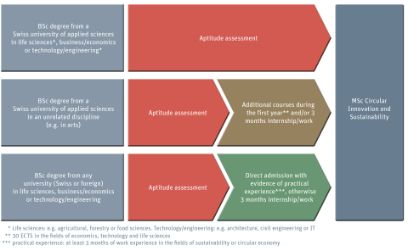
The MSc in Circular Innovation and Sustainability is aimed at graduates from a wide range of disciplines. The basic requirements are a bachelor’s degree in a relevant discipline and a feasible project idea. Admissions decisions are taken by the programme board after a personal interview (aptitude assessment).
Your previous education and professional experience
You will be admitted to the study programme,
- if you hold a bachelor’s degree from a Swiss university of applied sciences in the disciplines of economics, life sciences or technology.
- if you hold a bachelor’s degree from a Swiss university of applied sciences in another discipline, provided that at least 30 ECTS credits of the programme were completed in subjects with an economic, scientific or technical orientation or are made up in the first year of study of the master's programme.
- if you are studying at a Swiss or a foreign university, provided that you have at least three months of work experience related to sustainable development.
Additional information about the entry requirements
Aptitude assessment
The aptitude assessment consists of a 45-minute interview. We assess both your motivation and your conceptual skills in the field of sustainable development.
The aptitude assessment builds on your personal motivation letter and on the project outline you submitted with your application.
Language skills
The study language is English. Therefore, it’s recommended that you have at least B2-level language skills, as per the European Language Portfolio.
Application
Secure your place on the programme in good time.
Documents for online application
Prepare the following documents in PDF or JPG format:
- ID or passport
- passport photo according to international passport standards
- CV in tabular form
- copies of the required certificates and confirmations
- upper-secondary education (university entrance) certificate
- Job and/or internship reference
- copy of the confirmation of withdrawal from studies if the applicant was already enrolled at another higher education institution
- a personal letter of motivation
- a project outline with a subject-related reference to sustainable development
Your application (CV, letter of motivation, project outline) should ideally be written in English, but will also be accepted in German or French. Important: we require a certified translation of all documents issued in a language other than English, German, French or Italian.
Personal motivation letter
Outline your personal motivations and development prospects in relation to the Circular Innovation and Sustainability master’s programme (max. 500 words).
Project outline
Submit the outline of a practical project that you could imagine developing during your studies. You are free to choose any subject that interests you, as long as it relates to sustainable development and/or the circular economy.
It could be a purely hypothetical personal idea, a project you've already worked on or an existing case you’d like to pursue/develop further.
Suggested structure of the project outline
Expected elements:
- Background/Introduction/Relevance
- Methodology/Planning/Scale
- Potential partner(s)/Stakeholder(s) (if applicable)
- Expected results
Length: 500–1500 words
Language: preferably English (but also possible in German or French)
Using the individual project during studies
- Application: your project outline will be the basis for discussion during your “Aptitude Assessment” interview. This allows us to assess your interests, your structural thinking and overall understanding of sustainability concepts.
- General modules: during your studies, where appropriate, you will be able to apply course concepts to your individual project rather than to case studies.
- “Expansion of personal competences” modules: in the third semester (for full-time studies), you will have the opportunity to implement your project in collaboration with your partner.
Development
Your project can evolve over the course of your studies. If necessary, you can even switch to an alternative project from our project pool involving various partners: companies, research institutes, public service providers, etc.
If appropriate, you can also continue your project and develop it into a research topic for your master’s thesis.
Application, tuition and examination fees
The study costs include application, tuition and examination fees, and costs for teaching materials and excursions.
Costs
At BFH, different fees apply for programmes and examinations.
| Application fee (per application)* | CHF 100 |
| Tuition fees (per semester) | CHF 850 |
| Tuition fees for international students (per semester) | CHF 2,550 (or CHF 1,050 or CHF 850)** |
| Examination fee (per semester) | CHF 80 |
| Fee for social, cultural and sport offerings (per semester) | CHF 24 |
| Membership fee for the Bern University of Applied Sciences Student Association (VSBFH) (per semester) | CHF 15 |
|
Subject to change without notice.
* plus CHF 10 processing fee if paying by paying-in slip/paper invoice. A new application fee of CHF 150 will be implemented for registrations for the spring semester 2027. |

Advisory service + Information
If you have any questions about the study programme, please contact us.
Contact programme administration
Information events
At our information events, you will learn everything about the programme, admission requirements and your career prospects. Lecturers will answer all your questions about your studies and everyday student life.
Keine Veranstaltungen gefunden.
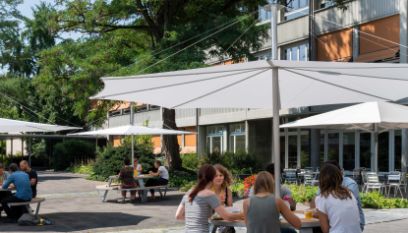
Location
The MSc in Circular Innovation and Sustainability programme takes place in Bern, Biel and Zollikofen. All three locations are easily accessible by public transport or car and offer a varied environment.