

Regulatory Affairs

Regulatory affairs professionals are essential in ensuring that medical devices and pharmaceutical products meet stringent regulatory standards throughout their life cycle, thereby upholding product quality, safety, and efficacy. This program prepares you to navigate the complex regulatory landscape of the medical technology, pharmaceutical, and biotechnology industries with in-depth knowledge and practical skills.

The program

  • aims at people from the fields of pharmacy, medical technology, biotechnology, life sciences and law.
  • focuses on the regulation of pharmaceutical products and medical devices (incl. in-vitro diagnostics, combination products, software as a medical device).
  • is close to industry.
  • consists of 3 CAS modules
  • is taught in English.
  • has national and international participants.
  • can later be extended to a corresponding MAS degree.
DAS Regulatory Affairs

Factsheet

  • Degree/Certificate Diploma of Advanced Studies (DAS) Regulatory Affairs
  • Duration 3 semesters
  • Application deadline 24 March
    23 September
  • ECTS credits 36 ECTS-Credits
  • Costs from CHF 23'550
  • Teaching language English
  • Location Biel, Aarbergstrasse 46 / Online
  • School School of Engineering and Computer Science
  • Next session Autumn semester 2026

Content + Structure

The diploma will provide you with the expertise to work as a Regulatory Affairs Professional in a highly regulated environment.

Portrait

The healthcare industry evolved greatly over the last 10 years. As a result, the tasks of Regulatory Affairs Professionals have changed accordingly. New technologies such as artificial intelligence and machine learning (e.g., decision support systems), home virus detection kits, wearable patient monitoring devices, companion diagnostics and precision medicine are already being used today. In the wake of such innovations and the resulting revision or creation of new regulations, Regulatory Affairs Professionals must continually expand their knowledge.

To obtain and maintain regulatory approval of healthcare products, Regulatory Affairs Professionals must fulfill the following core tasks:

  • Regulatory strategies
  • Implementing regulatory measures
  • Adhering to quality management
  • Solving trade-related issues
  • Negotiating/communicating with authorities
  • Crisis management

Career prospects

With a Diploma in Advanced Studies in Regulatory Affairs, you will be qualified to take on a responsible position in the medical technology and pharmaceutical industry. The roles are not only critical for the success of companies – many of them are also legally required functions.

Role Sector Main Responsibilities
Person Responsible for Regulatory Compliance
PRRC
Medical Devices   Compliance with regulatory requirement, technical documentation, PMS/Vigilance obligation, QMS oversight
Regulatory Affairs Manager RA Pharmaceuticals   Regulatory submissions, communications with authorities, lifecycle management of approvals
Qualified Person QA Pharmaceuticals Batch release, ensuring GMP compliance, responsibility for manufacturing conformity
Qualified Person for Pharmacovigilance QPPV Pharmaceuticals Establishment and oversight of the PV system, evaluation of safety data, authority communication


While these roles often require additional practical experience in the industries before you can take them on in full, the DAS in Regulatory Affairs provides you with the essential regulatory knowledge and qualifications to grow into these roles step by step.
Training objective Details
Regulatory strategies
  • You learn about the regulatory strategies in Switzerland, in the EU and around the world.
  • You understand the relevant regulatory bodies and how they operate.
Implementing regulatory measures
  • You become familiar with the EU Medical Devices Regulation (MDR) and the EU In Vitro Diagnostic Medical Devices Regulation (IVDR).
  • You learn the structure and function of regulatory bodies.
  • You know the different regulatory pathways for obtaining marketing authorization.
  • You know what clinical evaluation is and how it is done.
  • You understand the principles and requirements of GxP guidelines in relation to quality assurance, compliance and regulatory standards in the pharmaceutical, biotechnology and medical device industries.
  • You understand the market surveillance procedures.
Adhering to quality management
  • You understand the structure and requirements of the ICH Q10 pharmaceutical quality system.
  • You understand the structure and requirements of ISO 13485 quality management for medical devices.
  • You learn how to integrate risk management, usability engineering, reviews and design and process validation.
Solving trade-related issues
  • You are aware of the risks and challenges associated with the counterfeiting of medical devices and pharmaceutical products.
Negotiation/communication with authorities
  • You understand the processes and best practices for interacting with the regulator, including the preparation and conduct of meetings between the applicant and the regulatory authorities.
Management strategies
  • You learn how to interact (speaking and writing) with a global audience, including manufacturers, authorities, and Notified Bodies.
  • You learn the language of statistics and what questions to ask the statistician when you need to write your regulatory documents.
  • You can analyse and evaluate how AI technology transforms regulatory processes, enhances data-driven decision making, and improve patient safety.


Structure of the DAS in Regulatory Affairs Program
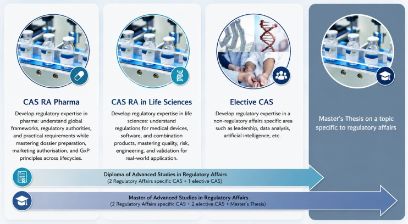
  • The program consists of three CAS modules completed over three semesters.
  • Each module is self-contained, lasts one semester, and corresponds to 12 ECTS credits (360 hours). All CAS modules can also be taken independently as stand-alone continuing education courses.
  • The modules may be completed in any order; however, both regulatory affairs modules are mandatory.
  • Participants may additionally choose one elective CAS module from the TI continuing education portfolio.
  • The workload is designed to allow participants to work approximately 80% while studying.

Description of the key CAS

To achieve the learning objectives outlined in Chapter 4 and align with the competency frameworks of the two leading professional associations in regulatory affairs – RAPS and TOPRA – we have developed two specific regulatory affairs modules. These can be complemented by other modules from the TI continuing education portfolio, allowing the DAS program to be tailored to induvial professional needs.

The regulatory affairs specific CAS modules

Two of the following modules must be completed to obtain the MAS in Regulatory Affairs:

The elective CAS modules

Depending on your individual learning path, you may complete one or two elective CAS modules. These electives can be freely chosen and should ideally align with your professional goals. Five examples of how you can complement your master’s Degree (CAS in German):

The wide range of modules for your studies available for download:
Master plan – continuing education programmes

Title + Degree

Diploma of Advanced Studies (DAS) in Regulatory Affairs

Requirements + Admission

Find out which professionals this continuing education program is designed for and what requirements you need to bring with you.

Target audience

  • Professionals who are already working in the regulated environment in the pharma and medical technology industries and want to broaden their regulatory knowledge.
  • Individuals aiming to enter the field of regulatory affairs, seeking a solid academic foundation and practical orientation for their career start.
  • Regulatory affairs specialists who are already active in the field and wish to keep up to date with constantly evolving national and international regulations.

Requirements

  • Bachelor’s/Master’s degree or PhD in life sciences, medicine, pharmacy, engineering, law, computer science or another relevant scientific field.
  • Five years of professional experience in the life sciences environment or in a comparable regulated field.

As a rule, a university degree and practical experience are required for admission. 
People with a high vocational training can apply, provided they have suitable professional experience and prior scientific and methodological knowledge.

Infoevent and Study guidance

Do you have questions about the program? The head degree of program, CAS heads, and lecturers will answer your questions at our information events.

Location

Please check the pages for the respective degree programs (CAS, SAS) to find out how and where your continuing education will take place. We are located at Aarbergstrasse 46 in the Switzerland Innovation Park Biel/Bienne.

Switzerland Innovation Park Biel/Bienne (SIPBB)

A location with many advantages

  • Classrooms within two minutes walking distance from Biel/Bienne railway station
  • Ideal train connections from Bern’s main railway station (every 15 minutes) and from Bern Wankdorf (every 30 minutes)
  • State-of-the-art infrastructure in the new SIPBB building
  • Various catering options in the immediate vicinity
  • Innovation and networking events

And that’s not all! Biel/Bienne is…

  • an innovation hotspot,
  • a university city,
  • an industrial and service city with numerous major players in the watchmaking, mechanical engineering, precision engineering and medical technology industries and major representatives of the communications and telecommunications sectors,
  • bordered by Lake Biel and its wide range of sports and leisure facilities,
  • a city that embodies bilingualism,
  • a town with a vibrant cultural life.

Biel Aarbergstrasse 46 (Switzerland Innovation Park Biel/Bienne)

Biel, Aarbergstrasse 46

Bern University of Applied Sciences

Engineering and Computer Science
Switzerland Innovation Park Biel/Bienne
Aarbergstrasse 46
CH 2503 Biel

Bern University of Applied Sciences

Engineering and Computer Science
Switzerland Innovation Park Biel/Bienne
Aarbergstrasse 46
CH 2503 Biel